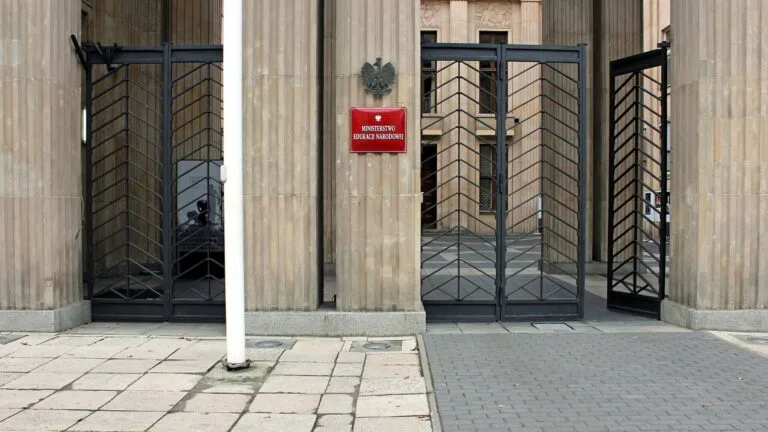


Between 30 November and 4 December, drills on responding to an air attack alarm will take place in 16 schools, one in each province. Students and teachers will practise moving to a safe place inside the school building. The drills have been confirmed by the Ministry of Interior and Administration (MSWiA) and the Ministry of National Education (MEN).
One school per province
Deputy Minister of Interior and Administration Magdalena Roguska announced on Wednesday: “We have decided that between 30 November and 4 December 2026, in 16 schools – one in each province – together with voivodes, services, MEN, education superintendents, school principals and school communities, we will carry out an exercise on responding during an alarm about the threat of an air attack.” In each province, one primary or secondary school will be selected. The choice is made jointly by the voivode, the education superintendent, the school’s governing body and the principal. MEN spokeswoman Ewelina Gorczyca said on Monday that the selection of schools is ongoing and that, since Friday, 20 November, superintendents have been contacting schools.
The drills will involve, among others, representatives of services, voivodes and school principals. The second part will be workshops for principals of the selected schools, focused on preparing facilities for emergencies and applying procedures. “We emphasise that children in schools are safe” – Roguska said.
MEN calls the drills model evacuations. The ministry’s spokeswoman said that the safety of students and staff is a priority, and that the exercises are “an opportunity to check procedures in practice and share experiences with other institutions”.
What the procedure requires
MSWiA, MEN and the Government Centre for Security (RCB) have prepared a model procedure for schools and kindergartens in the event of an air threat. The document describes how facilities should prepare and what to do after a threat warning, the announcement of an alarm and its cancellation. It has been published on the Ministry of National Education website.
- Once an alarm is announced, the rule is to stay inside the school or kindergarten building.
- The teacher leads the class to the shelter, checks attendance, reports and stays with the students.
- The shelter coordinator receives students, indicates their placement and monitors capacity.
- A support teacher or assistant helps students with special needs.
An outdoor location may be used only if staying inside the building poses a direct threat to life, and services indicate a safe way to get there. According to the procedure, during an alarm parents should not come to pick up their children or gather in front of the building, so as not to block access for emergency services. Children are handed over to authorised persons only after the alarm has been cancelled.
The procedure provides that staff are trained first, without children present, and that whole-school drills are conducted only after any detected errors have been corrected.
Different from fire drills
These exercises are separate from the mandatory fire evacuation drills that schools organise within three months of the start of the school year. MEN and MSWiA also announce changes to regulations that are to allow schools to practise not only evacuation but also sheltering in a safe place.
As of Wednesday, 25 November, MSWiA, MEN and the education superintendents had not published a list of schools.