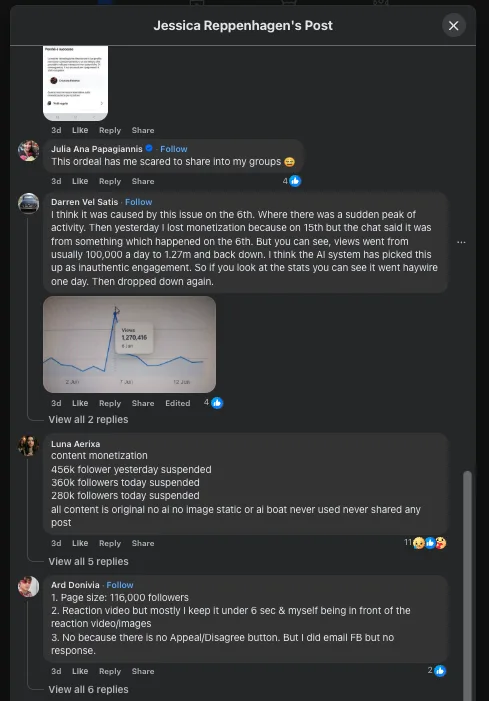
In mid-June 2026, Facebook (Meta) carried out one of the largest unofficial creator demonetization purges in the history of monetization. Within just 24-48 hours, thousands, and according to reports from groups and forums even millions, of pages and profiles around the world lost the ability to earn money from their content. The reason? A faulty artificial intelligence system that mass-imposed restrictions for „inauthentic engagement” (nieautentyczne zaangażowanie), even on creators who published only original material and strictly followed the platform’s rules.
Meta has issued no official statement. There are no mass apologies. There is no compensation. There is only the usual silence and automated replies from support, which for months has operated mainly on AI.
What exactly happened?
Creators report sudden violations of the type „Inauthentic Engagement” or similar monetization restrictions. Many people link this to the bonus program within content monetization, under which Facebook encouraged users to post in many groups in exchange for extra money. Creators mass-shared their content to as many as 9 groups at once, just as the system wanted. The AI classified this as spam.
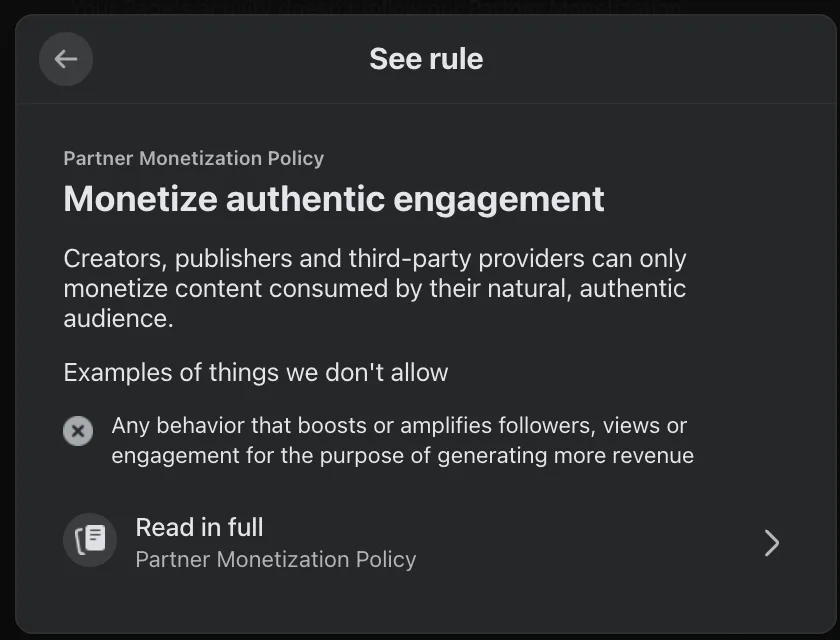
„Partner Monetization Policy
Monetize authentic engagement
Creators, publishers and third-party providers can only monetize content consumed by their natural, authentic audience.
Examples of things we don’t allow
Any behavior that boosts or amplifies followers, views or engagement for the purpose of generating more revenue”
„Zasady dotyczące monetyzacji dla partnerów
Monetyzuj autentyczne interakcje
Twórcy, wydawcy i zewnętrzni dostawcy mogą monetyzować wyłącznie treści konsumowane przez ich naturalną, autentyczną grupę odbiorców.
Przykłady działań, których nie zezwalamy
Wszelkie działania mające na celu sztuczne zwiększanie liczby obserwujących, wyświetleń lub interakcji w celu generowania większych przychodów”
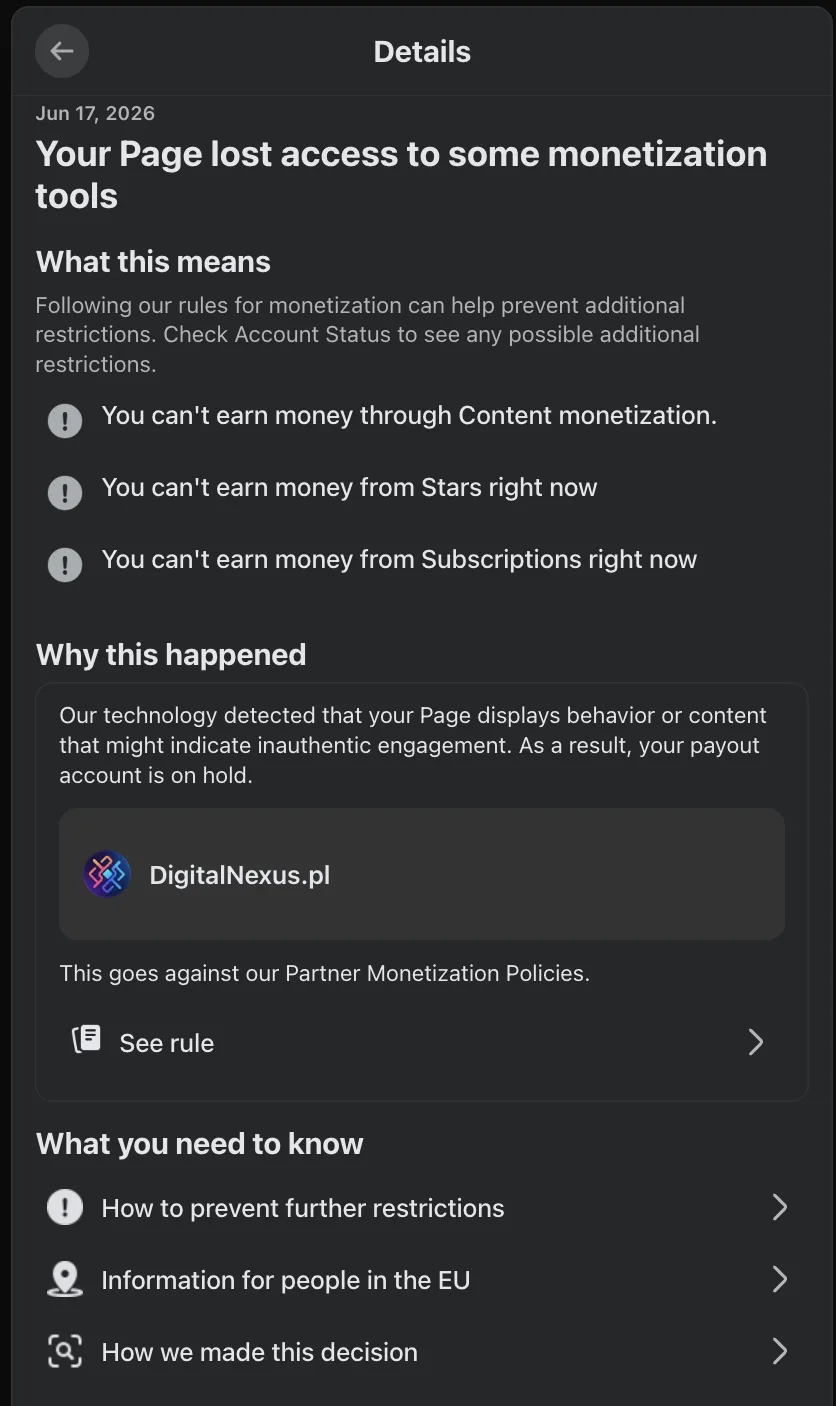
„Our technology detected that your Page displays behavior or content that might indicate inauthentic engagement. As a result, your payout account is on hold.”
„Nasza technologia wykryła, że Twoja strona wykazuje zachowania lub zawiera treści, które mogą wskazywać na nieautentyczne interakcje. W związku z tym wypłaty na Twoje konto zostały wstrzymane.”
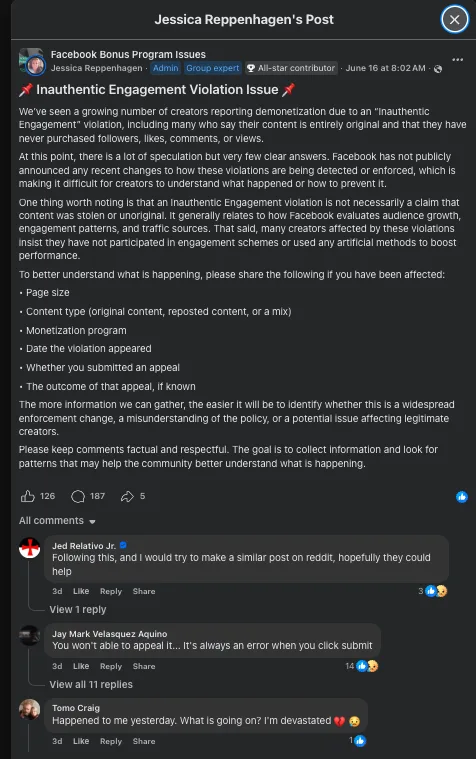
The problem is that those who never used groups, never bought likes, never used bots, and published only original reels and posts also suffered.
Monetization was also blocked on our official DigitalNexus.pl Facebook page. We have also received reports from other creators in Poland who received such restrictions without a reason given and without any way to appeal.
Similar stories are coming from India, Brazil and other countries. YouTube channels (including Alan Beck) and Reddit threads (including r/facebook) have been flooded with reports: „I had 90-150 million views a month and lost monetization”, „I went from $50,000 a month to $2-3 thousand”, „even after monetization is restored, the red flag remains and reach and rates keep falling”.
Meta’s AI: a „glitch” that persists and profits
Meta has not publicly acknowledged that this is a system error (glitch). Creators, however, are unanimous: it is an AI glitch. The system is so aggressive in its fight against „unoriginal” content (Meta has strongly promoted original creators since March 2026) that it has begun punishing honest creators too.
The worst part is what happens next:
Even if monetization returns after about 90 days, the account often remains „flagged”.
Reach and RPM (the rate per 1,000 ad views) drop dramatically (from about $100 per million views to $2-5, or at most $20-30).
Facebook continues to display ads under creators’ content and earns hundreds of millions of dollars a day.
There is no appeal path that works. Support consists mostly of bots or staff pasting replies from a ready-made template.
As one popular post on Reddit put it: „Even if this was an AI glitch, will Meta give creators back the money it earned in those two days? No. It’s their money now.”
„They stole our money”: creators’ anger
Increasingly strong language is appearing in comments and videos: Meta simply stole money from its creators.
It is not only about lost future income. It is about the fact that:
For several days the platform earned from ads shown alongside content for which it did not pay creators a cent.
There is no compensation mechanism for a system error.
There is no transparency: the creator does not know exactly what they „did wrong”, because the AI provides no evidence.
Even when the error is fixed, the penalty (lower reach and rates) remains permanently.
This is not the first time creators have felt cheated by Meta. For months RPM has been falling sharply, even though followers keep growing. The switch from the old bonus program to the new content monetization system only made things worse. Now a mass, erroneous demonetization has been added on top.
What can creators do?
Experienced creators who have already lost tens of thousands of dollars offer one piece of advice: don’t depend on Facebook monetization.
Instead:
Build your own mailing list and community outside the platform.
Move your audience to YouTube, newsletters, your own websites or closed groups.
Sell your own products, courses and services. Let Facebook be only a tool for building reach, not the main source of income.
Avoid mass-posting to groups (at least for now).
Summary
What happened in the second half of June 2026 is not an ordinary „AI error”. It is further proof that Meta treats creators as interchangeable parts of a system that generates data and content for the algorithm. When the system gets it wrong, and it got it wrong on a massive scale, the consequences fall solely on creators. Meta feels no obligation to fix the problem, apologize or compensate anyone.
For millions of people who built their livelihoods on Facebook, this is a painful lesson: the platform is not your friend. It is a tool that can be switched off or have its rules changed at any moment, with no consequences whatsoever.