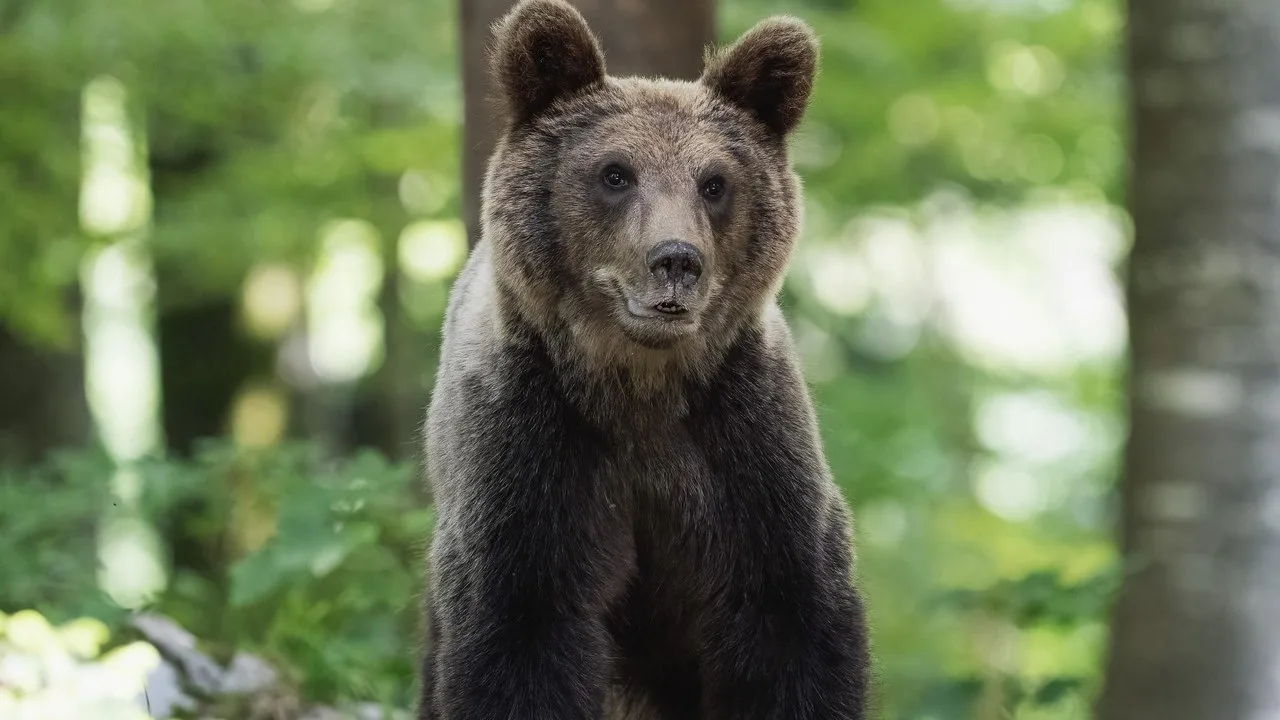
The General Directorate for Environmental Protection (GDOŚ) announced that it has not issued a permit to cull the female bear Trójka from the area of Wołkowyja in the Solina commune. Officials stress that killing the animal is a last resort.
GDOŚ’s position
GDOŚ spokeswoman Joanna Niedźwiecka said that no decision authorizing the killing of the female bear has been made. Only a meeting of an expert team was held, with the participation of scientists, nature experts and representatives of the Regional Directorate for Environmental Protection in Rzeszów. The meeting was advisory and opinion-giving in nature. It served to assess the risk and analyze data from the telemetry collar the animal wears.
The brown bear is strictly protected in Poland. Niedźwiecka stressed that, under both national and EU law, permission to eliminate an individual animal is a last resort. It may only be considered where there is a real threat to human life or health and after alternative methods have been exhausted.
Local government vs. activists
The collared female bear has for some time been appearing near buildings in Wołkowyja. Local councillors and local government officials are demanding her elimination for safety reasons. The Democracy Campaign (Akcja Demokracja) has spoken out against the cull. It organized a petition addressed to the Director General for Environmental Protection, the RDOŚ in Rzeszów and the Ministry of Climate and Environment. Activists argue that the problem is not the animal itself, but the garbage bins accessible to bears and hunting baiting sites, which lure predators close to people.
Baiting sites and garbage bins
GDOŚ shares the scientists’ view that the main cause of bears becoming accustomed to humans is easy access to food of human origin. According to the institution, the Ministry of Climate and Environment has appointed a working group to develop guidelines on hunting baiting sites and the feeding of wild animals, including European bison. GDOŚ believes that baiting sites should be eliminated and waste properly secured.
In the Bieszczady Mountains, ongoing telemetry monitoring, educational activities and the scaring away of predators approaching human settlements are being carried out. As GDOŚ noted, the effectiveness of these measures requires cooperation with residents and the local government. The situation in the Solina commune remains under the supervision of the RDOŚ in Rzeszów.
The dispute has been going on for a long time. In April 2025, the mayor of Solina, Adam Piątkowski, requested the culling of five bears, and GDOŚ then announced a monitoring and protection programme instead.