

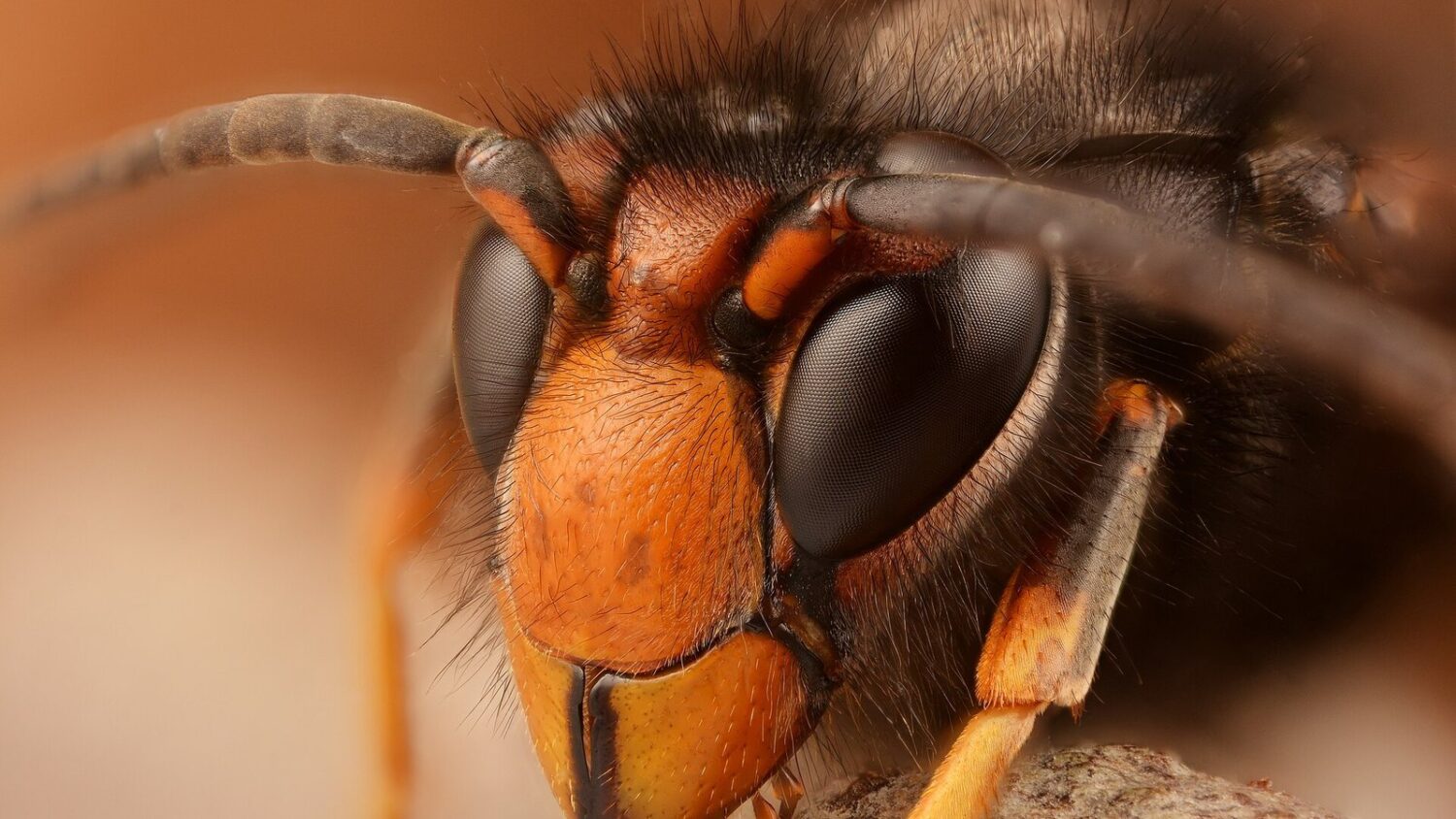
In Wielka Wieś near Kraków, scientists have confirmed the first fully developed nest of the yellow-legged hornet (Vespa velutina) in Poland, also known as the Asian hornet. It is an invasive species, dangerous above all to honeybees.
The insects were first noticed in October. According to scientists speaking to PAP, as cited by “Rzeczpospolita”, the nest in Wielka Wieś is fully developed. Later, individual insects were also observed at the apiary of the AGH University of Science and Technology in Kraków, but no nest has been found there so far.
How the hornet was detected
The case began with a photo of an adult insect posted on the iNaturalist app. Independently, beekeepers were posting photos of hornets circling their hives on forums. Beekeeper Henryk Hudy contacted scientists, who confirmed the species. They then reported it to the state nature protection services and organised a reconnaissance expedition. Researchers from the Wrocław University of Environmental and Life Sciences, the Jagiellonian University, the Upper Silesian Museum in Bytom and the Institute of Nature Conservation of the Polish Academy of Sciences (PAN) took part in the confirmation, among others.
Dr Łukasz Nicewicz of the University of Silesia told PAP that two sites have been confirmed so far, but experts expect more. The location surprised them. The closest known site to the Polish border was in the Czech city of Opava, so the hornet was expected in the Silesian Voivodeship rather than in Lesser Poland. The yellow-legged hornet appeared in Europe in 2004 in France and later spread to Germany and the Czech Republic, among other countries.
Why it is dangerous to bees
Honeybees are the hornet’s staple food. According to Nicewicz, it hunts right at the hive entrance, which can almost completely halt bee flights in an apiary. Foraging bees then fail to return with food, and the colony faces starvation. Bartłomiej Molasy of the Jagiellonian University added that in Western Europe this is a huge problem. Bee colonies weaken, losing many bees, or become trapped inside the nest.
Spring nests are small and often built under roofs or in farm buildings. Large secondary nests, round or pear-shaped, are usually built in tree crowns. Large colonies contain over a thousand individuals. By comparison, European hornet nests usually have 200–400 individuals.
A team from France and genetic research
In the scientists’ view, the only effective method of control is destroying nests. Traps are less effective. Nicewicz said that next week a brigade from France specialising in eliminating such nests will arrive on site. The task is difficult due to the height of the nest and the aggressiveness of the insects.
Researchers will also carry out genetic analyses of a dozen or so individuals. They aim to determine whether this is a new population, for example from Germany, France or Slovenia, or whether the insects were introduced, for example through transport. Nicewicz points to the time of year. In autumn, queens mate and burrow into the ground, and in spring they begin building their own nests. Therefore, in his view, action must be taken now and in spring.
What it means
Beekeepers in Lesser Poland, especially around Kraków, should watch their hive entrances. The insect can be recognised by its length of about 2.5 cm, black thorax, a single yellow-orange band at the end of the abdomen and yellow tips on its legs. Molasy calls for sightings to be reported to the Regional Directorates for Environmental Protection. Photos and videos can also be posted to the iNaturalist app. He also stresses that not everything resembling a hornet should be killed. Wasps and bumblebees are protected, and panic helps no one. Destroying a nest in a tree crown on one’s own is risky due to the aggressiveness of the insects.





Komentarze