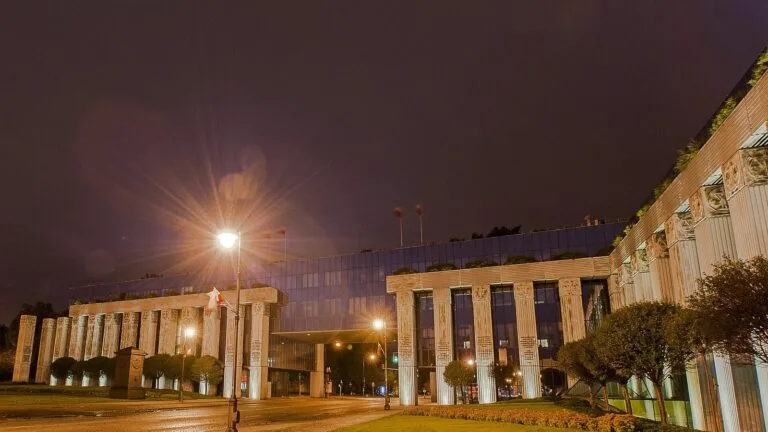
On Wednesday, three joined chambers of the Supreme Court (SN) ruled that a ruling of the Constitutional Tribunal (TK) is only one issued by persons who, after being elected by the Sejm, took the oath before the president. According to the SN, failure to publish a judgment does not strip it of its binding force.
What the three SN chambers ruled
The resolution, case reference III CZP 41/26 (according to the justice minister’s post), addresses two issues. First: who may issue a TK ruling. The joined chambers stated that this means a panel composed solely of persons elected by the Sejm who took the oath in the presence of the President of the Republic of Poland. Second: the significance of publication. According to the resolution, a TK ruling has binding force regardless of its announcement in the official journal.
The resolution therefore also applies to judgments that the government has not published in the Journal of Laws. This is one of the main sources of dispute over the effects of the Tribunal’s rulings in recent years.
Żurek: “sham resolution of the neo-judges”
Justice Minister Waldemar Żurek responded on Wednesday evening with a long post on X. He called the resolution a “sham resolution” adopted by “neo-judges,” meaning persons appointed on the motion of the National Council of the Judiciary (KRS) as constituted after 2017.
Żurek cited the resolution of seven judges of the Labour and Social Insurance Chamber of the SN of 24 September 2025 (III PZP 1/25), which has the force of a legal principle. According to him, a ruling issued with the participation of even one person appointed on the KRS motion after 2017 is a “non-existent ruling,” because such a panel is not a court within the meaning of Article 45(1) of the Constitution, Article 6(1) of the European Convention on Human Rights and Article 19(1) of the TEU.
The minister stated that the joined chambers cannot “heal” the rulings of persons he called “TK doubles,” nor undermine the status of properly elected judges of the Tribunal. According to him, the resolution has no legal effect and binds no court in Poland.
Two disputes in one
The resolution touches on two conflicts. The first concerns the composition of the Tribunal: some TK judges elected by the Sejm have not taken the oath before the president. The second concerns the status of SN judges appointed after 2017, whom some lawyers and the government consider improperly appointed. Because of this second dispute, the resolution was reportedly adopted despite the absence of so-called old SN judges, although a quorum was still gathered.
Earlier, other SN panels also commented on the status of judges and the effects of TK rulings, including in resolutions from 2020–2022. As of publication, there is no position from the president or the Constitutional Tribunal on Wednesday’s resolution.