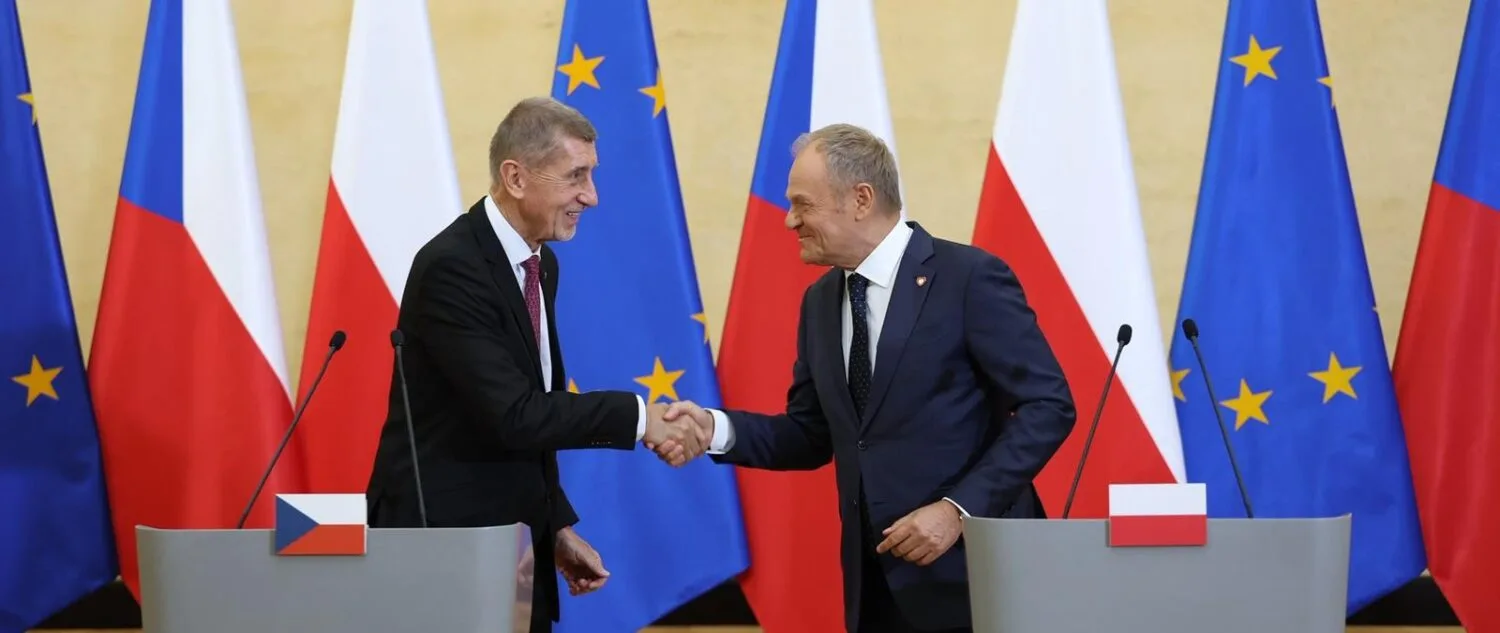
On Wednesday, 4 November, in Warsaw, Donald Tusk and Czech Prime Minister Andrej Babiš announced close cooperation in the EU on the ETS and ETS2 emissions trading systems and on the Union’s future budget. They also want to persuade other countries in the region to join them and to organise a joint government meeting later this year.
The meeting took place at the Chancellery of the Prime Minister and ended with a joint press conference. The Chancellery described it on gov.pl as a conversation about „close relations and shared goals” and about developing cooperation in Europe. According to media reports, the talks covered energy, climate policy and security.
What the prime ministers announced
Tusk said both politicians had confirmed close Polish-Czech cooperation on ETS and ETS2. He added that he believed other countries in the region could be persuaded too. As reported by the portal Energetyka24, the prime minister said ETS2 would „only make life worse” for citizens. In his view, the European Commission must recognise that the region has energy-intensive industry and different conditions from parts of Western Europe.
Babiš said both countries would defend their interests in the European Council. According to Interia, he said he would tell partners that he refuses to agree to ETS2 emission allowances. He justified this by its effects on refineries and housing. Tusk added that projects such as the Green Deal must not weaken the competitiveness of both countries. He also noted that for Polish exporters, the Czech Republic is their second most important trading partner.
The prime ministers also announced joint intergovernmental consultations. Babiš thanked them for the invitation to a joint government meeting and said they would look for a date later this year, as WNP reports. Tusk also indicated that EU support for agriculture in the new budget is an important issue for Poland.
What ETS2 is and where the dispute stands
ETS2 is an EU emissions trading system covering fuels used for heating buildings and for road transport. The costs are expected to be passed on to fuel and heating prices. At the European Council summit in October 2025, Tusk reported that leaders had agreed to Poland’s proposal to revise ETS2. As the Chancellery of the Prime Minister reported, the system was due to take effect in 2027, and the prime minister spoke of blocking its launch by that date.
The entry into force of ETS2 remains a political dispute. Confederation MEP Anna Bryłka responded to Tusk’s words by saying that ETS2 is a binding directive that takes effect in 2028 and that its costs will be built into fuel prices. Her post is cited by „Do Rzeczy”.
What it means
Wednesday’s statements do not change the law or prices. There is also no formal decision to block ETS2. The fate of the system will be decided by member states and EU institutions, including the European Council. For households in Poland, the stakes are future heating and fuel costs, and for businesses, energy costs. The joint position of Warsaw and Prague is meant to strengthen the region’s negotiating power, but for now there is no information about other countries that would join it. As of publication, the European Commission has not responded to the remarks of both prime ministers.