An international team led by Curtin University has reported finding structures resembling red blood cells and traces of heme in a dinosaur bone about 115 million years old. The results were published in the journal PNAS, but not all experts are convinced.
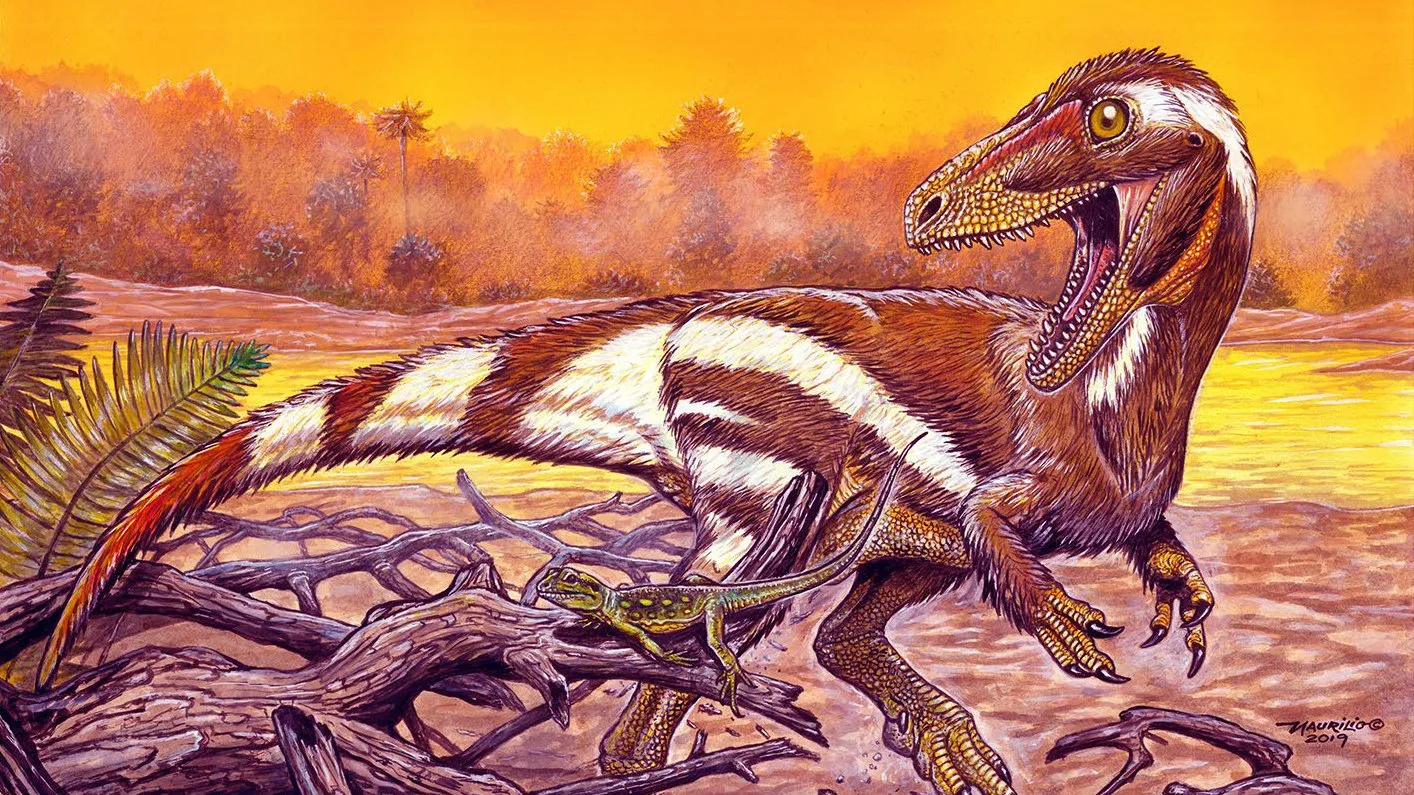
The study concerns Aratasaurus museunacionali, a small predatory dinosaur (theropod) from the Early Cretaceous, whose remains were discovered in northeastern Brazil. As reported in the Curtin University press release, numerous mineralized red blood cells in vascular canals and molecules of heme were found in the limb bones.
What exactly was found
The paper is titled “Heme signatures in mineralized red blood cells within vascular canals of a 115-million-year-old dinosaur bone” and appeared in the “Proceedings of the National Academy of Sciences.” Heme is an iron-containing molecule, the component of hemoglobin responsible for binding oxygen.
According to Live Science, earlier studies also pointed to traces of blood in fossils, but this is the first to use chemical analyses to detect heme signatures in dinosaur bone. ScienceAlert notes that previous finds of possible dinosaur blood cells were at most about 80 million years old.
Why it might have survived
The authors attribute the preservation to the mineralization of the cells by hausmannite, a manganese oxide. According to the press release, it acted like a “time capsule”: it stabilized cellular structures and biomolecules, including collagen amino acids. Prof. Kliti Grice, the study’s lead author, said the detection of intact heme-derived molecules in such ancient blood cells was “stunning” and the discovery “groundbreaking.” In her view, the results challenge the assumption that hemoglobin cannot survive for millions of years.
Caution in assessment
Live Science points out that not all experts agree with the authors’ interpretation. A commentator quoted by ScienceAlert cautions against imagining an intact 115-million-year-old cell, and instead suggests a original biological structure that reacted with its geochemical surroundings. The debate over whether biological traces can be distinguished from mineral ones in fossils has been ongoing for years, and similar reports from 2015 concerning 75-million-year-old bones also sparked discussion.
The university’s press release speaks of “unambiguous evidence,” while media and researchers outside the team express sharper reservations. For that reason, the term “dinosaur blood” should be understood as traces of blood-cell origin, not living tissue.
What it means
For readers, this is primarily a scientific curiosity with no direct practical consequences. The researchers note, however, that the method may help in studying the evolution of blood, metabolism and physiology of extinct animals. Confirmation of the results by independent teams will show whether similar traces can also be found in other fossils, including those in European collections.