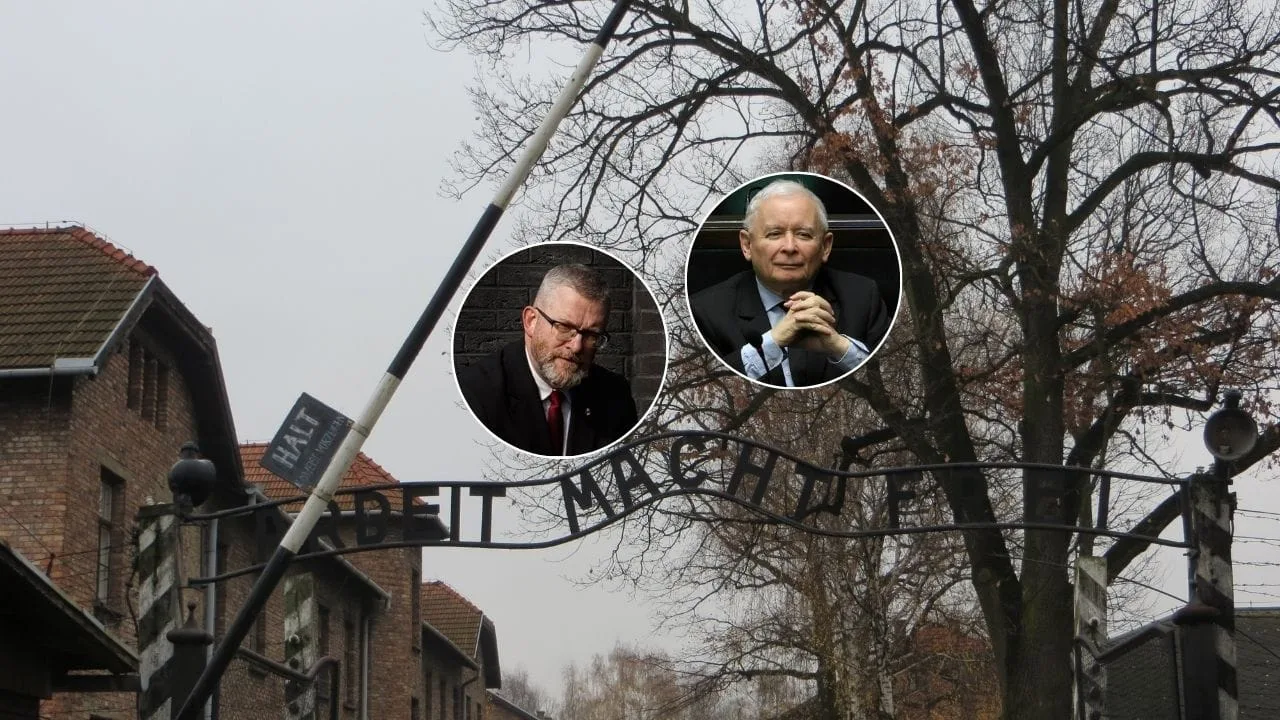
Grzegorz Braun’s remarks about the Auschwitz gas chambers sparked a storm in Polish politics. Jarosław Kaczyński responded sharply, stressing that such words show a lack of respect for the victims and threaten historical truth.
Braun’s Controversial Words
On Thursday, Grzegorz Braun, a Confederation MEP, said in a radio interview that „the gas chambers at Auschwitz are a fake”. The statement immediately triggered a wave of outrage among politicians, historians and the public. The interview was interrupted by the presenter, and the matter was taken up by the prosecutor’s office.
Grzegorz Braun twierdzi, że komory gazowe w Auschwitz-Birkenau to fake news, a @MuzeumAuschwitz oferuje przekaz pseudonaukowy. Rozmowa w radiu WNET po tych słowach została przerwana. pic.twitter.com/5q2fQ9L0XA
The Auschwitz Museum, the Israeli Embassy and the Institute of National Remembrance (IPN) firmly condemned Braun’s statement.
The prosecutor’s office passed the materials to the IPN so that an investigation into the denial of Nazi crimes could be launched.
On social media and among politicians, voices emerged saying that such words are not only harmful but also contrary to Polish law.
Jarosław Kaczyński: „An Act Against Poland”
Jarosław Kaczyński, leader of Law and Justice (PiS), strongly responded to Braun’s words. In his post on platform X, he wrote:
Questioning the Holocaust and what happened at Auschwitz is unacceptable, among other reasons because it is a lack of elementary respect for the victims who lost their lives there, and it fits into a policy of falsifying history. Grzegorz Braun’s statements on this matter only confirm that he acts under foreign inspiration, to the detriment – a very serious detriment – of our country. – Jarosław Kaczyński
Kwestionowanie Holokaustu i tego, co wydarzyło się w Auschwitz jest nieakceptowalne https://t.co/jrzkNjuVZ3. dlatego, że jest brakiem elementarnego szacunku wobec ofiar, które straciły tam życie oraz wpisuje się w politykę zafałszowywania historii. Wypowiedzi Grzegorza Brauna w…
Kaczyński stressed that denying the crimes committed at Auschwitz is not only an attack on the memory of the victims, but also feeds narratives that could be used against Poland on the international stage.
The Importance of Historical Truth and Respect for Victims
Denying the Holocaust and the crimes at Auschwitz is in Poland not only socially condemned but also punishable by law. Experts point out that:
The gas chambers at Auschwitz are one of the best-documented elements of the history of the Second World War.
Denying these facts is not only a crime but also an act of contempt for the victims and their families.
Statements denying the Holocaust and the crimes at Auschwitz should have no place in Polish public debate. Protecting historical truth and respect for the victims is important. This is not only a matter of politics, but of fundamental values that build community and national memory.
Antisemitism in any form is, in accordance with the teaching of the Church, a sin and a moral evil – wrote Cardinal Grzegorz Ryś, Metropolitan of Łódź and chairman of the Committee for Dialogue with Judaism of the Polish Episcopate Conference, in a statement.
Antysemityzm w każdej postaci jest, zgodnie z nauczaniem Kościoła, grzechem i złem moralnym – napisał w oświadczeniu kard. Grzegorz Ryś, metropolita łódzki, przewodniczący Komitetu Konferencji Episkopatu Polski ds. Dialogu z Judaizmem.https://t.co/Ry2sVD4aRzpic.twitter.com/vGnK6VqFHB
Janusz Korwin-Mikke Responds to the Episcopate’s Statement
I hope the Polish Episcopate reacted to the words of Ms. Nowacka and to the recent events in Oleśnica in the same measure and just as quickly. Because that’s how it was, right?
Mam nadzieję, że Episkopat Polski w równym stopniu i równie szybko zareagował na słowa p. Nowackiej oraz na ostatnie wydarzenia, jakie miały miejsce w Oleśnicy. Bo było tak, prawda?