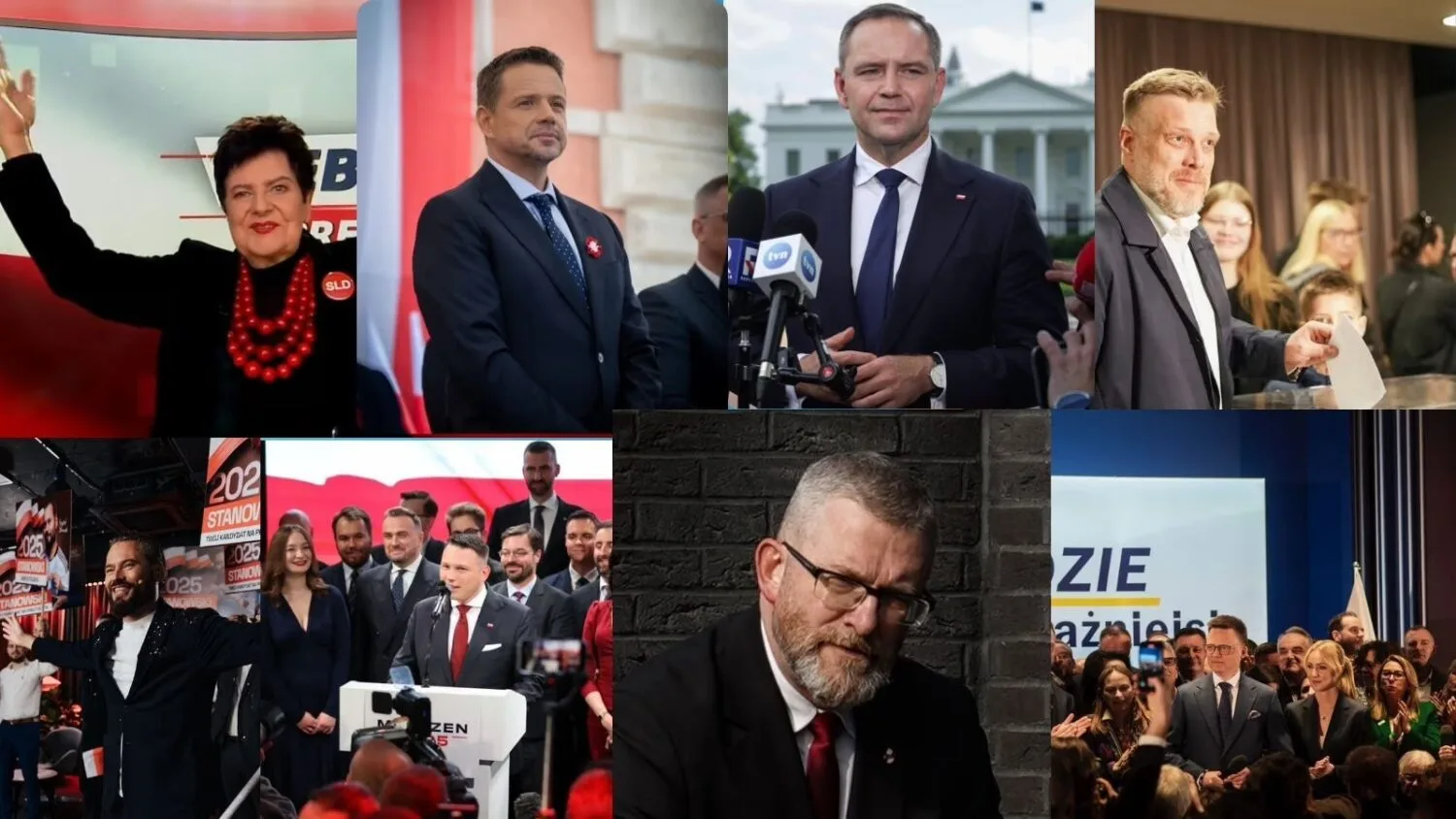
The second round of Poland’s presidential election promises to be highly dramatic. Karol Nawrocki and Rafał Trzaskowski must now win over voters who backed other candidates in the first round. What strategies will they choose to secure the decisive support?
The Battle for the Electorate: The Key Challenge of the Second Round
First-round results clearly showed that the victory will be decided by voters who cast their ballots for candidates outside the Trzaskowski–Nawrocki duo. Trzaskowski won 31.36%, Nawrocki 29.54%, and as many as 21.15% of voters chose Sławomir Mentzen and Grzegorz Braun. Their decisions may well determine the outcome of the second round.
What Strategies Will the Candidates Adopt?
Rafał Trzaskowski: Reaching Out to the Centre and Young People
Trzaskowski, a centrist and pro-European candidate, has already announced an intensive campaign for the votes of young people and moderate and left-leaning voters. He stresses that he wants to convince Poles to choose a „normal Poland, not a radical one”. His strategy includes:
- Direct meetings with voters in cities and smaller towns.
- Emphasising civil rights, tolerance and European cooperation.
- Seeking common ground with voters of the Third Way and the Left, whose support could be crucial.
Trzaskowski is also trying to build a bridge to moderate right-wing voters, highlighting the importance of stability and predictability in foreign and economic policy.
Karol Nawrocki: Appealing to Conservatives and Confederation Voters
Nawrocki, backed by PiS, must convince voters with national and libertarian views, especially young people who largely supported Mentzen. His strategy involves:
- Emphasising traditional values, family and national security.
- Highlighting social policy, while simultaneously trying to reach voters disillusioned with the establishment.
- Direct meetings and a presence on social media, where young voters are particularly active.
Nawrocki is also trying to convince voters that he is an alternative to the „old system” and a guarantor of the continuation of PiS’s social policy, while remaining open to the libertarian demands of Confederation.
The Key Groups to Win Over
Key voter groups in the second round
| Voter group | Potential influence | Which candidate has the edge? |
|---|---|---|
| Confederation voters | Very high | Slight edge for Nawrocki |
| Third Way voters | High | Potentially Trzaskowski |
| Left voters | High | Clear edge for Trzaskowski |
| Young people (18-29) | Very high | Undecided, a key group |
Is Vote Transfer Obvious?
Experts stress that an automatic transfer of votes cannot be assumed: some voters may stay at home or spoil their ballots. The electorate of Confederation is particularly unpredictable: some may back Nawrocki for his conservatism, while others will reject both candidates as „systemic”.
The Final Days Will Decide
The final days of the campaign will be a fight for every vote. Candidates must not only persuade the undecided, but also mobilise their own supporters to take part in the election. The ability to reach the voters of other candidates may well decide who becomes Poland’s next president.
The second round is not merely a duel between two names, but a clash of visions for Poland, and a test of whether the candidates can step outside their own electoral bubbles.