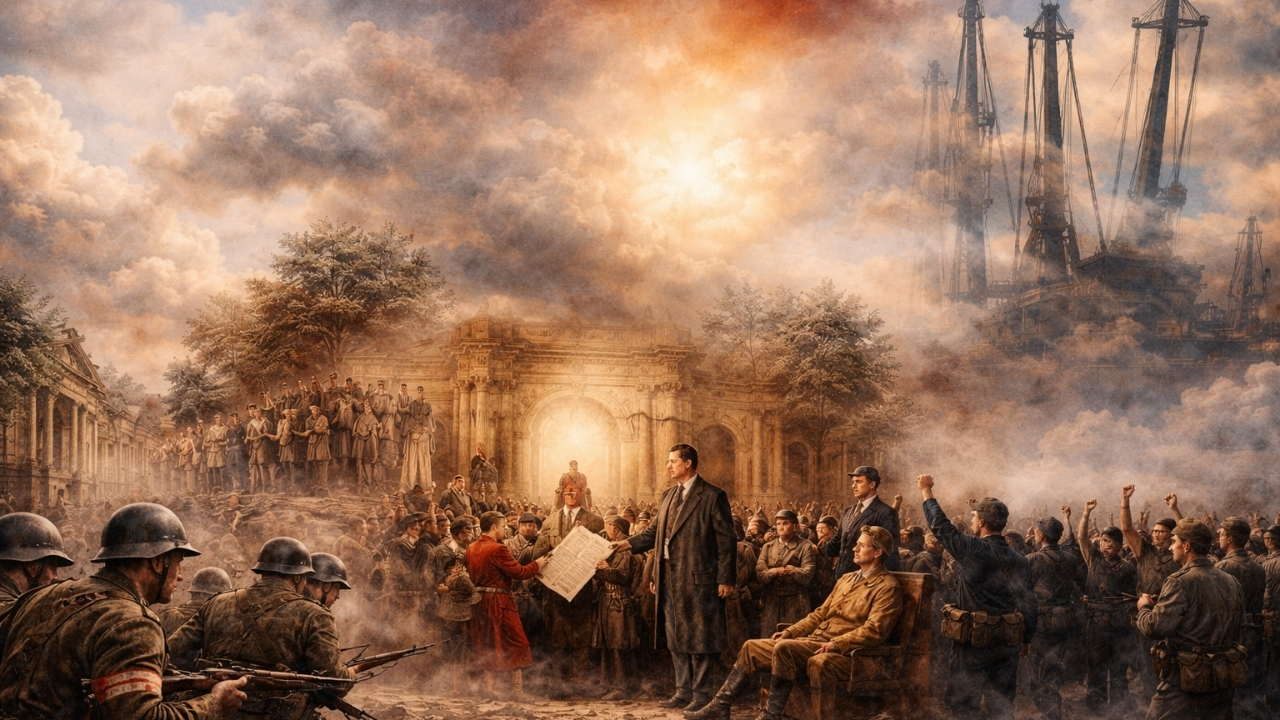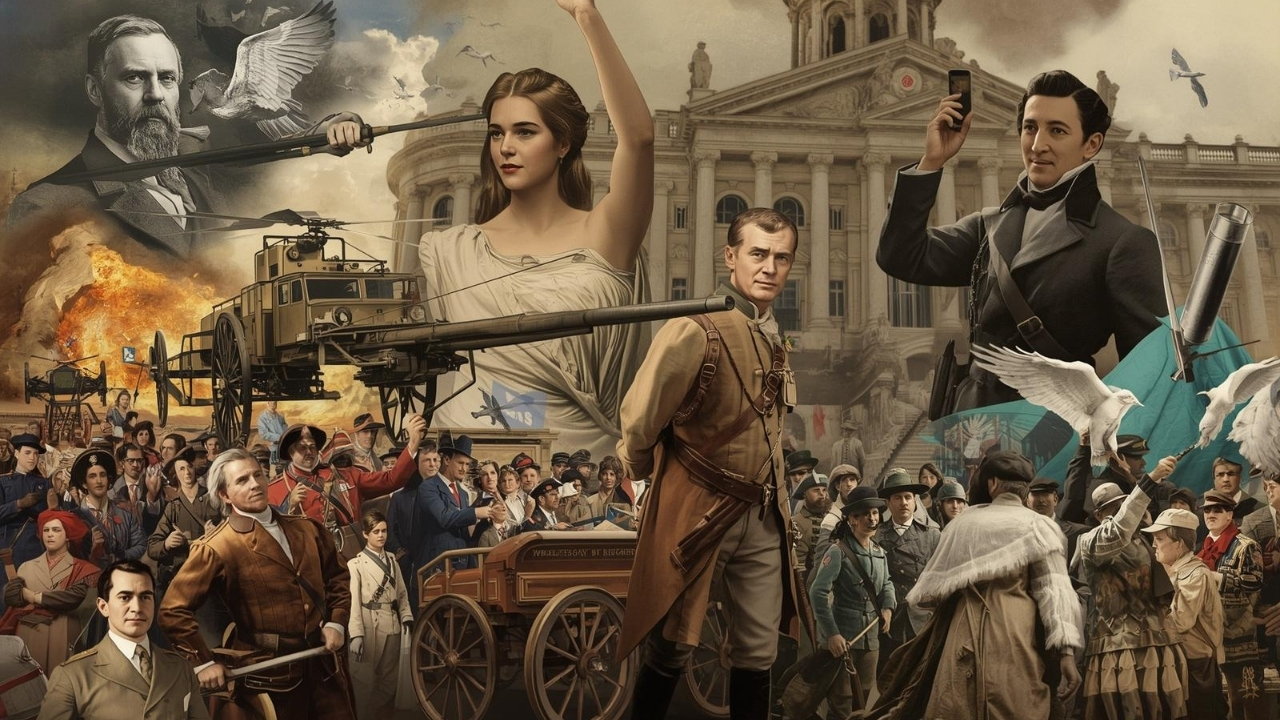
Did you know that one day in history can contain revolution, scientific discovery, and the birth of a music legend? This is the day of April 25. — A date worth stopping at and asking what happened that day in history. From ancient battles of the sea, through breakthrough discoveries in science, to events that changed the face of Europe — This day in history belongs to the very rich. We invite you to travel for centuries, which will surprise even the most dry lovers of history.
What happened on April 25? Major events in history
404 BC – The end of the Peloponnese War and the fall of Athens
One of the greatest conflicts of the ancient world came to an end on that very day when Athens capitulated before Sparta. The war of the Peloponnese lasted nearly thirty years and shuffled the arrangement of forces throughout the Greek world and ended the golden age of Athens' democracy. The defeat of Athens meant not only a military defeat, but also a symbolic twilight of the era in which Athens dictated the rhythm of the civilizational development of Greece. This event to this day is discussed in lectures from ancient history as a warning before the exhaustion of the empire with its own pride.
1507 – America for the first time on the world map
German cosmographers used the word "America" on the world map by Martin Waldseemüller for the first time in history that day. This name was a tribute to Amerigo Vespucci, a Florentine navigator who was the first to recognize that the land discovered by Columbus was not Asia, but a completely new continent. That decision had consequences that no one could have predicted at the time — Today the name "America" bears the whole continent, and Columbus himself remained nameless on the map. Waldseemüller reportedly tried to change his mind and withdraw that name, but it was too late — The story is done.
1719 – The adventures of Robinson Crusoe reach the hands of readers
On that day one of the most important novels in the history of Western literature was published — "The Cases of Robinson Crusoe" by Daniel Defoe. The story of a survivor struggling to survive on a deserted island has become a prototype of a modern adventure novel and has not come down from book shelves for over 300 years. Interestingly, many literary historians believe that Defoe created the first true novel in English. The historical calendar of that day would be poorer without this publication, which shaped the imagination of several dozen generations of readers.
1792 — Marseille and Guillotine — two symbols of revolution in one day
It is difficult to imagine a more symbolically filled day in the entire historical calendar. On April 25, 1792, Claude Joseph Rouget de Lisle wrote the words and music of Marseille, which soon became the anthem of France and one of the most recognizable songs in the world. On the same day, the first death sentence was executed using guillotine. — an invention which was to make the death penalty "more humanitarian". A summary of these two facts speaks of the French Revolution more than one textbook of history.
1859 – A shovel in Port Saida and the birth of the Suez Canal
On that day in the history of French diplomat Ferdinand de Lesseps put a symbolic shovel into the sand in Port Saida, inaugurating the construction of one of the largest engineering investments of the 19th century — Suez Canal. The combination of the Mediterranean and the Red Sea cut the sea route between Europe and Asia by thousands of kilometres and changed global trade forever. The construction lasted a decade and consumed the lives of tens of thousands of workers. The canal, commissioned in 1869, remains one of the most strategic waterways in the world to this day.
1953 – Watson and Crick reveal DNA mystery
What happened that day in science? On April 25, 1953, a short but epochal work by James Watson and Francis Crick describing a model of double-helix DNA appeared in the prestigious "Nature". This discovery opened a whole new chapter in biology, medicine and genetics, becoming the foundation for everything — from gene therapy to forensic DNA testing. It is worth noting that scientists around the world were waiting for the results of their research, and it took only a few pages to publish the work. That's why the International DNA Day is on April 25th. — It's not an accidental coincidence with the historical calendar.
1974 – Carnation Revolution in Portugal
One of the most beautiful and at the same time the most touching political coups of the 20th century was the "revolution of carnations" in Portugal, which just broke out on April 25, 1974. The military coup overturned dictator Marcelo Caetano, the successor of Antónia Salazar, who held the country in an iron grip of authoritarian power for decades. Soldiers accepted red carnations from the people of Lisbon, which they stuck in the barrels of rifles — That's where this breakthrough came from. As a result, Portugal returned to democracy and began decoloning its African estates, which had enormous consequences for the entire African continent. Today April 25th is in Portugal the State Saint.
2022 – Elon Musk buys Twitter for $44 billion
Although this event is relatively recent, it is already known that this day in social media history has proved to be a breakthrough. On April 25, 2022, Elon Musk finalized the purchase of the Twitter platform for an astronomical amount of $44 billion. The transaction caused a storm in the world of technology, media and politics, and the platform itself has since undergone a radical transformation — including the name change to X. Musko's decision was commented on by presidents, researchers of freedom of speech and ordinary users around the world, becoming a symbol of a new era in the debate on the control of public space on the Internet.
Born 25 April
Oliver Cromwell (1599) – English politician and military, Lord Protector of England, Scotland and Ireland, one of the most controversial leaders in the history of the British Isles.
Guglielmo Marconi (1874) – Italian physicist and inventor, radio pioneer, Nobel Prize winner, a man who changed the way humanity communicates at a distance.
Ella Fitzgerald (1917) – American jazz singer, called "The First Lady of Jazz", recognized as one of the biggest voices in music history.
Al Pacino (1940) – American actor with Italian roots, cinema legend, known for his roles in "Godfather", " Scarface" and "The Smell of a Woman", Oscar winner.
Björn Ulvaeus (1945) – Swedish composer and guitarist, co-writer of the ABBA group, one of the most cash and recognizable bands in popular music history.
Birthdays and Anniversarys
On that day, people were born who left a lasting mark in their fields. Oliver Cromwell revolutionized English politics, Guglielmo Marconi invented radio, and Ella Fitzgerald sang to delight several generations of listeners. Al Pacino and Björn Ulvaeus are, in turn, icons of popular culture that are still present in the collective imagination of millions of people around the world.
World events
1915 – Landing at Gallipoli – ANZAC troops (Australia and New Zealand) landed on the Turkish peninsula of Gallipoli, which gave rise to one of the most bloody campaigns First World War and Pertained ANZAC Day as one of the most important holidays in Australia and New Zealand.
1945 – Meeting on the Swan "In Torgau there was a historic first meeting of Soviet and American troops, which symbolically marked the coming end of World War II in Europe.
1945 – First UN Conference in San Francisco "The first meeting of the 50 founding countries of the United Nations was convened to safeguard world peace.
1982 – Israel withdraws from Sinai "By means of the Israeli-Egyptian Peace Treaty, Israel ended its presence on the Sinai Peninsula, which Egypt celebrates today as the Festival of the Liberation of Sinai.
2005 – Railway disaster in Amagasaki – A passenger train derailed in Japanese city of Amagasaki, killing 107 people and hurting more than 550 — This is one of the most tragic railway disasters in the post-war history of Japan.
This day in history is a true mosaic of human fates, discoveries, revolutions and dramas that have shaped our world for centuries. From the surrender of Athens to the purchase of Twitter — What happened that day shows how unpredictable and fascinating the course of history is. Look tomorrow, because on April 26th, there are equally surprising stories.