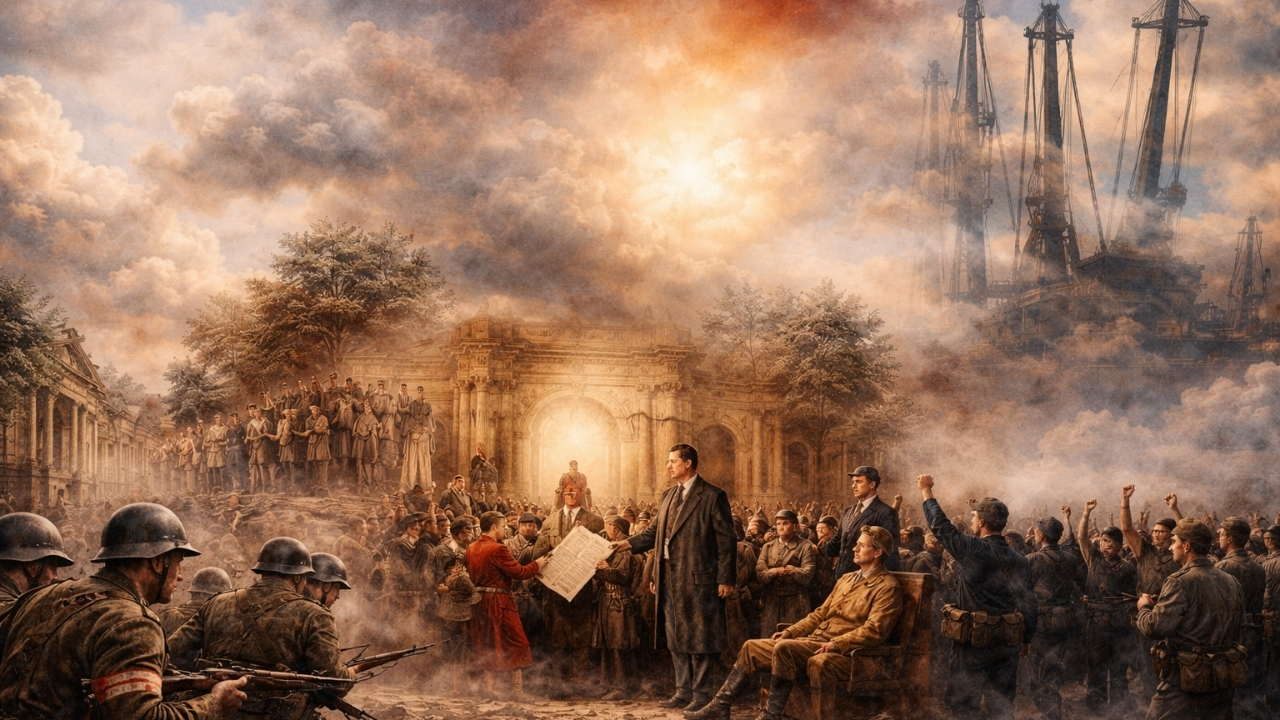
Did you know that one of the most important days in the history of the atom, the bravest escape from the extermination camp and the birth of a Marseillen woman — All these events connect the same date in the calendar? If you wonder what happened that day in history, you have a unique journey ahead of you for centuries. April 26 is a date that entered into the historical calendar extremely clearly — from the heroic acts of individual people to disasters changing the face of the world. Stay with us until the end — It's worth it.
What happened on April 26? Major events in history
1336 – Francesco Petrarka wins Mont Ventoux and initiates alpinism
The Italian poet recognized as the father of humanism one day decided to climb the Mont Ventoux summit in the Southern Prealpas — and thus, according to historians, started the entire tradition of mountainism. Petrarka was not a wanderer from an accident — He left a detailed description of the expedition in a letter to his friend, treating climbing as a metaphor for spiritual exultation. Today that day is considered a symbolic beginning of man's love for the mountains, long before the birth of modern climbing.
1792 – Marseille was first performed
Revolutionary France needed an anthem to fight, and Captain Claude Joseph Rouget de Lisle wrote it literally overnight. On 26 April 1792, the song, which was then called "The War Song for the Rhine Army", sounded publicly for the first time. No one then suspected that this melody would become one of the world's most recognizable hymns, a symbol of freedom and republicanism for the following centuries.
1937 – Bombing Guerniki by Legion Condor
This day in history has been recorded as one of the greatest symbols of the 20th century war crimes. The German air force operating in Franco's service raided the Basque city of Guernica, killing over 1,600 civilians and turning the quiet town into ruin. This tragedy inspired Pablo Picasso to paint the famous painting "Guernica", which still remains an icon of protest against war and air terror against defenseless people today.
1943 – Witold Pilecki escapes from Auschwitz
On the night of 26 to 27 April 1943, Captain Witold Pilecki — A man who voluntarily got arrested to infiltrate Auschwitz and gather information about Nazi crimes — He fled the camp with two comrades. Pilecki spent almost two and a half years in Auschwitz, organizing the camp resistance and sending reports of the Holocaust to the West. His escape and subsequent reports are today considered to be one of the most important documents of that era, though for decades this hero was sentenced to silence behind the Iron Curtain.
1933 – Hermann Göring appoints the Gestapo
On 26 April 1933, Geheimes Staatspolizeiamt, or Secret State Police Office, was officially established at the initiative of Hermann Göring in Prussia. — In short, the Gestapo. This organization was to become one of the most dangerous tools of the terror of the Nazi regime, responsible for the persecution, torture and extermination of millions of people. Interestingly, in Bavaria a similar structure had already reached a month earlier — April 1 of the same year — organize Heinrich Himmler.
1986 – Chernobyl Disaster
No other event of that day in history has changed the perception of atomic energy as drastically as the fire and explosion in reactor number 4 Nuclear Power Plant in Chernobyl near Pripeci in Ukraine. On the night of April 25, 26, 1986, there was a breakdown that unleashed huge amounts of radioactive substances into the atmosphere, contaminating the whole of Europe. The effects of the disaster are still felt today — In the health of the region and in the global debate on the future of nuclear energy. In remembrance of this tragedy, the UN General Assembly established on April 26 the International Day of Memory of the Chernobyl Disaster.
1954 – Prime Minister of "Seven Samurais" Kurosawa
The same day when America tested a hydrogen bomb on a Bikini atoll, a film appeared in Japanese cinemas to change the history of the cinema. "Seven Samurais" Akira Kurosawa is a work today recognized as one of the greatest masterpieces of cinematography, which directly inspired among others the "Seven Wonderful" and many other productions. Kurosawa created the film language Hollywood uses until today.
1794 – First edition of "Gazeta Wolna Warszawska"
At the heart of the Kościuszko Insurrection, when Warsaw defended itself against the possessive power, on 26 April 1794 the first edition of "Gazeta Wolna Warszawska" was released. — the official press authority of the uprising. This historical calendar reminds us that the free press accompanied Polish aspirations of independence from the very beginning. The newspaper was to inform Poles about the course of the fighting and to mobilize the nation to resistance.
1945 – Red Army wins Szczecin
On April 26, 1945, Soviet troops entered Szczecin, ending their German presence in the city, which would soon become Polish. This date has been celebrated for decades as the Day of the Liberation of Szczecin, and since 2000 it has been officially named the Festival of the Winning of Szczecin. On the 50th anniversary of this event, in 1995, it sounded like Hejnal Szczecin for the first time — A beautiful symbol of the revival of the city.
Born 26 April
Marek Aurelius (121) – Roman emperor, philosopher and author of "Thoughts", one of the most prominent representatives of stoicism in history.
Eugène Delacroix (1798) – French romantic painter, creator of the famous painting "Freedom leading the people to barricades", the icon of European Romanticism.
Jet Li (1963) – Chinese actor and martial arts master wushu, one of the biggest action stars in the world.
Melania Trump (1970) – Slovenian-American model and first lady of the United States, wife of the 45th and 47th U.S. President Donald Trump.
Ludwig Wittgenstein (1889) – Austrian philosopher, one of the most important thinkers of the 20th century, the creator of the philosophy of language and the author of the "Logical and Philosophical Treaty".
World events
1248 – Sacrifice of the Holy Chapel in Paris – King Louis IX dedicated Sainte-Chappelle, one of the most excellent examples of Gothic sacral architecture, erected specifically for the preservation of the relic of the Thorn Crown.
1607 – First ships of English settlers reach Chesapeake Bay – three ships with English colonists began sailing up the river James in search of a place for the first permanent English settlement on the continent, which will become history as Jamestown.
1803 – Meteorite L’Aigle falls on France – this was the first ever documented and scientifically confirmed meteorological event that eventually convinced the scientists of the time that stones could fall from the sky.
1965 – Brazilian broadcast started Rede Globo – the station, which was to become the largest television network of Latin America and one of the largest in the world, first entered the air on that day.
1992 – Riots in Los Angeles after acquittal of police in Rodney King's case – The verdict of the court acquittaling officers who brutally beat black Rodney King has sparked one of the largest and most bloody city revolts in United States history.
April 26 is a date that proves that history does not know boredom — Each year he added new and shocking chapters to this calendar. From the poetic climb of Petrarka, through the sounds of Marseille, to the glowing reactor in Chernobyl — What happened that day, we feel to this day. Look in our service tomorrow — Because April 27th has an equally rich story to tell.