

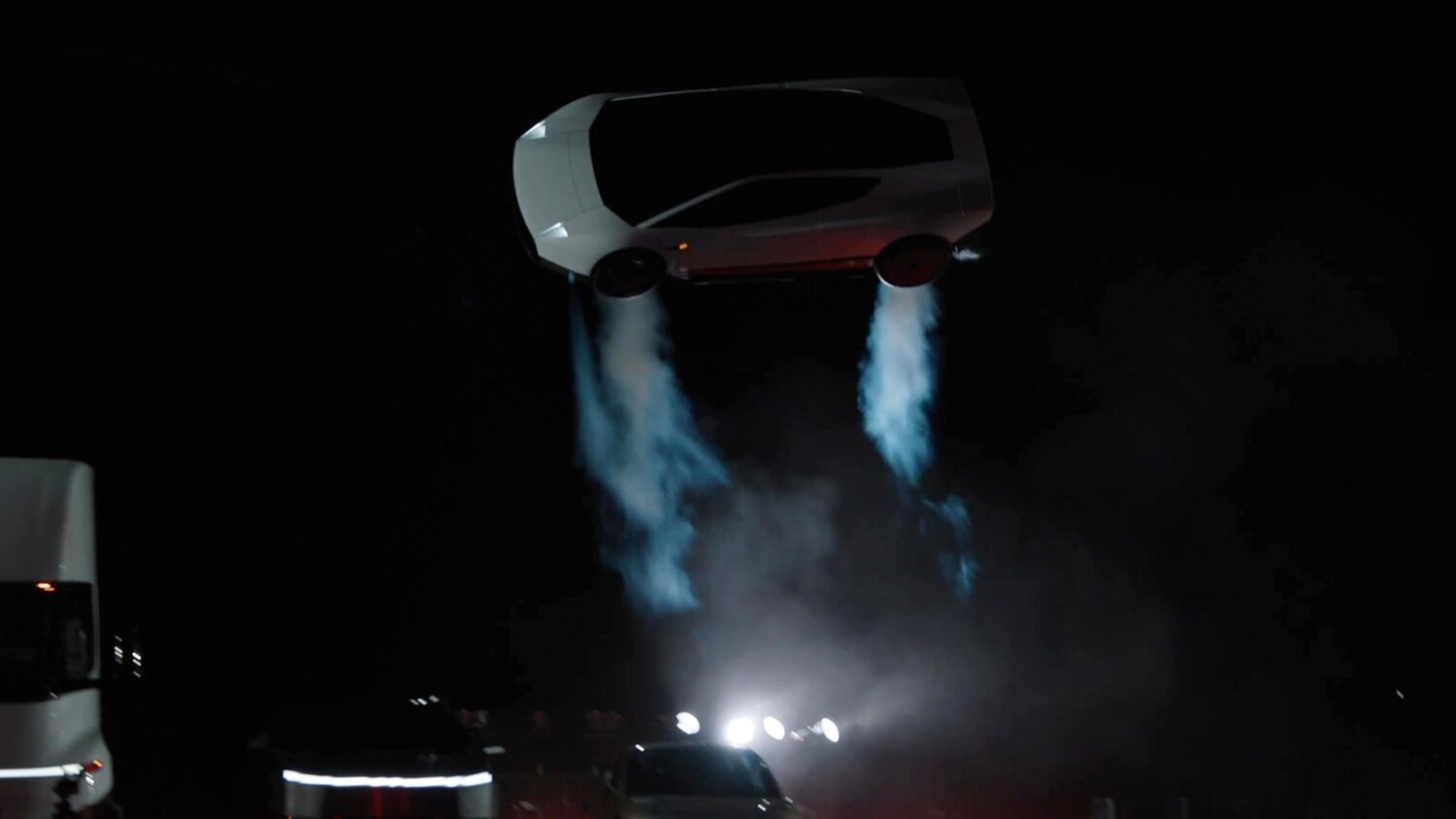
Tesla unveiled a new version of the Roadster on the night of 15 to 16 October, one that lifts off the ground and rotates in the air thanks to compressed-gas thrusters. The company gave no price or production date; Elon Musk reportedly named 2028.
Tesla published the video “Do a kickflip!” on its account on X on the morning of Friday, 16 October, Polish time. In the 44-second clip, the Roadster accelerates, fires thrusters under the chassis, lifts off the ground, spins in the air above a row of Tesla vehicles, including the Semi truck, and then returns to the asphalt. Within a few hours, the video had more than 1.7 million views on X.
Tesla wrote simply: “So… yes, it can fly”. This is not a flying car in the aviation sense, however. The manufacturer describes a system of cold-gas thrusters, which deliver a short burst of force and allow the vehicle to lift off and rotate. According to Tesla, how long such a “flight” lasts depends on the amount of compressed gas on board.
Three versions, one of them not for the road
Tesla revealed the configuration details only after the broadcast, in a thread on X. According to the company, there are three variants:
- Performance – “road ready”, two seats, active aerodynamics and an air intake system; 0–60 mph (approx. 97 km/h) in under 1.6 s,
- Thrust – “race ready”, two seats, additional thrusters at the rear; the same acceleration in under 0.9 s,
- Rocket – “air ready”, one seat, thrusters arranged around the body, enabling movement forward, upward and rotation; under 0.59 s to 60 mph and a top speed above 230 mph (approx. 370 km/h).
Tesla puts the range at over 300 miles, or approx. 480 km. As Electrek notes, according to Tesla’s website the Rocket version is not approved for road use, and Thrust and Rocket are treated as add-ons to the base Performance. All figures are manufacturer claims, independently unverified.
How it is supposed to work
Tesla argues that the thrusters are a solution known from SpaceX, which had to be adapted to work in the atmosphere: new hardware and control software were needed, and every free space in the car is filled with carbon-composite pressure vessels (COPVs).
The company also claims the thruster system generates 4–5 times more force than tires can transmit, which is meant to bypass the grip limit that applies to every car on the road.
In track mode, the car is meant to lower itself and deploy wings powered by actuators from the Optimus robot design. Tesla speaks of downforce “approaching F1 levels”, the best among road cars. This too is a manufacturer claim.
A lot has changed since 2017
Tesla unveiled a prototype of the Roadster’s successor in November 2017, promising production in 2020. As Electrek recalls, this year the unveiling date was pushed back several times: from April to August, and then to 1 October.
The design has changed too. Tesla writes that since that presentation its design language has traveled “from S3XY to Cybertruck, Cybercab and Optimus” (S3XY refers to the Model S, 3, X and Y), and the new Roadster is inspired by the SR-71 and F-35 aircraft, the American reconnaissance plane and fighter jet.
A comparison with the announcements from almost nine years ago, according to Electrek:
- range: 620 miles (approx. 1,000 km) then, over 300 miles (approx. 480 km) now,
- top speed: over 250 mph (approx. 400 km/h) then, over 230 mph (approx. 370 km/h) now, in the Rocket version,
- seats: a 2+2 layout then, now at most two,
- acceleration: 1.9 s to 60 mph then, under 1.6 s in the base version now.
Acceleration is therefore better than promised, but the claimed range has roughly halved, and of the four seats, at most two remain.
Reservations without a price
Tesla has reopened reservations. According to Electrek, buyers must pay $5,000 (approx. 19,500 zł; the company describes this amount as refundable) and another $45,000 (approx. 175,000 zł) within 10 days, otherwise the reservation lapses. In total, $50,000, the same as in 2017. No price has been given for any version, and the only mention of a production date is Musk’s remark “2028, actually”, quoted by Electrek.
Competitors have already responded
Alef Aeronautics, a Silicon Valley maker of an electric flying car, quickly reacted to the unveiling. The company published footage of its vehicle flying over the Roadster. “Welcome, Tesla, to the flying car race. We were alone in it for eleven years” said Alef’s CEO Jim Dukhovny, as quoted by Electrek.
Alef has held a special airworthiness certificate issued by the US Federal Aviation Administration (FAA) since 2023. As Electrek notes, if the Roadster were to actually fly beyond a closed area, it would have to undergo type certification from the FAA, a process that can take years.
What it means
For a reader in Poland, this is for now an announcement, not an offer: there is no price, date or information on availability in Europe, and the most spectacular features concern versions that are not meant to drive on public roads. A reservation requires a payment of $50,000 (approx. 195,000 zł at the average NBP rate from 15 October). The credibility of the 2028 date is not helped by history: the car was originally supposed to launch in 2020.




Komentarze