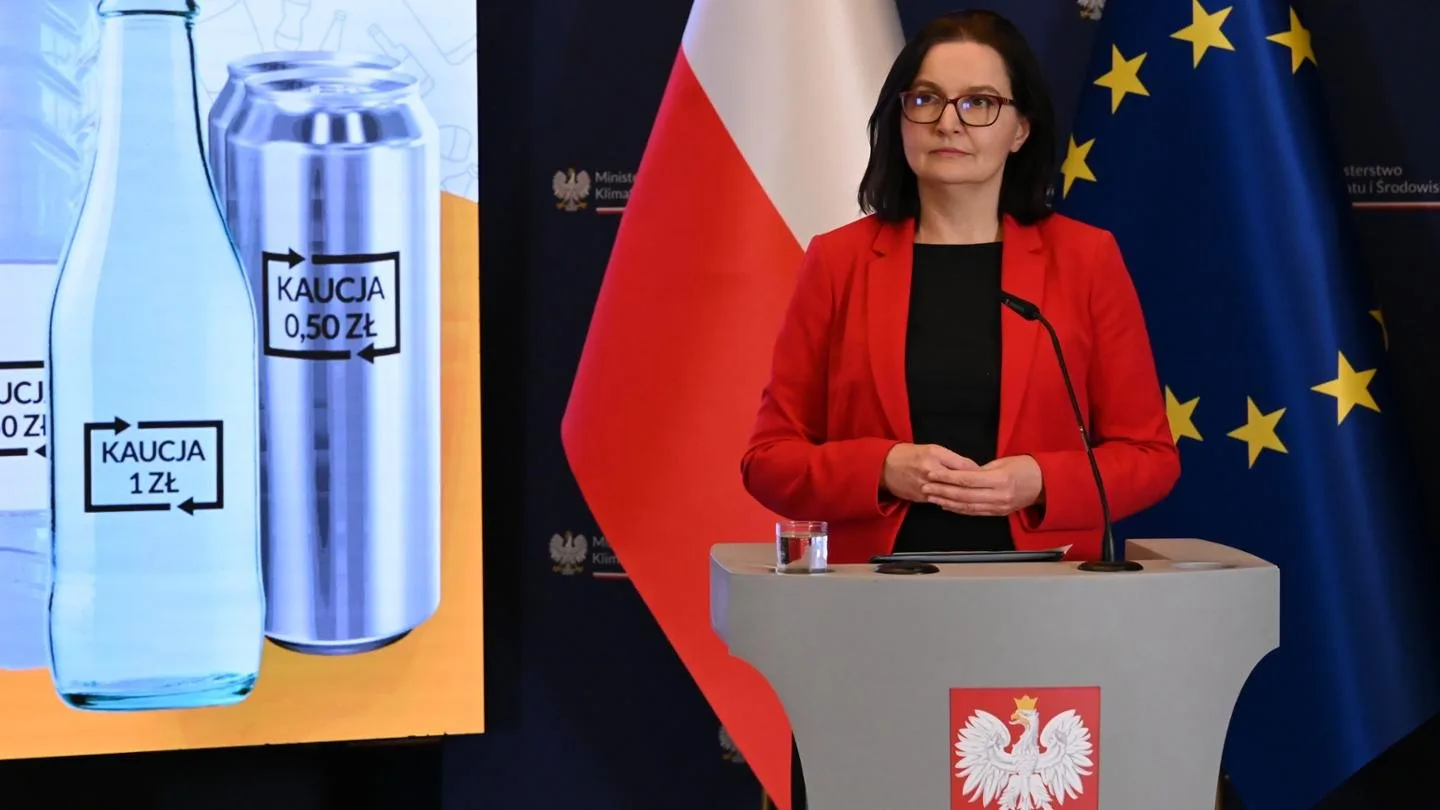
From 1 January 2027 the product fee in the deposit system rises, but the deposit paid at the till, 50 gr for plastic and cans and 1 zł for glass, does not change. Concerns about food prices relate to indirect effects, not to a new fee charged to customers.
Two different mechanisms
The controversy stems from mixing up two concepts. The deposit is money that customers pay when buying a drink and get back after returning the packaging. According to the Ministry of Climate and Environment (MKiŚ), it is 50 gr for a plastic bottle up to 3 l and a can up to 1 l, and 1 zł for a reusable glass bottle up to 1.5 l. The ministry stresses that the deposit system “is neither a tax nor a public fee”.
The product fee, on the other hand, is a charge on companies that place drinks on the market. They pay it when they fail to reach the required level of packaging collection. The ministry says this level is 77 percent. The fee is calculated on the missing mass of packaging, not on total sales.
How the rates grew
Ministry materials show that the basic rate initially stood at 0.10 zł per kg for plastic bottles and cans and 0.01 zł for reusable glass. In 2026 it rose to 1.00 zł and 0.05 zł. In 2027 it will be 5.00 zł and 0.25 zł per kilogram, respectively.
Companies that have not signed an agreement with the system operator have been paying a triple rate since 2026. After the change, this will be 15 zł per kilogram for plastic and cans. For example, with a missing mass of 1,000 kg, the basic fee would be 5,000 zł. We wrote about the increase itself in our article on the fivefold higher product fee from 2027.
Will food get more expensive
No regulations introduce an additional fee on consumers from January. The price concerns stem from the assumption that producers who pay more may pass the costs on to buyers. This scenario is a hypothesis put forward by market commentators, not a finding of any authority. The ministry, however, points out that the higher rate is meant to motivate companies to join the system and collect effectively, because then the fee does not apply to them. In addition, the fee covers drinks in packaging subject to the deposit, not food in general.
The scale of the system
The system has operated since 1 October 2025. According to ministry data, 5 billion bottles and cans have been returned since its launch. There are over 65.5 thousand return points across the country, including 23.5 thousand with automated machines that handle 90 percent of returns. Nearly half of the points operate in small shops.
The ministry also notes that operators work on a not-for-profit basis, and unclaimed deposits may be used solely to run the system, including paying shops for operating return points.