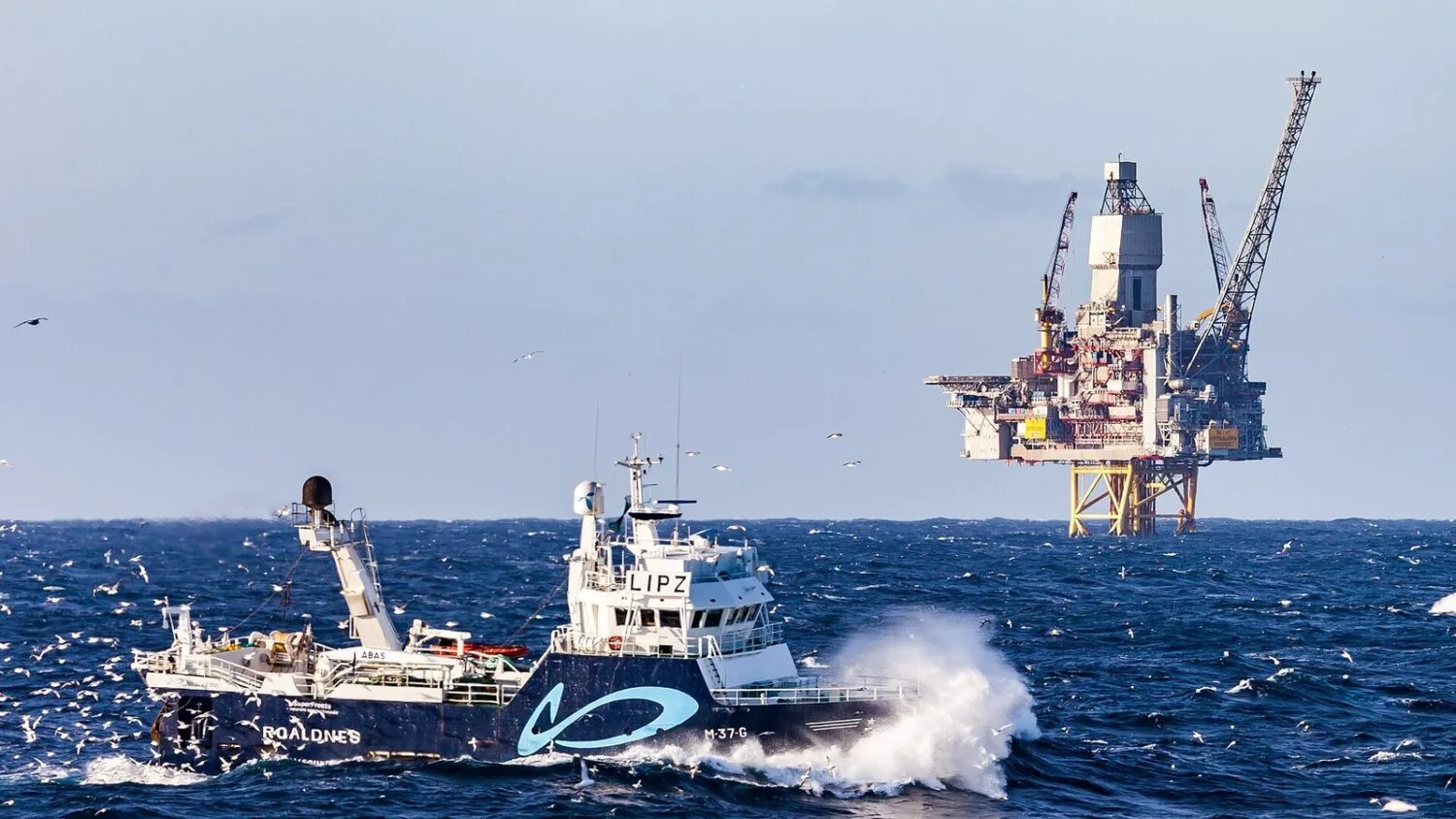
Orlen Upstream Norway, together with Equinor, DNO and Wellesley Petroleum, has completed appraisal drilling at the Afrodite field in the North Sea. Recoverable resources are more than twice as large as previously assumed, and Orlen’s share exceeds 4 billion cubic meters of gas.
Orlen announced the results on Thursday, October 29, in a press release. According to the company, data from the appraisal well show that recoverable resources are more than twice as large as earlier estimates. Equinor, the concession operator, presented the results at the same time.
New estimates: 77–180 million boe
When Orlen took over a 25% stake in the PL293 licence from Vår Energi in February 2026, total recoverable resources at Afrodite were estimated at around 50 million barrels of oil equivalent (boe). Of this, about 12 million boe was attributed to Orlen, or roughly 1.9 billion cubic meters of gas out of an estimated 7.5 billion cubic meters.
Now, according to Equinor’s estimates, recoverable resources fall within a range of 77–180 million boe. Orlen reports an average of 128 million boe, of which more than 32 million boe is attributed to Orlen Upstream Norway. This corresponds to over 4 billion cubic meters of gas. Besides gas, the field also contains oil and other hydrocarbons.
Equinor states in a statement cited by OE Digital that total resources in the field are about three times greater than the amount that can be recovered. This is limited by the low permeability of the rock, through which gas flows slowly. As Reuters reports, citing Equinor, the partners hold the following stakes: Equinor 60%, Orlen 25%, DNO 10%, Wellesley Petroleum 5%.
Bigger than Omega Alfa?
The field was discovered in 2008 by Eni Norway. The first well did not settle whether production would be profitable. Wiesław Prugar, Orlen’s Deputy President for Upstream, notes that technological progress prompted the partners to reassess the project.
The field may be larger than Omega Alfa, the largest discovery on the Norwegian Shelf in recent years, in which Orlen also took part.
— Wiesław Prugar, Deputy President of Orlen (company statement, October 29, editorial translation). For comparison, Orlen gives the average recoverable resources of Omega Alfa, discovered last year, as 115 million boe.
The 35/7-2 well was drilled about 35 km northeast of the Kvitebjørn field. According to Offshore Energy, citing the Norwegian Offshore Directorate, the well was operated by Wellesley, with work carried out by the Deepsea Yantai platform.
What’s next
Equinor considers the discovery commercially viable and is analysing a subsea development with a connection to the Kvitebjørn platform. Gas could flow through existing infrastructure to the Kollsnes plant and from there to the European market. Orlen is also a partner in Kvitebjørn. No investment decision or production schedule has been announced.
What it means
For Orlen, this means a larger base of its own gas production in Norway, where the company aims to increase output as part of its ORLEN 2035 strategy. The scale, however, depends on how much can be extracted from the poorly permeable rock. For now these are resource estimates, not supply volumes to Poland. As of publication, no development costs or first gas date have been disclosed.