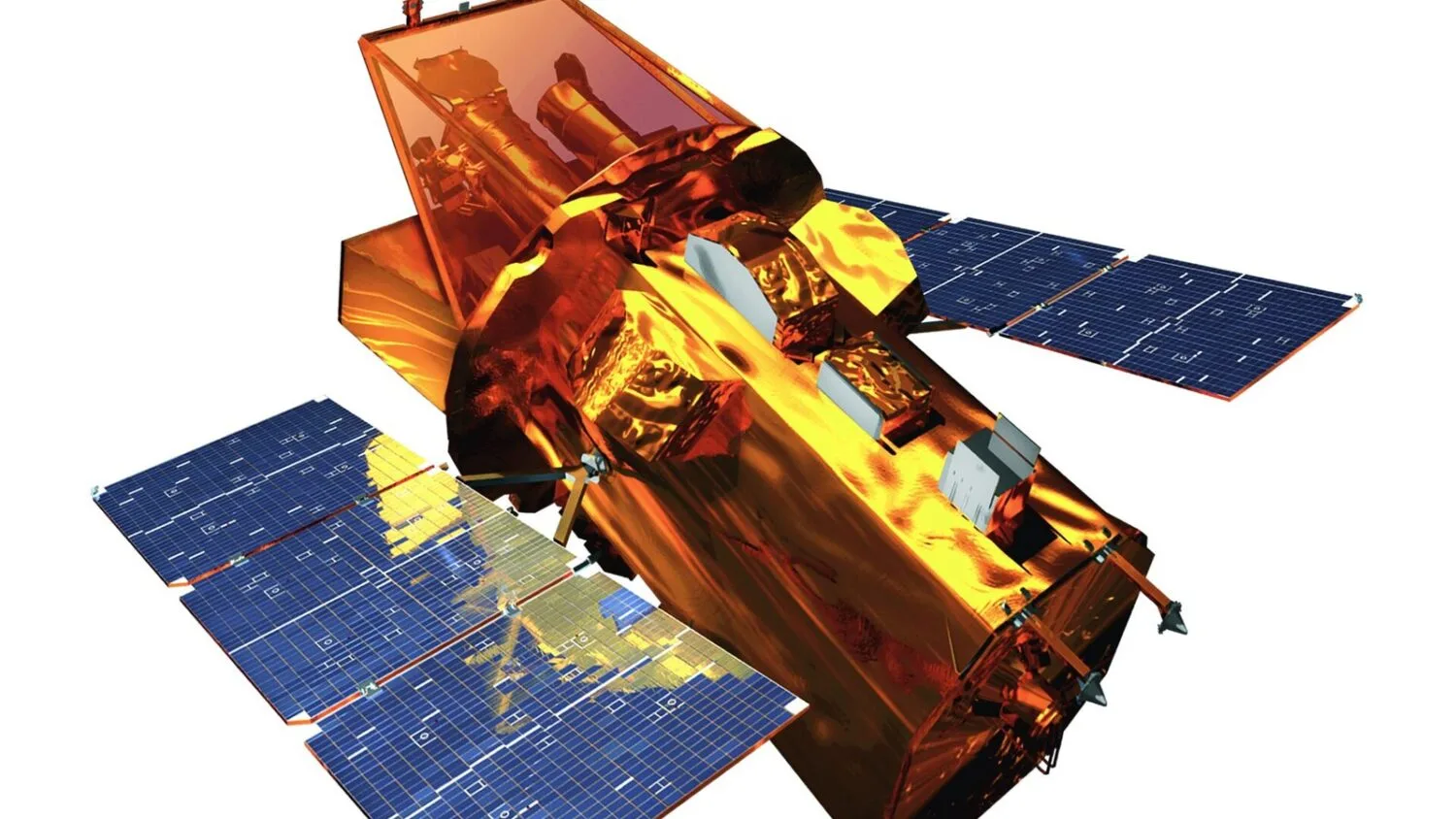
The Neil Gehrels Swift Observatory, a 1.5-tonne NASA telescope, is set to re-enter the atmosphere on Wednesday, November 4. The agency says most of the spacecraft will burn up and the risk to people is low.
As NASA stated in a release on Monday, November 2, the US Space Force expects the roughly 1.5-tonne (about 3,200-pound) satellite to enter the atmosphere at around 3:30 a.m. US Eastern Time on November 4. The forecast uncertainty is 11 hours in either direction. Converted to Polish time, the centre of the forecast is around 9:30 a.m., so the whole window runs from Tuesday evening (around 10:30 p.m.) to Wednesday evening (around 8:30 p.m.).
Where fragments could fall
According to NASA’s statement, the agency expects most of the spacecraft to burn up, but some components are likely to survive re-entry. Because of the low orbital inclination, possible impact sites are limited to a band between 20.6 degrees south and 20.6 degrees north latitude. Poland and Europe lie outside this area.
As CBS News reports, citing AP, the debris will most likely fall into the ocean. However, the potential zone also includes parts of Africa, Australia, India, Southeast Asia, and Central and South America. According to mission scientist Brad Cenko, small tungsten pieces, which are denser than lead, and fragments of mirrors could survive.
What the risk is
NASA assessed the risk that anyone on Earth will be harmed as low. As CBS News and AP report, that is about 1 in 2,100. The agency says it will continue monitoring the re-entry together with the Space Force and updating forecasts. Other organisations give slightly different timings: according to one service, the Aerospace Corporation forecast pointed to November 4 with a wider margin of uncertainty, while earlier reports mentioned November 6. NASA’s latest forecast is the binding one.
Why Swift is falling
The telescope launched in 2004 to study gamma-ray bursts, the most powerful explosions in the universe. It was designed for a primary mission of two years. After 21 years in operation, its orbit began to decay rapidly due to increased solar activity, which increased atmospheric drag.
NASA contracted Katalyst Space for $30 million to attempt raising the telescope to a higher orbit. Due to a problem controlling the spacecraft’s orientation, the mission did not go ahead. Its goal was changed to testing rendezvous techniques in space. NASA ended Swift’s operations on October 23, when it was orbiting below 275 km above Earth.
What it means
For people in Poland, the event poses no threat, because the debris path will not cover Europe. It can be followed through NASA’s updates. If someone finds a suspicious piece of metal in the area of possible impacts, NASA usually advises not to touch it and to report it to the authorities. For astronomers, this means the loss of one of the key tools for rapidly observing gamma-ray bursts. NASA says it is looking for ways to fill this gap, including with existing telescopes.