
In recent years, the development of artificial intelligence has been experiencing unprecedented growth, which is increasingly affecting different areas of life, including the management of states. More and more discussions and initiatives are emerging in the form of governance, in which AI plays a central role and even... first experimental countries or enclaves, where the artificial intelligence system makes decisions.
How will the AI work?
The concept of an AI-managed state implies using advanced algorithms to make administrative, legal, economic and social decisions. Such a state would benefit from huge data resources, analyse trends, anticipate the effects of decisions and act on the basis of objective criteria, minimising human error and subjectivity. AI would be the coordinator of all state activities, from strategic planning to law enforcement.
First steps taken

In the world, the first steps towards such solutions are already emerging. An example is the island that announced the rise of the first state, where governments operate the AI and the autonomous decision-making system. These experiments test how AI manages real-time management and what solutions can be scaled to larger territories.
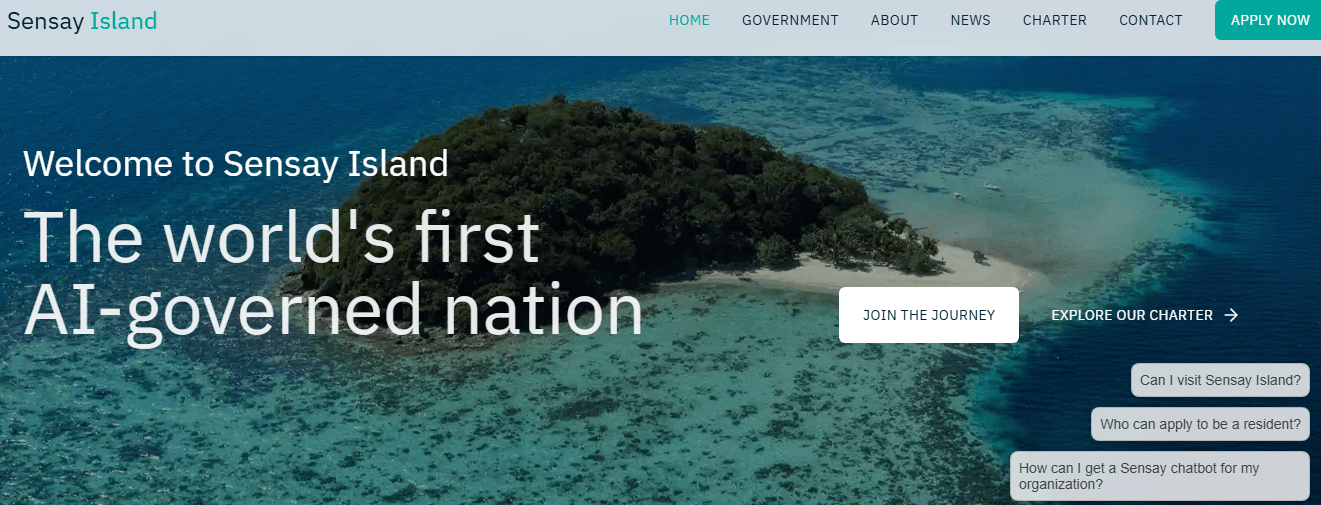
The island referred to in the context of an AI-controlled country is most likely island Sensay, sovereign micronation on the Filipino archipelago, managed by the Council of Artificial Intelligence.
Sensay Island already owns its own website:
Such a country faces many challenges. International conventions, such as the first global treaty on AI regulation, highlight the need to protect human rights, democracy and transparency in the use of this technology. States deciding to use AI in government must guarantee oversight, audit and accountability mechanisms to prevent manipulation and civil rights violations.