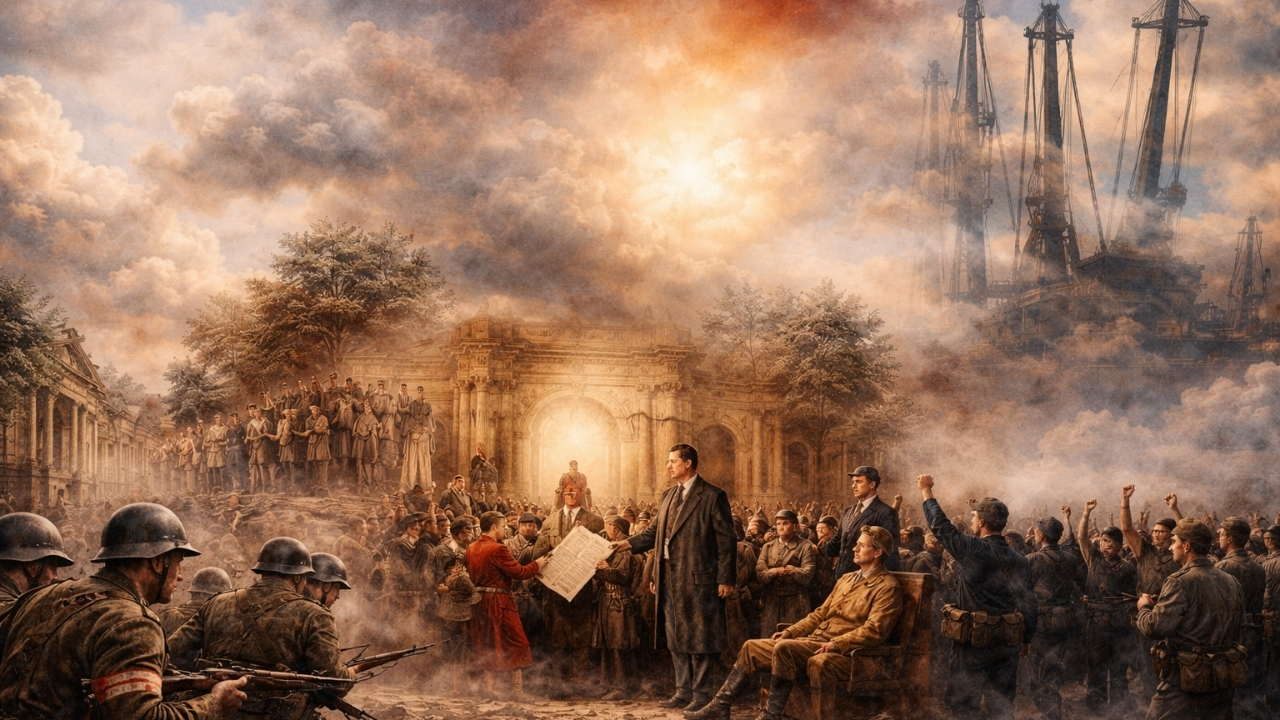
Did you know that one day in the calendar can accommodate the birth of the state, the premiere of a cult Polish film and one of the most important medical discoveries in human history? This day in the history of May 14 is the true treasure of events that shaped the modern world. We're looking at what happened that day over the centuries. — And we guarantee that some of these stories will surprise you. We invite you to read a unique historical calendar.
What happened on May 14th? Major events in history
1607 – Establishment of Jamestown, the first permanent English settlement in North America
It was that day in 1607, English settlers founded Jamestown, Virginia — a settlement that became history's first permanent English colony on the American continent. This event launched one of the largest migration and colonization processes in world history, leading ultimately to the rise of the United States. Jamestown was on the brink of destruction for a long time — The famines, diseases and conflicts with indigenous residents decimated the colonists, yet the settlement survived. Without that day, North America's history would have looked completely different.
1796 – Edward Jenner performs the first effective vaccination in medical history
It is difficult to overestimate what happened that day in 1796. British physician Edward Jenner vaccinated an eight-year-old boy with cowpox viruses, gaining for the first time in history the recipient's resistance to deadly chickenpox real. This experiment, today raising ethical doubts, has given humanity one of the most powerful weapons to fight infectious diseases — vaccine. He opened the way to invent preparations that saved hundreds of millions of lives in the following centuries.
1948 – Proclamation of Israel's Independence
On May 14, 1948, at four o'clock in the afternoon local time David Ben Gurion read Israel's Declaration of Independence in Tel Aviv — a document that, after nearly two thousand years of diasporous wandering of the Jewish people, proclaimed the new state in the Middle East. This is one of the most important political events of the 20th century, which in a few hours radically changed the map of the world and started one of the longest lasting conflicts in modern history. The United States recognized Israel only eleven minutes after independence was declared. This day in history is still a source of extreme emotion and is the subject of heated debates.
1610 – The assassination of Henry IV Bourbon, King of France
Paris, May 14, 1610 — A carriage with King Henry IV of Bourbon is on the streets of the city. Suddenly Catholic fanatic François Ravaillac stops the vehicle and stabs the monarch several times. Henry IV, who became famous as a tolerant and wise king, the creator of the famous Nantes Edict providing freedom of religion to the Huguenots, dies from the wounds. His successor is nine-year-old son Louis XIII, and the country falls into religious conflicts and court intrigue for many years. This killing remains one of the most dramatic moments in the history of the French monarchy.
1955 – Conclusion of the Warsaw Pact
On that day, in 1955, eight Eastern bloc states signed in Warsaw the Agreement on Friendship, Cooperation and Mutual Assistance, which went to history as the Warsaw Pact. This was a direct response from the Soviet Union to the accession of West Germany to NATO. The agreement created a formal military structure of the communist bloc and for 36 years it was one of the main pillars of the cold war order in Europe. For many signing countries, including Poland, it was a symbol of limited sovereignty and Soviet dominance.
1984 – Premiere of the "Sexmission" by Juliusz Machulski
One might ask if there is another such film in the history of Polish cinema, which after four decades still entertains, moves and provokes to think. This day in the history of Polish cinematography was written in gold letters — On May 14, 1984, the premiere of science fiction comedy "Sexmission" directed by Juliusz Machulski took place. The film with Jerzy Stuhr and Olgierd Łukaszewicz in the lead roles became immediately cult and quotes from it entered pop culture permanently. Importantly, under the coat of absurd comedy there was a sharp satire on the then political reality of the PRL.
1983 – The death of Grzegorz Przemik, symbol of resistance to power
One of the most moving and tragic cards in the Polish historical calendar was recorded on 14 May 1983, when a 19-year-old senior and poet Grzegorz Przemyk died in the Warsaw hospital. — beaten two days earlier by civil militia officers at a police station on Jesuit Street. The case shook the entire society and became a symbol of the brutality of martial law. Despite the obvious evidence of guilt, the militiamen never held responsibility, and the government-fabricated trial became one of the largest court scandals of the Polish People's Republic. The story of Przemysł saw a loud screening in Jan P. Matuszinski's film "So that there were no traces" from 2021.
1926 – The May Revolution: The End and the Beginning of the Age
When checking what happened that day in the history of Poland, one cannot ignore the dramatic finale of the May coup. On May 14, 1926, against the counterattack of the troops of Marshal Józef Piłsudski, the Polish constitutional authorities withdrew to Wilanów. In the evening, President Stanisław Wojciechowski resigned and Prime Minister Wincenty Witos resigned the government. Three days of street fights in Warsaw cost nearly 400 people. The coup opened an era of so-called sanitization in Poland — the undemocratic rule of the Piłsudski camp, which continued until the outbreak of World War II.
Born 14 May
George Lucas (1944) – American film director and producer, creator of the saga "Star Wars" and series "Indiana Jones", one of the most influential people in Hollywood history.
Cate Blanchett (1969) – Australian actress, two-time Oscar winner, recognized as one of the most outstanding artists of her generation, known, among others, for her role as Galadriela in "Lord of the Rings".
Mark Zuckerberg (1984) – American programmer and entrepreneur, co-founder and CEO of Facebook (Meta), one of the richest people in the world, who revolutionized the way of communication.
Robert Zemeckis (1952) – American film director, creator of such classics as "Back to the Future", "Forrest Gump" or "Cast Away", Oscar winner for directing.
Frank Sinatra (born 1915, May 14, 1998) – legendary American singer and actor of Italian origin, called "Ol' Blue Eyes", an icon of 20th century music, whose recordings are still listening to millions of people around the world — On that day we celebrate the anniversary of his death.
World events
1804 – Lewis and Clark Expedition – a famous expedition began, which first reached the western coast of North America by land, opening an era of exploration of the continent.
1908 – Wilbur Wright flies with passenger – Aviation pioneer Wilbur Wright made the first ever aircraft flight with a passenger on board, setting a new chapter in transport history.
1973 – Taking Skylab Station into orbit "The United States has brought the first U.S. manned Skylab space station into orbit, opening a new stage of space conquest.
1963 – The Rolling Stones sign with Decca Records – On that day, members of the legendary band signed under their first record contract, starting a career that continues to this day.
2017 – Emmanuel Macron sworn in as President of France – The youngest president in the history of the Vth French Republic, Emmanuel Macron, took office as head of state, becoming one of the key figures of European policy of the turn of the second and third decades of the 21st century.
May 14 is a day that resembles how dense history can be from events — from the foundations of medicine, through the birth of states, to Polish dramas and triumphs of culture. Looking at this historical calendar, it is hard to resist thinking that each day contains stories worth knowing. Look tomorrow — Because May 15th has just as much to say for us.