

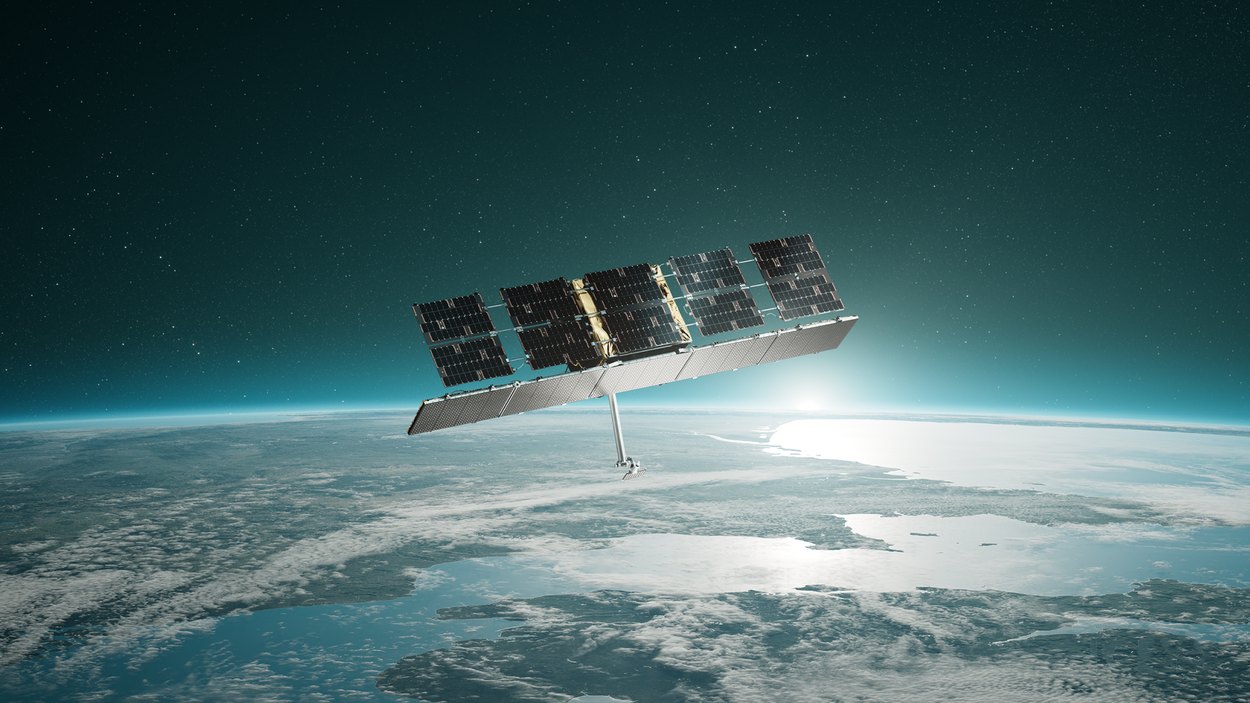
The Russian military satellite Kosmos 2612 has come close in orbit to the radar satellite ICEYE-X36, whose services are used, among others, by Ukraine. Analysts assess that the manoeuvre was deliberate; the reported distance ranges from a few kilometres to 1–2 km.
According to the company LeoLabs, as cited by the outlet Axios, on Friday 17 October Kosmos 2612 was about three miles (approx. 4.8 km) from ICEYE-X36. A day earlier, the satellites were more than 200 miles apart. LeoLabs assesses that the Russian craft’s movement “appears to be a deliberate approach”. Some commentators, including reports cited by Wirtualna Polska (WP), mention a distance of 1–2 km. The data are not uniform, as they are based on public orbital elements and calculations by independent observers, not on a statement from the operator.
What observers established
Astrophysicist Jonathan McDowell wrote on X on Saturday 17 October that Kosmos-2612 passed ICEYE X36 at a distance of a few kilometres.
Later, as Defence Blog reports, McDowell noted that after the 16 October manoeuvre the Russian satellite remains within up to 5 km. He added that, to his knowledge, this is the first such encounter between two active satellites in low orbit to which the owner of one of them has not consented. He cautioned, however, that he is awaiting further data.
In a separate post, McDowell described Kosmos-2612 as an “inspection satellite”.
Weeks of preparation
According to an analysis by the firm Integrity ISR, cited by Vice President Greg Gillinger in an interview with the Polish Press Agency (PAP), the Russian craft spent about two weeks carrying out precise, fuel-intensive manoeuvres to enter an orbit matching that of ICEYE. Around 12 October it lowered its altitude and aligned its orbital plane, and at that point it was about 475 km from maximum proximity. Gillinger judged that this was no coincidence, and that possible actions from such a position include reconnaissance, electronic jamming or kinetic action. No evidence has been presented that Russia plans an attack.
Kosmos 2612 is one of six satellites launched from Plesetsk in April. In May, according to a CSIS analysis, five of them positioned themselves in the orbital plane of ICEYE-X36, and one passed about 2.5 km from it.
What is ICEYE
ICEYE is a company founded, among others, by Pole Rafał Modrzewski, which operates the largest commercial constellation of radar satellites. Their images are not dependent on cloud cover or time of day. According to Wirtualna Polska, the Polish military and Ukraine use them. ICEYE-X36 is linked to the American company ICEYE US. The firm declined to comment, as did the Pentagon. A Ukrainian official confirmed to Axios that the military uses ICEYE’s services, but did not know whether this applied to this particular satellite.
Prof. Aaron Brynildson of the University of Mississippi noted that there is no fixed limit on close approaches, but operators usually keep a distance of more than about six miles. At smaller distances, the risk of collision rises, especially when both objects are manoeuvring.
What it means
For readers in Poland, there is for now no direct threat: there is no report of damage to the satellite or of data loss. However, the matter concerns reconnaissance infrastructure on which part of Poland’s observation capabilities rely. According to WP, further approaches by Russian satellites to ICEYE’s twin craft may occur on 6 and 17 November. As of publication, neither ICEYE nor Polish military authorities have publicly responded to the matter.



Komentarze