

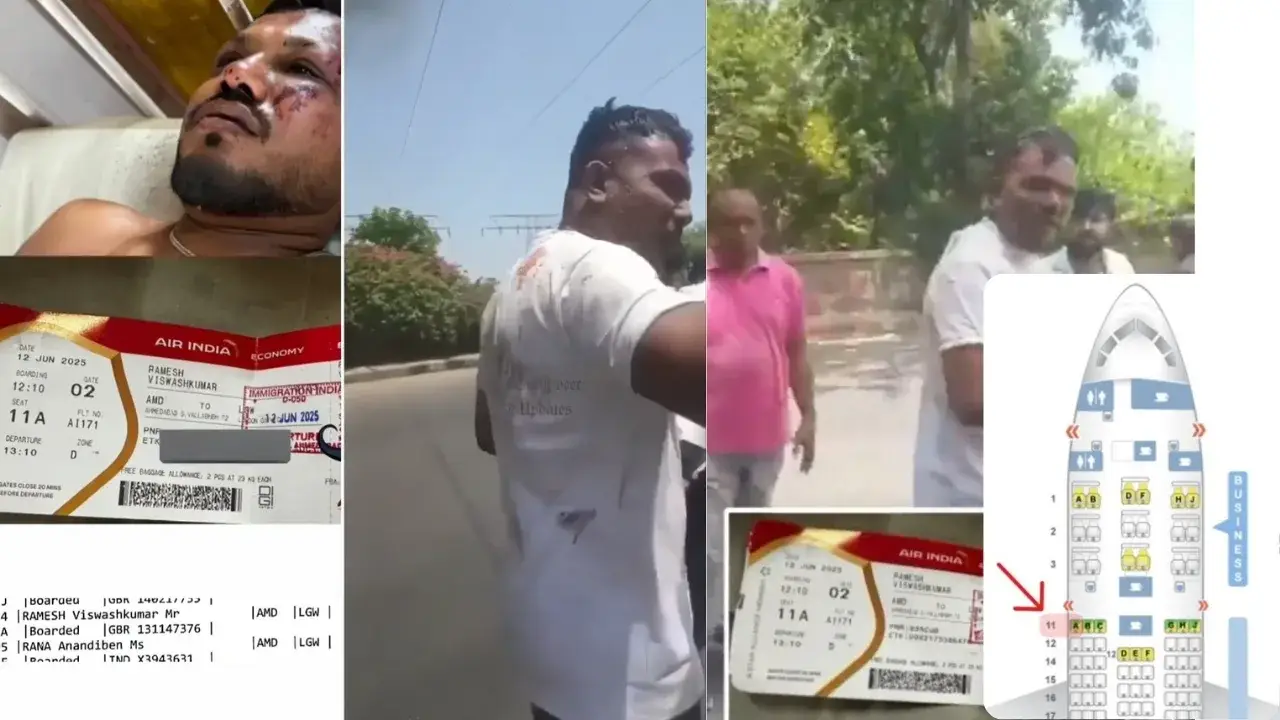
The shocking Air India crash on the Ahmedabad–London route claimed the lives of 241 people. However, a video of the passenger who was the only one to walk alive out of the wreckage has circled the world. Who is this man, where was he sitting, and how did he survive a tragedy that seemed impossible to survive?
Video of the sole survivor right after the crash
Who is the sole survivor of the Air India crash?
The only survivor of the crash of flight AI171 is 40-year-old British citizen of Indian origin, Vishwash Kumar Ramesh. He was returning to the United Kingdom after a family visit to India. In dramatic footage from the crash site, he can be seen, bloodied and dazed, walking out of the wreckage while holding a mobile phone and trying to understand what had happened.
Where was Vishwash Kumar Ramesh sitting?
Seat 11A – the key to survival?
Ramesh was sitting in seat 11A – a window seat on the left side of the aircraft, in the first row of economy class, right next to the emergency exit, the cockpit and the toilet. This location may have played a key role in his survival. Aviation experts point out that seats next to emergency exits often offer better chances of escape in the event of a crash, although this is not a rule – every accident has its own unique dynamics.
| Seat | Location | Potential advantages |
|---|---|---|
| 11A | Window, first row of economy, next to emergency exit | Greater chance of quick evacuation, extra space, possible protection from impact |
How did he survive the crash? A firsthand account
Ramesh recounts that just a few seconds after takeoff he felt something was wrong – the plane was not gaining altitude, the lights began to flicker, and then the aircraft crashed violently into a building and burst into flames. For a moment he was convinced he was dead. When he regained consciousness, he noticed a gap in the fuselage next to his seat and managed to get out through it, although he suffered burns to his hands.
“I don’t know how I got out of this alive. I saw people dying around me, flight attendants, passengers… I just got out” – he said from his hospital bed.
Ramesh still tried to find his brother, who had been sitting nearby, but unfortunately without success.
Is seat 11A safer?
Experts stress that although in this case seat 11A next to the emergency exit may have saved his life, there is no universally “safest” seat on an aircraft. Each crash has different dynamics, and the chances of survival depend on many factors: the force of impact, fire, the structure of the wreckage, and the possibility of a quick evacuation.
Summary: a miracle or a lucky coincidence?
Vishwash Kumar Ramesh’s survival was a combination of luck, the location of his seat and a quick reaction. His case shows how unpredictable aviation disasters are and how thin the line is between life and death. Today Ramesh is recovering in hospital, and his story is moving people around the world – as proof that even in the greatest tragedy, a miracle can happen.
The scale of the tragedy – death toll and course of the crash
The crash of Air India flight AI171 was one of the deadliest in the history of Indian aviation. There were 242 people on board the Boeing 787 Dreamliner, including citizens of India, the United Kingdom, Portugal and Canada. The aircraft crashed shortly after takeoff from Ahmedabad airport, hitting a hostel for students of a medical university in the Meghani Nagar district. As a result of the disaster, more than 290 people died – both passengers and crew, as well as people on the ground at the point of impact. Official Air India statements confirm the deaths of 241 people on board, and the number of victims on the ground may still rise. The causes of the accident are not yet fully known, but it is known that the aircraft sent a mayday signal one minute after takeoff, then rapidly lost altitude and plunged onto a built-up area, causing enormous destruction and a dramatic death toll.



Komentarze