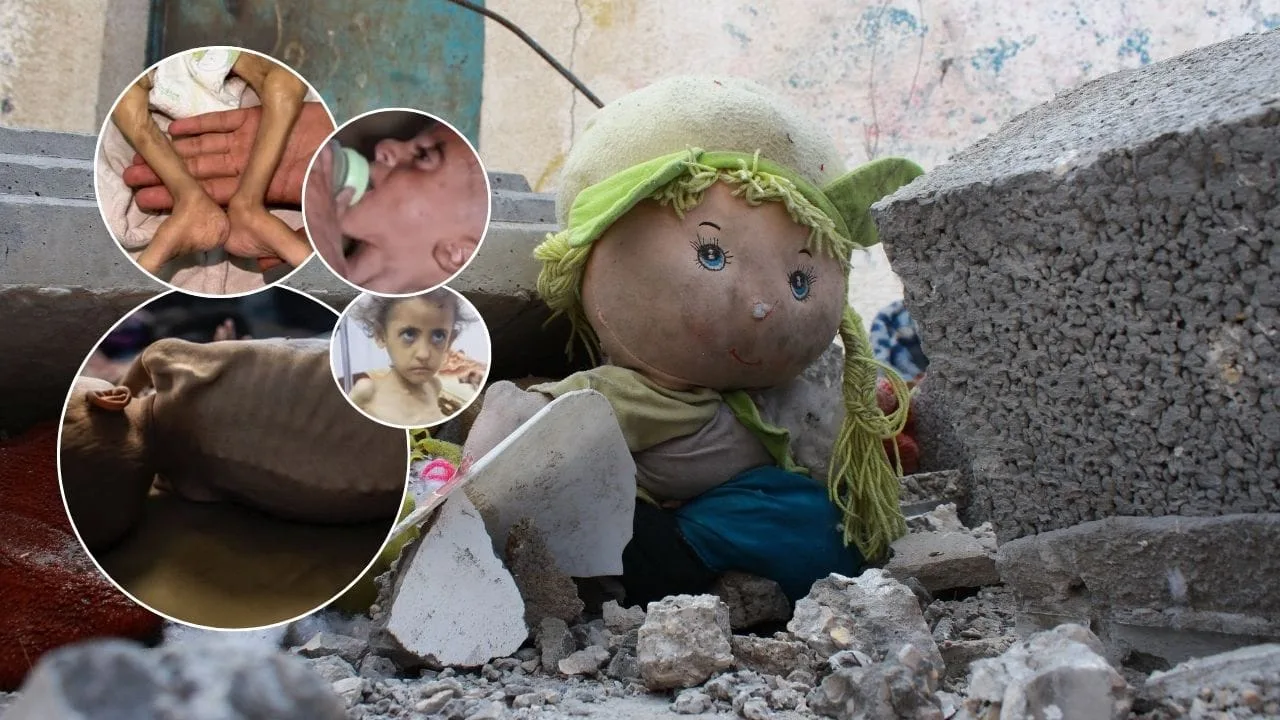
For months the Gaza Strip has been grappling with a dramatic malnutrition crisis that mainly affects women and children. The latest data is alarming: as many as 90,000 children and mothers urgently need specialised treatment to survive.
A humanitarian catastrophe on an unprecedented scale
Imagine your father standing in front of you, trembling from hunger. Imagine your father starving to death in front of you. Here, in Gaza, fathers are dying before their children, because hunger kills them silently, while they try to hide their pain so their children do not feel it.
The World Food Programme (WFP) warns that nearly one in three people in the Gaza Strip has gone many days without access to any food. The organisation warns of a rapid rise in malnutrition, with more than 90,000 women and children in need of immediate food assistance. As the conflict has intensified, the flow of aid has practically come to a halt.
WFP estimates that between May and September 2025 around 470,000 residents of the Gaza Strip may experience so-called “catastrophic hunger”, which is the highest level of risk on the UN food crisis scale.
Children and women at greatest risk
Israel continues to kill children in the Gaza Strip, starving them and preventing food from reaching them.
Zainab, a very young Palestinian girl, died of hunger in the Gaza Strip.
The difference between Gaza in 2025 and the Warsaw Ghetto in 1945 is that the world still has a chance to stop the hunger in Gaza.
According to the World Health Organization and humanitarian organisations:
- 71,000 children under the age of five are severely malnourished, with tens of thousands more at risk to their health and lives.
- About 25% of young children and pregnant women show signs of malnutrition or are at high risk.
- In northern Gaza, 1 in 5 children is already suffering from malnutrition, and this number is rising rapidly every day as aid fails to arrive.
Most affected: children and women
Two brothers, Abdul Rahman Matar (6 years old) and Anni (4 years old), are at risk of death from severe malnutrition. Both suffer from cerebral palsy and physical and intellectual disabilities.
The organisation Doctors Without Borders (MSF) reports that as many as one in four children and pregnant or breastfeeding women are suffering from severe malnutrition, and the number of the youngest children requiring urgent intervention has tripled over the last two weeks.
According to local authorities, the number of people who have died of hunger has already exceeded 120, the vast majority of them children.
The UN’s response to global inaction
United Nations (UN) Secretary-General Antonio Guterres expressed deep concern over the worsening hunger situation in the Gaza Strip.
He stated that the situation in the Gaza Strip is not merely a humanitarian crisis, but a moral crisis that shocks the conscience of the world.
In his latest statement, Guterres revealed how severe the hunger in the region is. He said that children in the Gaza Strip now talk about wanting to go to heaven, because they believe that there, at least, “there is food”.
“Children talk about wanting to go to heaven because, at least according to them, there is food there” – Guterres said.
UN Secretary-General António Guterres strongly condemned the international community for its “lack of compassion and action” in the face of the scale of the catastrophe and hunger in Gaza. He called it a “global moral crisis”.
List of key challenges:
- Lack of access to food and water
- Destroyed medical and sanitation infrastructure
- A particularly sharp rise in severe malnutrition among infants, pregnant women and young mothers
- Risk of disease outbreaks and further deaths from starvation
What does aid look like on the ground?
The siege has made food, water and medicine unavailable, and families are feeding on whatever they can find – often animal fodder or plant roots. The destruction of infrastructure and the extremely limited access to aid further deepen the tragedy.
Doctors, volunteers and humanitarian workers – despite shortages – are trying to treat small children and mothers in makeshift nutrition centres. However, resources are insufficient, and food and medicine supplies urgently need to be increased.
Causes of the tragedy and threats to humanitarian convoys
The UN and aid organisations point out that the main causes of the escalating crisis are:
- Limited inflow of humanitarian aid caused by military and bureaucratic blockades.
- Destroyed infrastructure preventing the smooth transport and distribution of food.
- Frequent attacks on aid convoys – people receiving food often come under fire.
International appeal for a ceasefire and the lifting of blockades
More than 100 humanitarian organisations are calling for an immediate, lasting ceasefire, the lifting of all blockades, and guaranteed full and safe access for humanitarian aid to all residents of the Gaza Strip.