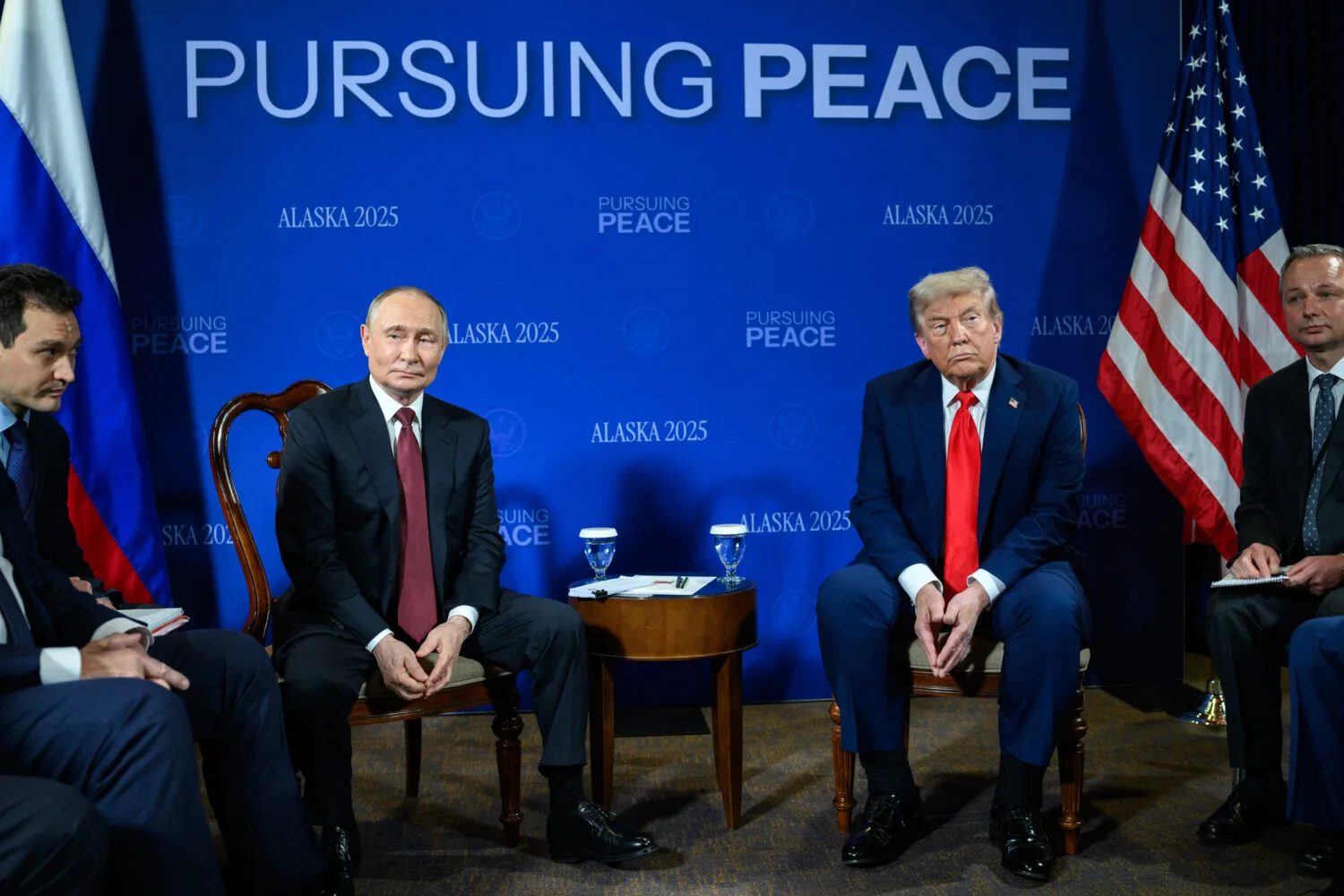
Władimir Putin i Donald Trump, Alaska 15 Sierpnia 2025 r. | Foto: x.com/WhiteHouse
The Trump-Putin call surprised Washington and Moscow. Within 24 hours, the US president markedly shifted his rhetoric on Ukraine, causing uncertainty in global markets and among allies.
Trump, Putin and Ukraine’s Tomahawks – a Quick Reversal
Just a day earlier, President Donald Trump had suggested that the US could consider transferring thousands of Tomahawk missiles to Ukraine – something he reportedly even stated directly to Vladimir Putin during a phone call. „I said to Putin: You don’t mind if I give your opponents a few thousand Tomahawks? He didn’t like that idea” – the American leader recounted. The Kremlin responded with a warning, describing such a decision as a hostile act and threatening escalation. Reactions from markets and politicians showed how tense the situation has become.
Po rozmowie Putin zebrał w Moskwie stałych członków Rady Bezpieczeństwa Federacji Rosyjskiej, co wskazuje na powagę sytuacji. Trump ujawnił część przebiegu rozmowy: „Powiedziałem Putinowi: Nie masz nic przeciwko, jeśli dam twoim przeciwnikom kilka tysięcy Tomahawków? 3/14
I just concluded a phone call with the President of Russia, Vladimir Putin, which was very productive. President Putin congratulated me and the United States on the great achievement of peace in the Middle East, which he said has been talked about for centuries. I believe that success in the Middle East will help us in negotiations aimed at ending the war between Russia and Ukraine. President Putin thanked First Lady Melania for her commitment to children. He was very grateful and said that it will be continued. We also spent a lot of time discussing trade between Russia and the United States after the end of the war with Ukraine. At the end of the conversation, we agreed that a meeting of our high-level advisers will take place next week. The first meetings on the American side will be led by Secretary of State Marco Rubio, along with other persons to be designated. The meeting location has yet to be determined. Then President Putin and I will meet at an agreed location, in Budapest, Hungary, to see whether we can end this „unfortunate” war between Russia and Ukraine. President Zelensky and I will meet tomorrow in the Oval Office, where we will discuss my conversation with President Putin and many other matters. I believe today’s phone call brought tremendous progress. – President Donald Trump on Truth Social
I have just concluded my telephone conversation with President Vladimir Putin, of Russia, and it was a very productive one. President Putin congratulated me and the United States on the Great Accomplishment of Peace in the Middle East, something that, he said, has been dreamed of…
— Commentary Donald J. Trump Truth Social Posts On X (@TrumpTruthOnX) October 16, 2025
The Pentagon and International Reactions
The Pentagon’s considered Tomahawk deliveries to Ukraine met with unprecedented opposition from Moscow. Russian intelligence chief Sergei Naryshkin warned that such a step would „significantly increase the risk to global security”. Meanwhile, the Trump administration has begun signaling that tariffs and economic sanctions hitting Russian exports may be more effective than military support for Ukraine.
A Sudden Retreat – Tomahawks in the Shadow of the Summit
According to Reuters and many political experts, the result of Trump’s call with Putin was in effect a lower likelihood of Tomahawks being sent to Ukraine – an attempt to de-escalate tensions between Washington and Moscow. The White House, meanwhile, says the call was „productive” and that key decisions are expected in the coming weeks.
🇷🇺🇺🇸🇺🇦 Rosja odebrałaby dostawy pocisków Tomahawk na Ukrainę jako wrogi krok, co znacznie zwiększyłoby ryzyko dla światowego bezpieczeństwa światowego – Siergiej Naryszkin, dyrektor Służby Wywiadu Zagranicznego Federacji Rosyjskiej
The shift in narrative and tone from the US president may signal a search for a new strategy of pressure on the Kremlin.
The announcement of a top-level meeting „within two weeks” suggests diplomatic momentum is picking up, with real decisions possibly only coming at the Trump-Putin summit in Budapest.
Budapest as the „Island of Peace” – Orbán as Host
Hungarian Prime Minister Viktor Orbán said preparations for the summit had moved quickly, and that Budapest was reportedly chosen as the venue due to Hungary’s neutrality and Orbán’s ambitions to act as a mediator. The prime minister described the country as an „island of peace”, stressing the importance of neutrality and dialogue.
🇷🇺🇺🇦🇭🇺🇺🇸 ❗️ Państwo Węgierskie zapewni Władimirowi Putinowi pełne bezpieczeństwo podczas wizyty w Budapeszcie – szef węgierskiego MSZ
I have just spoken on the phone with President @realDonaldTrump. Preparations are underway for a peace summit between the United States and Russia. Hungary is an island of PEACE! – Hungarian President Viktor Orbán on X
I just got off the phone with President @realDonaldTrump. Preparations for the USA-Russia peace summit are underway.
🇺🇸🇷🇺🇭🇺 Budapest is the only suitable place in Europe for a USA–Russia peace summit. With long-standing pro-peace leadership and trusted partnerships, we provide a reliable, secure, and politically stable setting. There was no other option. Simply put: they can count on us! pic.twitter.com/ftQ4n9Slcu
Western media, including The Telegraph and Business Insider, forecast that the meeting could prove a cold shower for Ukraine and a blow to the European Union – strengthening Orbán’s line and his pro-Russian narrative within the community. The Kremlin is already using the diplomatic opening to promote its version of events, portraying Brussels as isolated.
The Vision of „New Bridges” and a Russia–US Tunnel
During the conversation, the idea of building a symbolic tunnel connecting Russia and the United States came up. Although it seems exotic, experts note that such ideas carry propaganda value – they underline the need to „build new bridges” in Washington–Moscow relations.
The Future of Relations: Peace or Another Conflict?
The Trump-Putin summit announced for Budapest could be a turning point – both for peace in eastern Europe and for the role of the US in the European security system. The Trump administration is weighing alternatives to military support and looking for economic tools of pressure on Russia. Ukraine and Russia themselves still show fundamental differences and are not yet ready for a realistic compromise – emphasizes Vice President J.D. Vance, citing US intelligence assessments.
Trump suggested giving Ukraine Tomahawks, only to back away from the idea shortly afterward following his call with Putin.
The Kremlin warned that delivering the weapons would be a hostile act and a threat to a peaceful settlement.
The White House is leaning toward economic solutions, while Washington and Moscow prepare for the summit in Budapest.
The EU is increasingly sidelined in negotiations by the diplomatic moves of the Kremlin and Orbán.
The Trump-Putin summit may bring key decisions on Ukraine’s future and Europe’s security.
Tomasz Kamiński, redaktor serwisu DigitalNexus.pl. Zajmuje się tematyką show-biznesową i rozrywką. Ukończył dziennikarstwo i medioznawstwo na Uniwersytecie Warszawskim. W wolnym czasie gra w gry, jest fanatykiem Call of Duty. W temacie gier pisze od 2008 roku.