Imagine that you solve one of the most difficult mysteries of mathematics of all time, and then you just turn around and go back to normal life. No interviews, no awards, no publicity. This is the story of Grigorij Perelman – a Russian mathematician who proved Poincaré's hypothesis and refused a million dollars.
Who's Grigory Perelman?
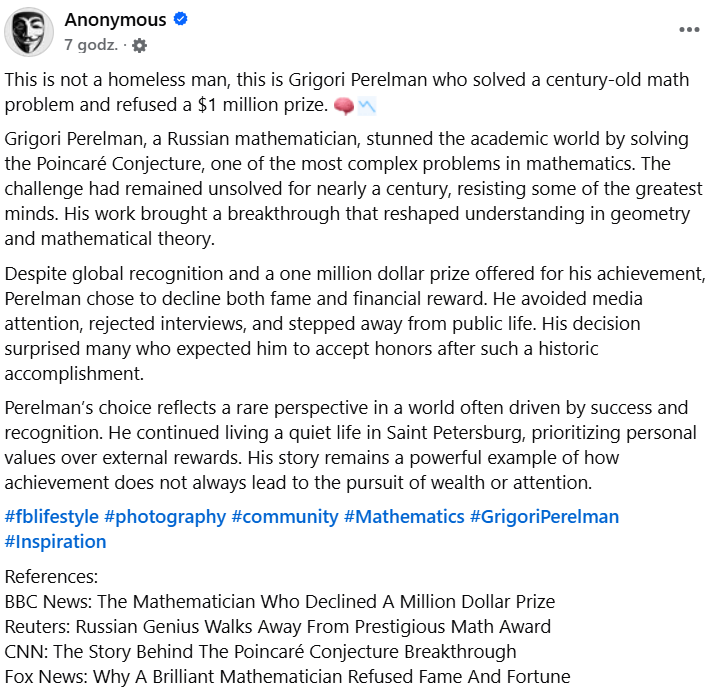
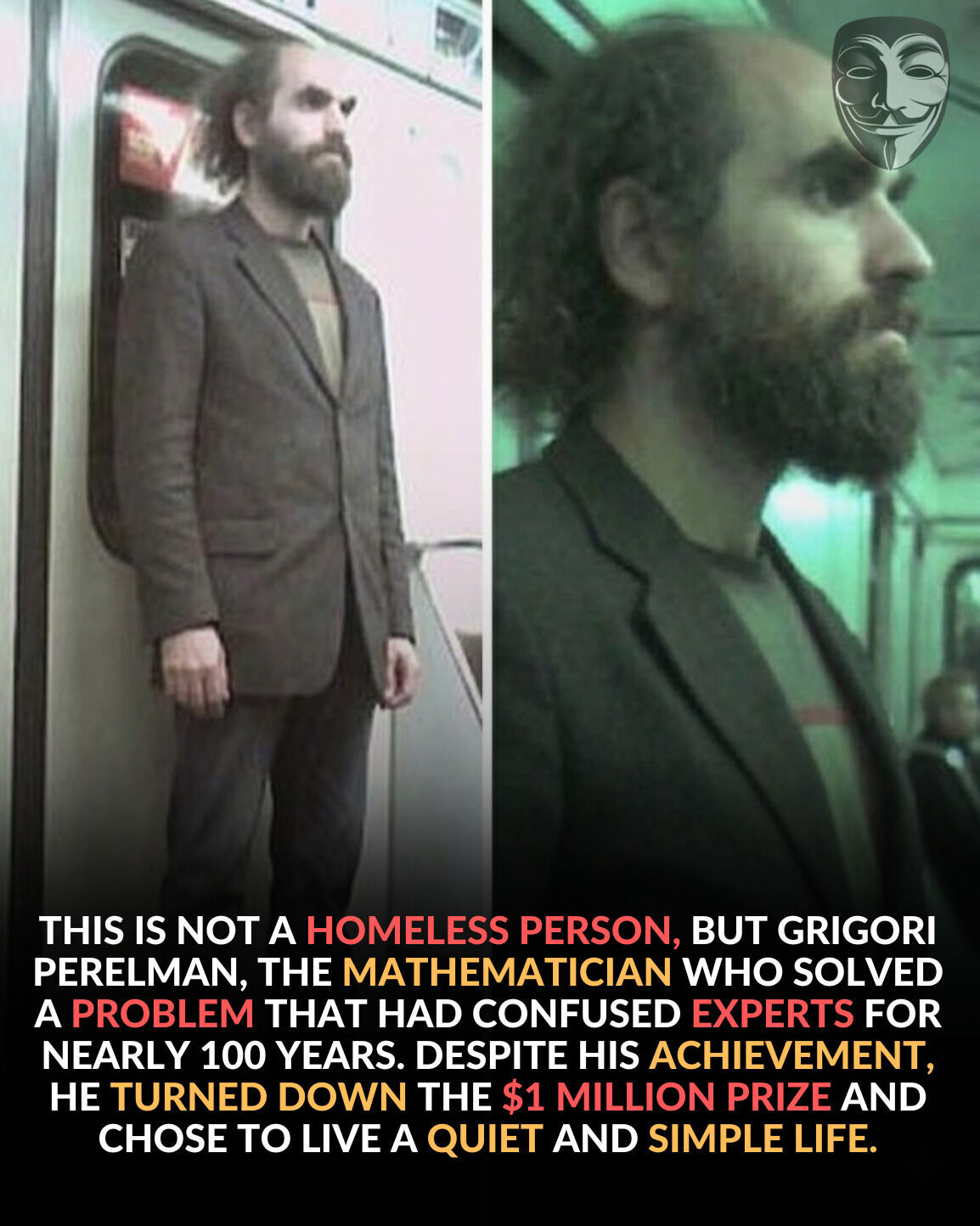
Grigorij Perelman was born in 1966 in Leningrad (today Saint Petersburg). As a teenager, he showed extraordinary talent – in 1982 he won a gold medal at the International Mathematics Olympiad with a perfect score. He later worked at the Stekov Institute, focusing on geometry and topology.
His greatest achievement came in the early 2000s. In 2002 and 2003 he published on ArXiv a series of preprints in which he proved Poincaré hypothesis – the problem formulated in 1904 by Henri Poincaré.
What exactly did Perelman solve?
Poincaré's hypothesis concerned three-dimensional shapes (three-dimensional variations). She simply said that if a certain space is "simple" like a sphere (each loop can shrink to a point), then it is a topologically ball. Does that sound abstract? Imagine a balloon – you can crush it in different ways, but its basic "shape" remains the same. Perelman showed how it works in three dimensions.
His evidence was based on Richard Hamilton's Ricci flow theory. It's like releasing the "heat wave" into a shape that smoothes it out and helps to understand its structure. Perelman added key elements that allowed to solve the problem.
His work was so groundbreaking that she also proved wider Thurston geometric hypothesis.
Why would he refuse a million dollars?
In 2010, Clay Mathematics Institute awarded him the Millennium Award – A million dollars to solve one of the seven hardest math problems. Perelman just... refused. He didn't show up for the ceremony in Paris.
He said his contribution was no greater than Hamilton's, and the decision of the committee was unfair. He did not want to participate in the "system" which in his opinion rewards the performance, not pure science. He had also rejected the Fields Medal – the mathematical equivalent of Nobel.
It wasn't poverty or eccentricity for the show. Perelman simply valued mathematics in himself. "I have everything I need," he said.
Living Away From the Light
Today Perelman leads a very peaceful life in St. Petersburg. She takes care of her mother, avoids the media, and has not given interviews for many years. There are occasionally reports that she is interested in other problems, such as Navier-Stokes equations.