
Today on the cryptocurrency market, on December 17, 2025, brought extreme volatility to Bitcoin's course. In just 30 minutes, the price of BTC increased by about $3300, reaching a level above $90 000 and eliminating short positions worth USD 106 million. Then, over the next 45 minutes, there was a sharp drop of $3400, leading to a US$52 million long position being wound up. This mood swing caused losses for many investors and fueled discussions about market manipulation. Below is a graph that illustrates today's variability.
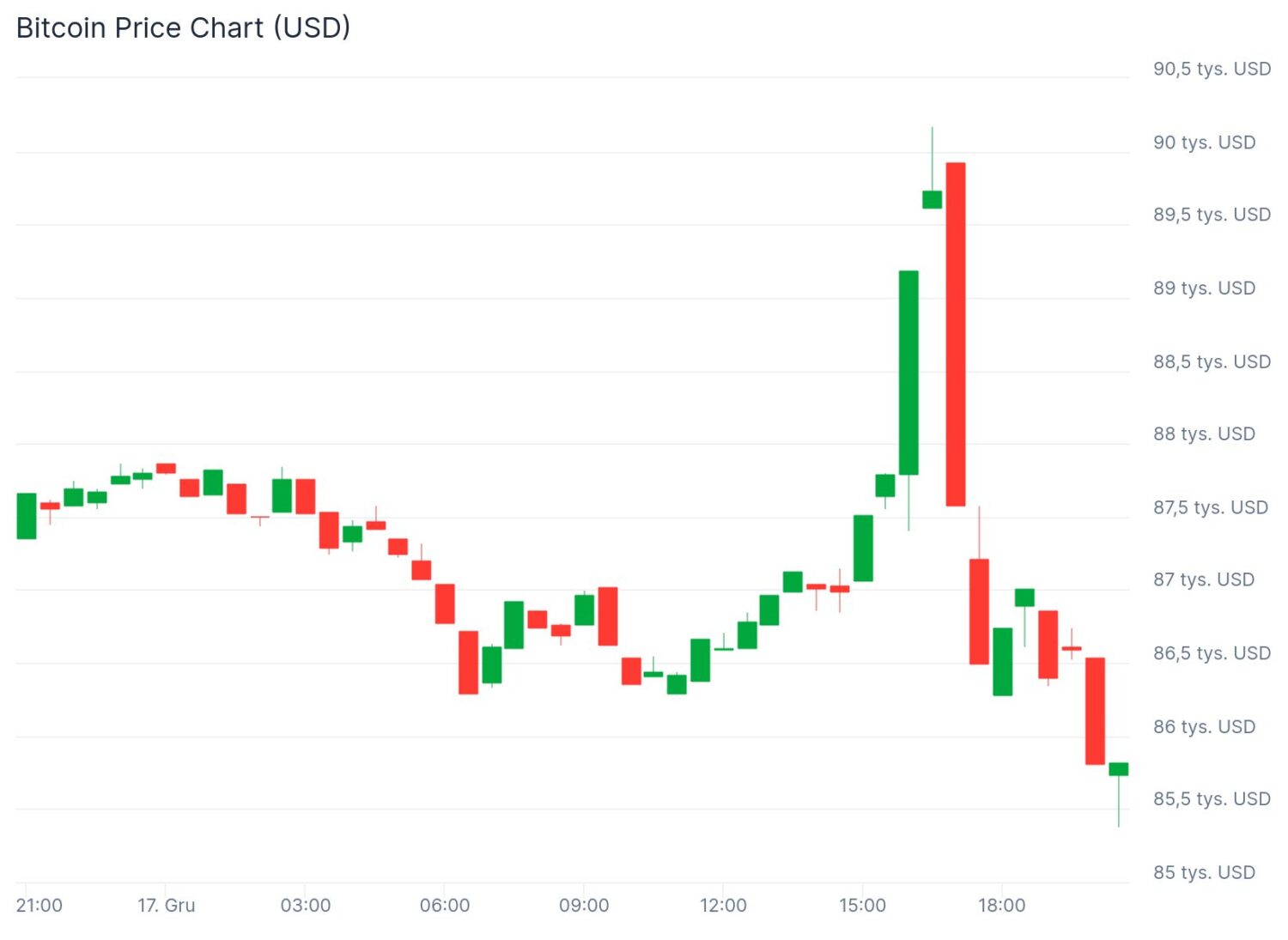
This rapid price share is not accidental – it is due to a combination of macroeconomic, structural and speculative factors. Analyzing market data, expert reports and discussions on platforms such as X (formerly Twitter), there are several key reasons. Below we discuss the most important of them.
1. High leverage and cascading positions
One of the main culprits of today's volatility is the excessive use of leverage (left) by traders. As Bitcoin's price increased rapidly, there was a massive liquidation of short positions (presuming a drop in price), which further fueled growth. However, a rapid retreat resulted in the elimination of long positions (presuming growth), creating a domino effect. In total, more than US$150 million has been eliminated within an hour. Experts emphasize that such events are typical of high leverage markets, where algorithms and market brokers "hunt for fluidity", deliberately triggering movements to force them to close positions. As noted in the analysis, "pump then dump" in less than two hours is rarely driven by news, and more often by the cleaning of the jack.
2. End of options and gamma expiri
The Bitcoin market is now "attached" to USD 85,000 by option dealers who protect this "strice price" from the end of contracts on Friday, December 19. As much as 18.3% of all gamma (measure of sensitivity of options to price changes) expires this week, resulting in an artificial reduction in price movements and increased volatility. The lack of a spot volume reduces growth, while the "put wall" at the bottom protects against deeper declines. This makes the market in the "waiting room" where small movements can turn into violent swings.
3. Macroeconomic uncertainty and central bank decisions
Global macroeconomic factors play a key role. Investors fear an increase in interest rates by the Bank of Japan (BOJ) scheduled for December 18-19, which could lead to the development of a yen carry trade – a strategy to borrow cheap yen to purchase risk assets like Bitcoin. Historically, after similar decisions by BOJ, BTC fell by 20-30%. In addition, upcoming US inflation (CPI) and labour market data introduce uncertainty about further Fed cuts. Bitcoin, as a liquidity sensitive asset, reacts to these signals in advance – risk reduction by investors. The weakness of technological actions in the US (e.g. Nvidia, Broadcom) further shifts to crypto, creating a "risk-off" climate.
4. Repressions against mines in China
Another factor is the sudden regulatory action in China: in the province of Xinjiang mining farms were closed, excluding over 400,000 excavators. This caused the hashrate of Bitcoin's network to decline by about 8%, which forced miners to sell BTC to cover operating costs. Such supply pressure creates real spot sales, not just speculative sales. Similar events occurred earlier, but always ended with the adaptation of the network – but they increase volatility in the short term.
5. Thin liquidity and outflows from ETFs
The end of the year means lower liquidity in cryptic exchanges – BTC reserves are close to cycle minima, which makes small orders cause large price movements. Additionally, outflows from ETFs to Bitcoin (e.g. BTC ETF spot) indicate institutional care. Large entities like Wintermute sold a BTC worth over $1.5 billion in risk rebalancing, which reinforced the downward pressure. In combination with low volume, these are ideal conditions for violent swings.
In summary, today's volatility of Bitcoin is due to a mix of speculation, market structure and external macroeconomic pressures. Although the BTC foundations remain strong (e.g. growing institutional adoption), short-term risks – such as the BOJ decision or US data – can prolong instability. Investors should focus on risk management, avoid high leverage and monitor key levels of support (approx. $85,000-80,000). The crypto market is known for such episodes, but history shows that after a storm often comes reflection. Remember that investing in Crypto carries a high risk of capital loss.