

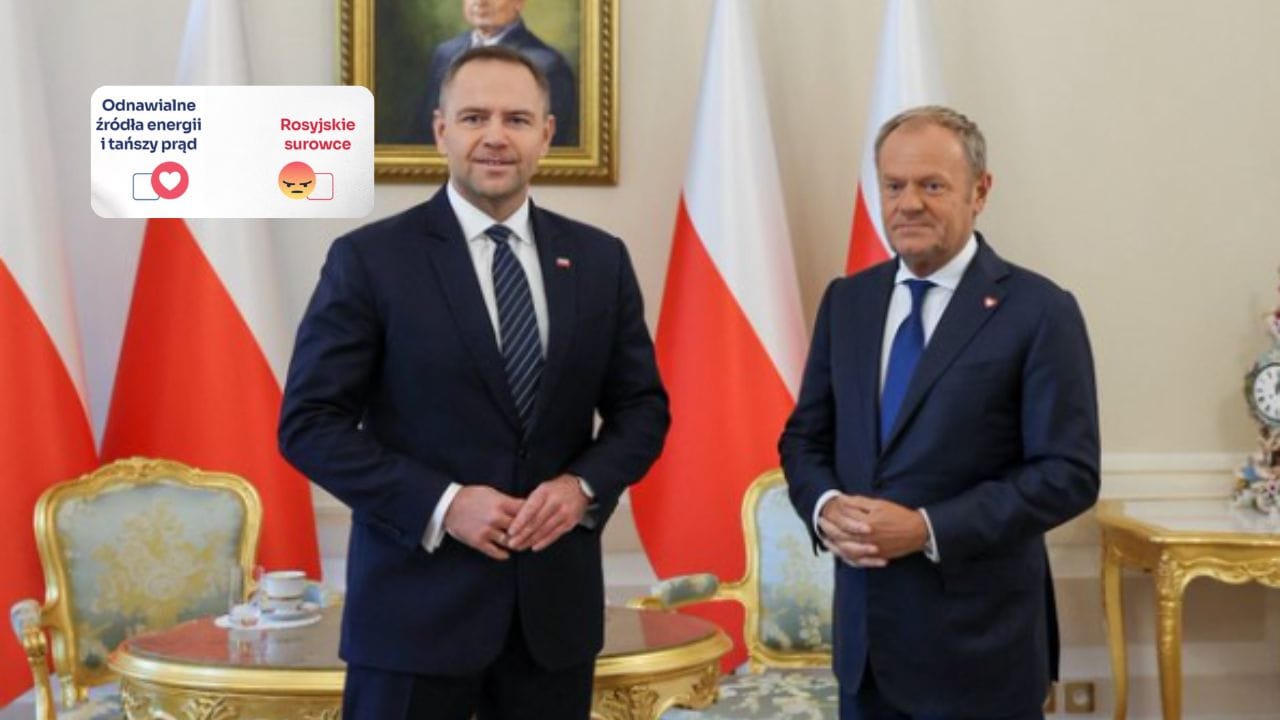
Poland’s energy transition is back at the centre of the debate. Civic Platform puts a sharp question to voters.
The choice between green energy and traditional fuels is once again dividing Poles. Civic Platform (PO) is provoking with a question that leaves no one indifferent.
Civic Platform
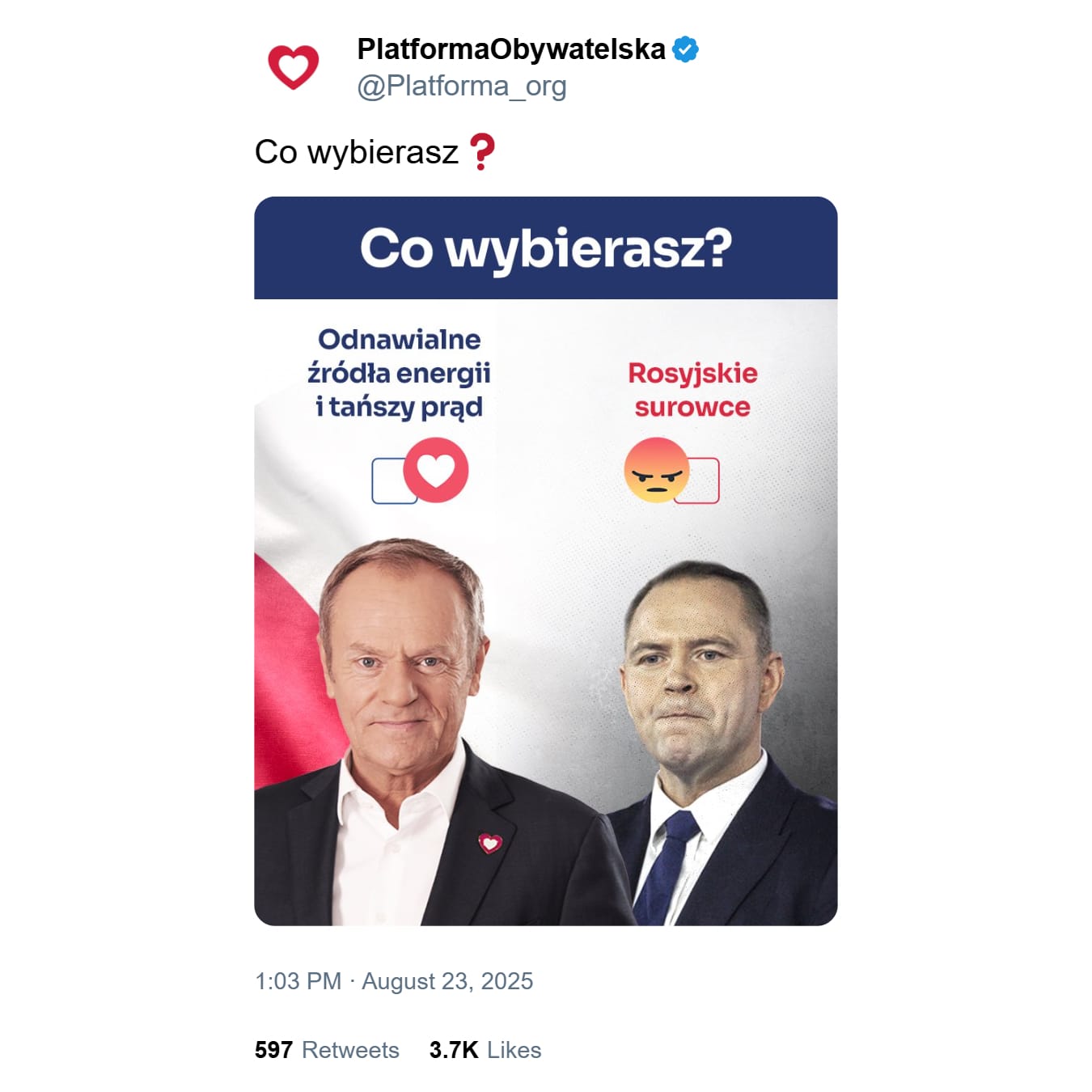
PO published a graphic on social media with a clear message – “renewable energy sources and cheaper electricity” (signed by Donald Tusk) versus “Russian raw materials” (featuring President Karol Nawrocki). It is a response to the president’s recent veto of the wind turbine act, which was meant to accelerate the development of wind energy in Poland.
What was the dispute about?
- President Karol Nawrocki vetoed a act meant to make it easier to develop wind turbines.
- Donald Tusk argues that the president’s veto means higher electricity prices today and in the future, because it blocks the development of renewables and cheap power.
- PO suggests that the alternative to developing green energy is a return to importing raw materials from Russia.
Renewables in the European context
In June 2025 renewable energy sources generated more electricity than coal for the first time – as much as 44.1% of electricity came from renewables, while the share of coal fell to 43.7%. Photovoltaics and wind turbines are growing the fastest:
- Installed renewable capacity at the end of June 2025: 35.7 GW (16.5% more than a year earlier).
- The largest share is photovoltaics – nearly 23 GW (64.4% of all renewables).
- In June alone, over 9 thousand new renewable installations were added, mainly solar panels.
Does Poland still use Russian raw materials?
Since 2024, Poland has practically stopped importing Russian gas and coal. Just a decade ago, in 2015, Russian gas accounted for more than half of imports; today that share is 0%. The main sources of raw materials are now Saudi Arabia, Norway and the USA.
- In 2024, the share of Russian raw materials in Poland’s energy mix stood at 0%.
- Coal and gas from Russia have been replaced by supplies from, among others, Norway and the domestic renewables sector.
- Poland nevertheless still pays heavily for fossil fuel imports: in 2024 this came to over 112 billion zlotys, but only a minimal part of that sum concerned final deliveries from Russia.
What does the presidential veto mean for electricity bills?
According to the government, halting the wind turbine act may mean higher energy prices – it blocks further expansion of renewables, which are today the cheapest source of new energy. On the other hand, opponents of PO point out that not all renewables can be built at the expense of energy security and system stability.




Komentarze