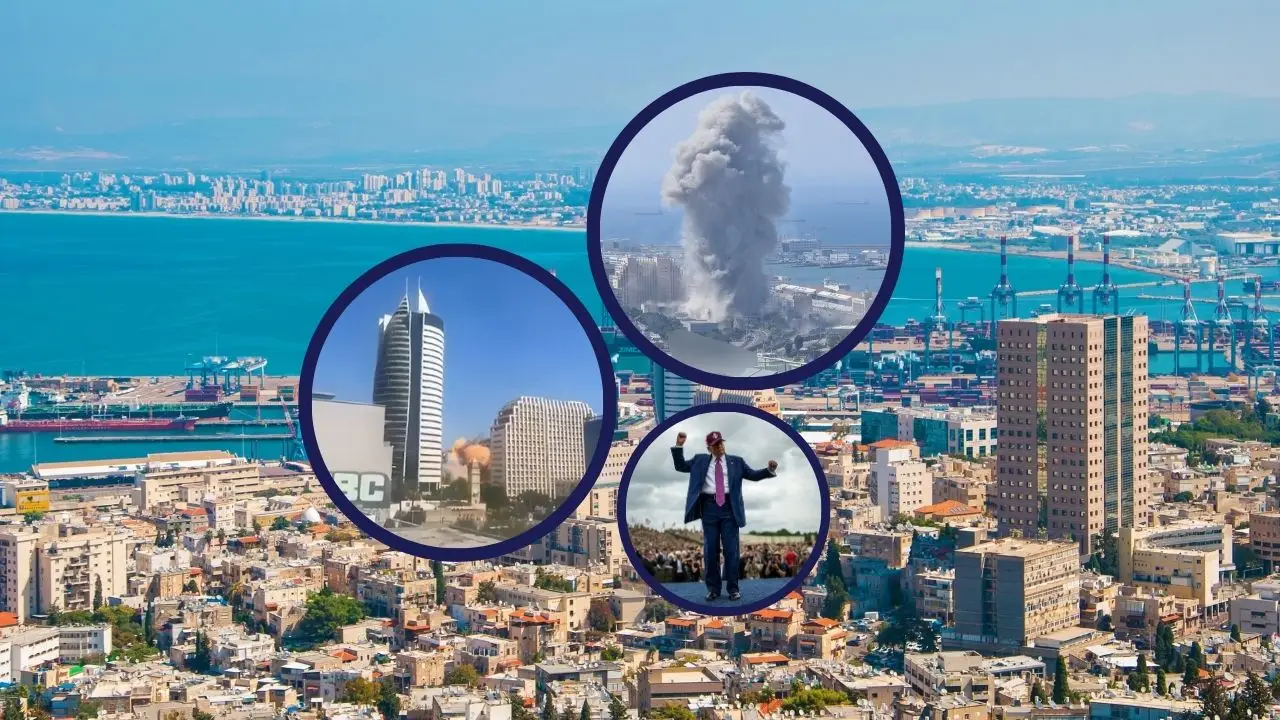
On Friday afternoon, explosions rang out over Haifa, a sign to its residents that the war is not letting up. Iran fired around 20 ballistic missiles toward Israel, some of which hit buildings in the very centre of the city. It is the largest salvo since the start of the week, coming after earlier attacks on Tel Aviv and Jerusalem.
At least 30 people were wounded in Haifa. Some of the injured were taken to the Rambam and Bnei Zion hospitals, where doctors are fighting for their health and lives.
Iron Dome Less and Less Effective
Israel’s air defence systems, led by the so-called Iron Dome, were for years a synonym for security. Now, however, even the most modern technologies no longer offer one hundred percent protection. According to the latest reports, around 65% of Iranian missiles were intercepted over the past day. That is a lot, but it is not enough for residents to sleep peacefully. Especially since some of the rockets that get through the system hit densely populated neighbourhoods, causing casualties and destruction.
Experts stress that the Iron Dome was designed mainly to counter short, slower projectiles, such as those used by Hamas or Hezbollah. Against Iranian ballistic missiles, which are faster and harder to intercept, the system performs worse. As a result, every new attack from Iran is not only a test for Israel’s defenders but also a sign that the conflict could spiral out of control.
Videos from the Attack on Haifa
Trump Still Not Joining the War
As missiles fall on Haifa, Washington remains unsettlingly silent. President Donald Trump, who just a month ago threatened Iran with consequences, now says he will not decide on US involvement in the war for at least two weeks. The White House explains this by the need for negotiations, but in practice it means Israel is left alone to face Iranian pressure.
Trump, although he had earlier supported Israel and moved military assets to the region, now does not want to risk escalation. His hesitation is visible among allies. France, Germany and the United Kingdom are trying to develop a joint diplomatic proposal that would halt the spiral of violence. For now, however, talks are not producing a breakthrough.
What Next for Haifa and the Iron Dome?
The attack on Haifa is further proof that the war between Israel and Iran is no longer just an occasional exchange of blows, but a creeping conflict that is hitting civilians. The Iron Dome, while still effective, is no longer impenetrable.
Residents of Haifa and other Israeli cities must reckon with the possibility that further missiles may hit their homes.
In this situation, Israel cannot count on quick support from the US. Trump, although he describes himself as a „”peace broker”, has still not decided whether he will join the war. Meanwhile, the evacuation of the wounded is under way in Haifa, and doctors are working under time pressure. This is no longer just a war of politicians and generals – it is a war that affects ordinary people.