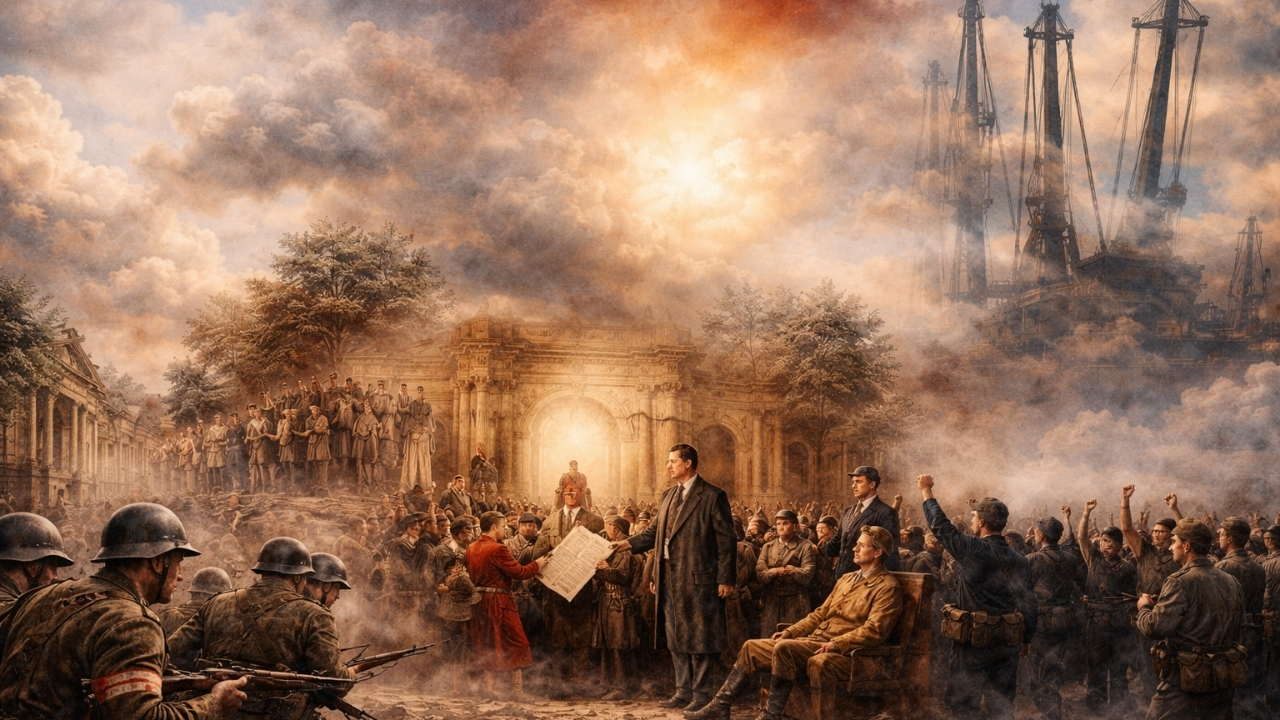
Did you know that one day a year can accommodate both the opening of one of the world's most famous monuments and the birth of a Baroque music genius, and also groundbreaking political decisions that changed the course of history? This is what March 31st looks like when we look at what happened that day in history over the centuries. If you think it's just an average calendar date — This article will quickly change your mind. See what is hidden in this fascinating historical calendar and discover how many significant moments have occurred on that very day.
What happened on March 31? Major events in history
1241 – Mongols smoke Kraków
On that day the retreating Mongol troops did something that had long written into the collective memory of Poles — completely burned Kraków. Only the brick church of Saint Andrew and Wawel survived from all over the city. About 3,000 people died in the fire and during the invasion itself. This day in history reminds us of how fragile civilization can be to a wave of barbarian raids. — And how stone walls can survive where wood turns to ash.
1596 — The Birth of Descartes
"I think so I am" — This sentence is known by almost anyone who has ever encountered philosophy. His author, René Descartes, known as Descartes, was born on March 31, 1596. The French mathematician and philosopher revolutionized the way Europe thinks about knowing, understanding and the nature of reality. Without his work, it is hard to imagine modern science and philosophy — Therefore, this day in history deserves a special place in every historical calendar.
1685 – Birthday of John Sebastian Bach
It is difficult to have a more symbolic coincidence: on one day, March 31, 1685, a man was born, whose music for over three centuries continues to amaze. Johann Sebastian Bach, born in Eisenach, became one of the greatest composers in human history. His Preludes, Toccatas, Masses and Passions to this day are performed in concert halls around the world. Bach's music became one of the symbols attached to the gold disc launched into space by Voyager probes. — as if humanity wanted to say to alien civilizations: listen, this is what we can be.
1889 – Eiffel Tower Opening in Paris
Today it is difficult to imagine Paris without it, but when the Eiffel Tower was officially opened to visitors on March 31, 1889, many people considered it an aesthetic disaster. The iron construction designed by Gustave Eiffel for the World Exhibition was then the highest structure in the world. Critics called it "metal asparagus" and demanded its demolition. The story, however, showed that those who saw her as a genius in engineering were right. — Today, the Eiffel Tower is one of the most visited monuments in the world. This is one of those events that makes what happened that day a real worthy question.
1909 – The beginning of Titanic construction
On March 31, 1909, construction of a ship was officially started at the Belfast shipyard, which was to become a symbol of human pride and the inevitability of the disaster. RMS Titanic, built over two years, embarked on his maiden voyage in April 1912 — And he never got to his destination. Over a thousand 500 people died. Today, the history of Titanic construction is a reminder that no technology is resistant to the forces of nature, and the word "unsinkable" should never be spoken too confidently.
1931 – EMI label uprising
The same day the earthquake struck the capital of Nicaragua, on the other side of the globe something happened that changed the face of world music for a long time. On March 31, 1931, a British EMI record label was founded, which became one of the most powerful music companies in the world for decades to come. It was EMI who signed the Beatles, discovered Pink Floyd, and released hundreds of albums that entered the canon of popular culture forever. One of those events that is rarely remembered and that has changed the daily lives of millions of people.
1959 – The Dalai Lama escapes Tibet
On March 31, 1959, the fourteenth Dalai Lama Tenzin Gjaco crossed the Indian border, fleeing Tibet from the Chinese army. India granted him political asylum, and he himself settled in Dharamsala, where he remains today. Since then, the Dalai Lama has become not only a spiritual leader of Tibetan Buddhists, but also one of the most recognizable voices in the defence of human rights in the world. This historical calendar often records dates after which nothing is the same anymore — March 31, 1959 is just such a date.
1991 – Dissolution of military structures of the Warsaw Pact
As the cold war came to an end, the symbols of the old order disappeared one by one. On March 31, 1991, the military structures of the Warsaw Pact were dissolved. — an alliance that for more than thirty-five years defined the geopolitical division of Europe. On the same day, a referendum was held in Georgia, in which citizens advocated independence. In Yugoslavia, Serbian forces occupied the directorate building of Plitvice Lakes National Park — The beginning of a bloody conflict between Croatia and Serbia. One day, three tectonic shocks in post-Soviet space.
1998 – Poland launches accession negotiations with the European Union
Today, when Poland has been a full member of the European Union for over twenty years, it is worth remembering that the path to this membership had a concrete beginning. On 31 March 1998 Poland officially launched accession negotiations with the European Union. It was one of the most important moments in the postwar history of our country — The step that opened the way for accession in 2004 and permanently tied Poland's fate with the European integration project. This day in history deserves to be reminded whenever we talk about who we are as a nation in Europe.
1999 – Matrix Premiere
It's hard to think about the end of the 1990s without this production. On March 31, 1999, Matrix film directed by Larry and Andy Wachowski entered cinema screens. The painting didn't just raise the movie money and win four Oscars — He also changed the language we talk about reality, technology and identity. Concepts such as "red pill" or "Matrix" have become part of the culture of popular and philosophical discourse on the nature of reality. It's rare for an entertainment film to so deeply penetrate a collective consciousness.
Born March 31
René Descartes — Descartes (1596) – French mathematician and philosopher, creator of modern rationalism, author of the famous cogito ergo sum, without which it is difficult to imagine the history of Western thought.
Johann Sebastian Bach (1685) – German composer and organist of the Baroque era, recognized as one of the greatest musical creators in human history, author of Passion according to Saint Matthew and Mass h minor.
Joseph Haydn (1732) – Austrian composer, father of symphony and string quartet, one of the pillars of classical music, mentor of young Mozart and teacher of Beethoven.
Al Gore (1948) – American politician, Vice President of the United States from 1993 to 2001, Nobel Peace Prize winner for climate protection activities and the popularization of knowledge of climate change.
Ewan McGregor (1971) – British actor, known among others for his role as Obi-Wan Kenobi in the Star Wars series and for his iconic Trainspotting, one of the most versatile artists of his generation.
Angus Young (1955) – Australian guitarist of Scottish origin, co-founder and inherent visual icon of the AC/DC band, known for its distinctive school uniform and unmatched guitar riffing.
Christopher Walken (1943) – American film and theatre actor, Oscar winner, known for his original diction and creation in films such as Deer Hunter, Pulp Fiction or Batman: Return.
World events
1814 – The capture of Paris by the 6th Coalition troops – After years of Napoleonic wars, Allied forces entered the capital of France, which sealed Napoleon's fall and opened the way to his first abdication.
1854 – Treaty of Kanagawa "Japan and the United States signed a groundbreaking agreement that ended Japanese isolation and opened ports of Shimoda and Hakodate for American merchant ships.
1931 – Establishment of EMI – An EMI record label was established in the UK, which shaped the face of world popular music for decades to come.
1943 – Oklahoma musical premiere! – The New York Broadway premiered one of the most important musicals in American theatre history, with Richard Rodgers' music and Oscar Hammerstein II librett.
1974 – The British Airways Uprising – British Airways Corporation and British European Airways formed British Airways, today one of the largest airlines in the world.
The story, as it turns out, does not know the day off. March 31st is the date at which the historical calendar breaks in the seams — from the Mongolian fire of Krakow, through the birth of Bach and Descartes, to the opening of the Eiffel Tower and the launch of the Matrix. Each year adds to this date subsequent events, and we can only wonder what happened that day and what we do not yet know. Look tomorrow — Because on April 1, there are equally surprising surprises.