Did you know that May 7 is one of those days where history seems to speak in full voice — from the Nazi German surrender to the birth of Sony, from Joanna d’Arc's triumph to the tragedy in the Atlantic? If you've ever wondered what happened that day in history, you've just had the opportunity to discover some absolutely groundbreaking moments that have shaped the world we live in. This day in history turns out to be extremely rich — And it's worth a moment of attention.
What happened on May 7th? Major events in history
1429 – Joanna d’ Arc breaks the siege of Orleans
On that day, French troops led by eighteen-year-old Joanna d’Arc forced the English to break the siege of Orleans, which had been going on for over six months. It was one of the landmark moments of the Hundred Years' War. — The city was considered the key to all of France, and its defence became a symbol of the resistance and determination of the nation. Joanna's victory breathed a new life in the morale of the French and accelerated the coronation of Charles VII. To this day, this battle remains one of the most inspiring episodes of medieval history of Europe.
1794 – Kościuszko issues the Połaniecki University
Tadeusz Kościuszko, the head of the National Insurrection, issued on May 7, 1794, one of the most important documents in the history of pre-selection Poland. The Polanite universe abolished the personal submission of peasants, prohibited them from ruging off the ground, and reduced the size of the serfdom. It was a revolutionary act for Polish social relations at the time — Although he never fully entered into force due to the defeat of the uprising, he set the way of thinking about freedom and equality. It is this day in the history of Poland that can be considered as one of the first steps towards the emancipation of the Polish peasant.
1824 – Beethoven's 9th Symphony premiere in Vienna
On May 7, 1824, the Vienna audience first heard Ludwig van Beethoven's 9th Symphony — The work the composer created when he was already completely deaf. The final Oda to Joy, based on Friedrich Schiller's text, became one of the most recognizable musical works in human history. What is worth highlighting, Beethoven reportedly did not hear the audience cheering and had to be turned face to face the audience to see the applause. Today, Oda to Joy is the anthem of the European Union, and that Prime Minister belongs to the canon of dates which each historical calendar should take into account.
1867 – Alfred Nobel patents dynamite
On that day in 1867, Swedish inventor Alfred Nobel received a patent on dynamite in the UK — The invention that revolutionized mining, construction and unfortunately military. Nobel developed it a year earlier, stabilizing dangerous nitroglycerin using diatom earth. The irony of fate is that a man who has become rich in an invention for destruction has allocated his wealth to the establishment of the Nobel Prize. — The most prestigious award in the world. This is a fascinating example of how one day and one patent can change the course of civilization.
1915 – The sinking of Lusitania
On May 7, 1915, a German submarine U-20 torpedoed the Atlantic British transatlantic "Lusitania". In the crash, 1198 of 1962 people were killed on board, including 128 American citizens. This tragedy provoked great outrage in the United States and became one of the key factors that prompted Washington to join World War I in 1917. This day in history recalls how dramatically one event can outweigh the scales of great politics.
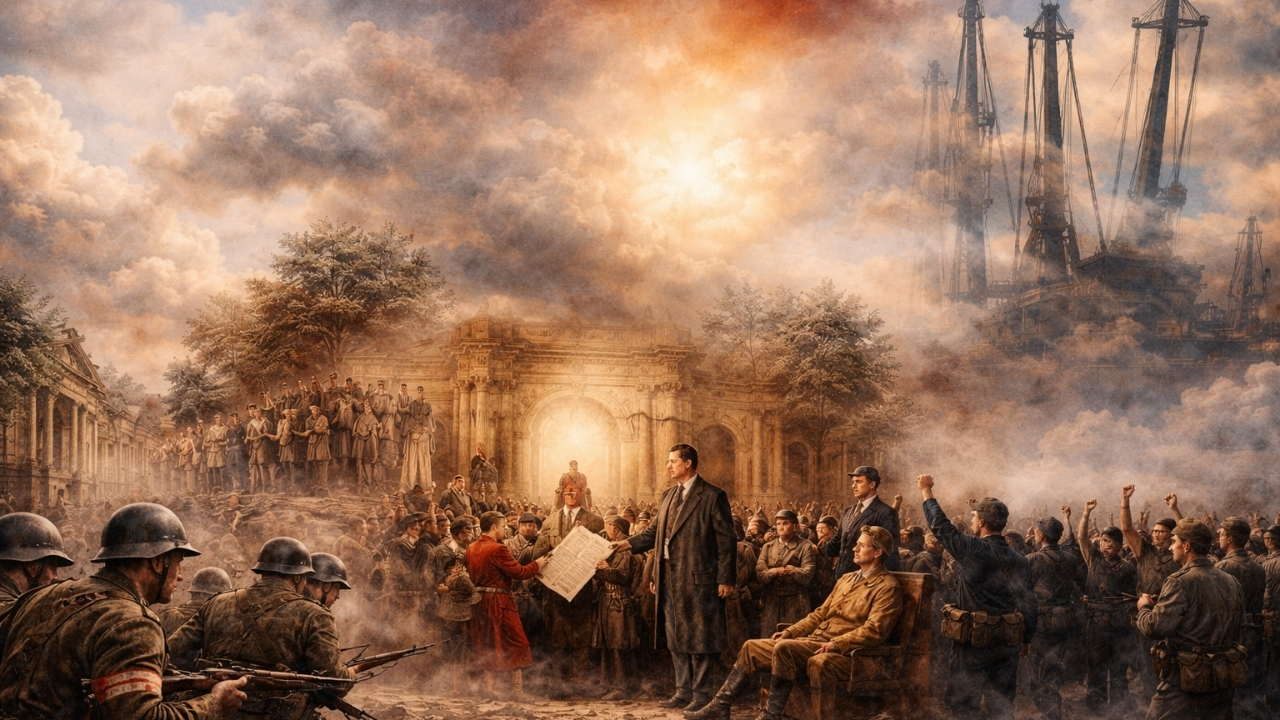
1945 – Unconditional German surrender
In the French Reims, at 2:41 a.m., German generals Alfred Jodl and Hans-Georg von Friedeburg signed an act of unconditional surrender of the Third Reich. The document ended six years of the bloodiest war in human history on the European front. At Stalin's request, the ceremony was repeated a day later in Berlin — hence the difference between Western Victory Day (8 May) and Russian (9 May). This is one of those moments that can be said without a shadow of exaggeration: the world after May 7, 1945 was never the same.
1946 – Sony's Birth
Just a year after the war ended, on May 7, 1946, two Japanese engineers — Masaru Ibuka and Akio Morita — They started a small technology company in destroyed Tokyo. Initially named Tokyo Tsushin Kogyo, the company employed only a few dozen employees and was located in makeshift rooms. Today we know her as a global Sony company, responsible for the Walkman, PlayStation and dozens of other products that have defined the popular culture of recent decades. A better example is that great things are born from small beginnings, I don't think there is.
1997 – Intel presents Pentium II
On that day in 1997, Intel presented the Pentium II processor — a calculation unit that pushed personal computers to a whole new level of performance. Pentium II went to millions of homes and offices, becoming the heart of computers in the late 1990s. It was an era when PC became a daily tool for work and entertainment, and the Internet began to change the way people communicate and get information. Interestingly, the same day in history, in 1946, Sony was formed — It's like May 7th has a particular taste for technological breakthroughs.
1765 – Establishment of the Order of Saint Stanislaus
King Stanislaus August Poniatowski established the Order of St. Stanislaus on May 7, 1765 — one of the most important Polish state awards awarded for civil and military service. The Order survived the partitions, the revival of independence and was broadcast for centuries as a symbol of recognition from the Republic. It is worth remembering that on the same day of 1765 a famous HMS Victory sailing ship was launched in England, which stands today in the Portsmouth museum. Such dates coincide make the historical calendar a real treasure of surprises.
Born 7 May
Johannes Brahms (1833) – one of the most outstanding romantic composers, the author of four symphonics, piano concerts and the famous Kolysanka, recognized as the last great representative of classical music tradition.
Piotr Tchaikovsky (1840) – Russian composer, ballet designer Swan Lake, Nutcracker and Sleeping Beauty, as well as the 6th Pathetic Symphony, which belongs to the most frequently performed composers in the world.
Rabindranath Tagore (1861) – Indian poet, writer, philosopher and composer of Bengali origin, the first Asian awarded the Nobel Prize in Literature in 1913.
Władysław Reymont (1867) – Polish prosaik and novelist, Nobel Prize laureate of 1924, author of the monumental Thedralogy of the Peasant, showing the life of the Polish village at the turn of the 19th and 20th centuries.
Józef Poniatowski (1763) – Polish prince and general, Minister of War of the Duchy of Warsaw, appointed Marshal of France by Napoleon himself, symbol of honor and dedication — He died three days after receiving the bush, surviving only fifty years.
World events
1189 – Hamburg receives the status of Free City of the Reich – Emperor Frederick I Barbarossa granted Hamburg commercial and free-urban privileges, which started its development as one of Europe's largest ports.
1718 – Establishment of New Orleans – French settlers founded a city in Louisiana, which became one of the most important cultural and music centers in North America, today famous for jazz and Mardi Gras.
1840 – Tornado over Natchez – a deadly air trumpet passed over the town of Natchez, Mississippi, killing 317 people and enrolling as one of the largest natural disasters in the history of the southern U.S. states.
1895 – Aleksander Popow demonstrates radio – The Russian physicist presented a working radio receiver of his own design in St. Petersburg, which is celebrated in Russia today as Radio Day on 7 May.
2000 – Vladimir Putin becomes President of Russia – former KGB officer took the presidential oath, starting an era that will define Russia's policy and relations with the West for the following decades.
May 7 is a day that for centuries has constantly provided history of reasons to remember — From battlefields and concert halls, through laboratories of inventors, to the cabinets of politicians. Looking over what happened that day in history, it's hard to resist the impression that no day of the year is ordinary when you look deep enough into the past. Look here tomorrow — On May 8, she hides equally unexpected surprises.