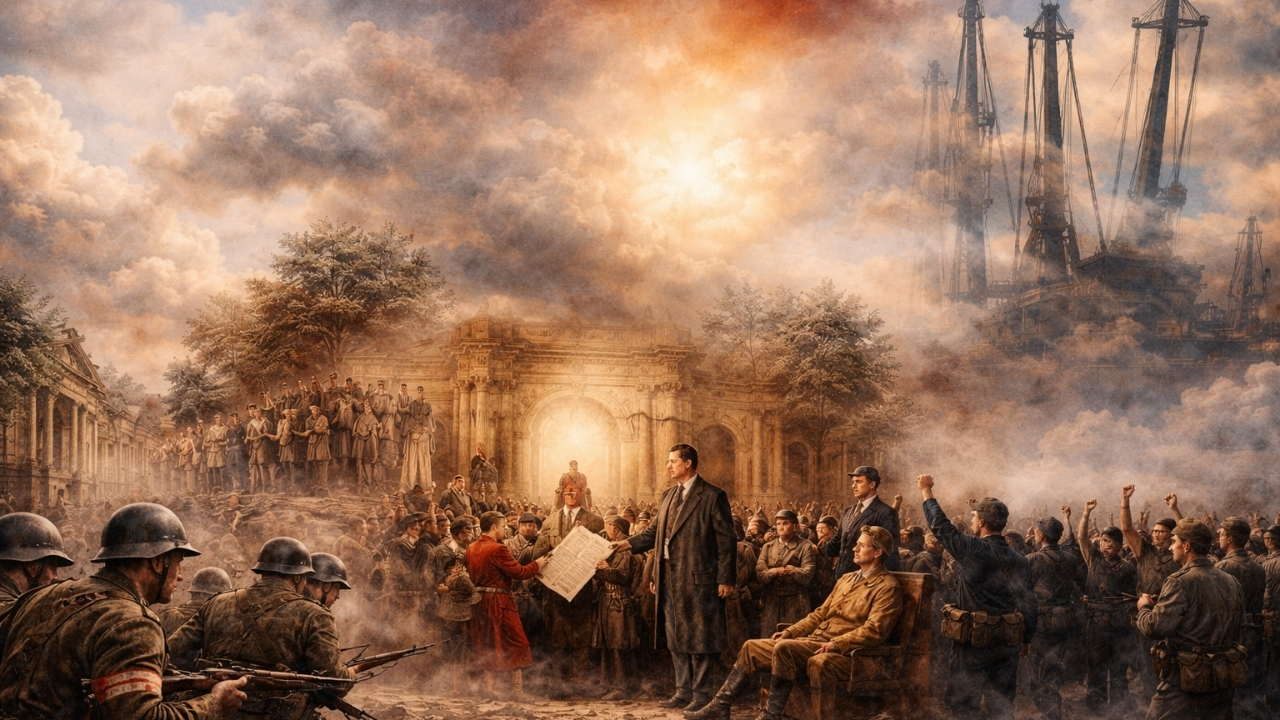
Did you know that May 11 is one of those days that changed the course of entire civilizations — From the birth of the empire, through the assassinations of prime ministers, to pioneering flights over the pole? If you want to know what happened that day in history and see how many groundbreaking moments have accumulated at this date, this article is for you. Prepare to travel for centuries — from Constantinople, via Napoleonic Sweden, to the 21st century Internet.
What happened on May 11th? Major events in history
330 – The inauguration of Constantinople as the new capital of the Roman Empire
On that day, Emperor Constantine the Great officially declared Constantinople the new capital of the Roman Empire, replacing Rome in this role. The city, erected on the site of the Greek Byzantium, above the Strait of Bosfor, was to become the center of power for over a thousand years — until the fall in 1453. It was one of the most important decisions of political antiquity, which for centuries shaped the cultural and religious map of Europe and the Middle East. It's hard to overestimate the impact of that one day on the fate of Western civilization. — This is where the Byzantine Empire, the guardian of the ancient heritage, flourished.
1573 – First free election in Poland: Henry valezy king
In the village of Stone near Warsaw, the first free election was held in Poland, in which the nobles gave the floor — directly, not by Members. Henry Walez, a French prince, was chosen, but only a year later he secretly fled the country to take the throne of France after his brother died. This day in history has been recorded as the birth of a unique system of the system that no other European monarchy has ever known. — a noble democracy, with all its virtues and weaknesses.
1812 – The assassination of UK Prime Minister Spencer Perceval
Spencer Perceval passed into history as the sole Prime Minister of Great Britain murdered in the course of office. He was shot by merchant John Bellingham in the lobby of the House of Commons, motivated by personal grievances towards the government — Bellingham felt hurt by the British authorities during his stay in Russia. The attack has shaken the whole country and to this day remains a unique episode in the history of British democracy. What happened that day changed the thought of protecting the highest government officials for a long time.
1860 – Garibaldi lands in Sicily
Giuseppe Garibaldi with over a thousand volunteers — The famous Thousand Expedition — He landed in Sicily, starting one of the most romantic military campaigns of the 19th century. The goal was to overthrow the Bourbon rule and unite Italy under the Sabaudian scepter. Within a few months, Garibaldi conquered the entire south of the peninsula, giving it to King Victor Emanuel II. This event opened the last act of Risorgimento and modern Italy was born.
1926 – Launch of the "Norge" airship to the North Pole
On that day, a "Norge" with Roald Amundsen and Umberto Nobile on board embarked from Ny-Ålesund on Spitsbergen. This was the first ever confirmed expedition to reach the North Pole — And the first to fly over it in a documentary way. Amundsen, a conqueror of the South Pole, thus being the first man to stand symbolically on both ends of the Earth. The historical calendar is full of great discoveries, but it was really the last white field on the planet map.
1960 – Mossad kidnaps Adolf Eichmann in Argentina
Israeli intelligence agents captured Adolf Eichmann in Buenos Aires — one of the main architects of the Holocaust and responsible for the logistics of the extermination of millions of Jews. Eichmann lived for years under a false name in Argentina, avoiding justice. He was secretly taken to Israel, faced trial in Jerusalem and was executed in 1962. His trial was the first in history broadcast live by television and contributed to spreading knowledge of Nazi crimes worldwide.
1981 – "Cats" musical premiere by Andrew Lloyd Webber
The London West End premiered one of the most recognizable musicals in theatre history. "Cats" based on T.S. Eliot's poems revolutionized musical theatre — The show was played continuously for 21 years in London and 18 years on Broadway, beating season length records. This day in musical entertainment history opened a new era of megamusicals that dominated world scenes for decades to come.
1997 – Kasparov loses to Deep Blue computer
Russian chess player Garri Kasparov, considered the best player of all time, lost a historic match to the IBM Deep Blue supercomputer. It was a moment that changed the perception of the limits of the human mind and the capabilities of machines. — For the first time the computer defeated in a regular match of the world's reigning champion. This event has become a symbol of the coming era of artificial intelligence, and to this day it is recalled in every discussion about the rivalry of man with machine.
2019 – Release of the "Just Don't Tell anyone" document on YouTube
The documentary by Tomasz Sekielski, devoted to pedophilia in the Polish Catholic Church, debuted on YouTube and in a few days collected several million views. The premiere sparked a nationwide public debate, a wave of comments and reactions of the church hierarchy. This is one of those events from the latest history of Poland, which has changed the conversation to subjects that have been silenced so far — and recalled how much independent investigative journalism can do.
Born 11 May
Salvador Dalí (1904) – Catalan Surrealist painter, author of "Storms of Memory" and one of the most recognizable artists of the 20th century.
Richard Feynman (1918) – American theoretical physicist, Nobel Prize laureate, pioneer of quantum electrodynamics and outstanding science popularizer.
Irving Berlin (1888) – American composer of Jewish origin, author of over 1500 songs, including "White Christmas" — One of the best-selling songs in history.
Andrés Iniesta (1984) – Spanish footballer, 2010 World Champion and author of the historic final goal, one of the most elegant helpers in football history.
Martha Graham (1894) – American dancer and choreographer, pioneer of modern dance, who revolutionized the way of thinking about movement and artistic expression.
World events
1858 – Minnesota joins US – Minnesota as the 32nd state joined the United States of America Union.
1949 – Israel member of the UN "Just a year after the declaration of independence, Israel was admitted to the United Nations, receiving full international recognition.
1949 – Siam renamed Thailand "The official change in the name of the country marked a break with the colonial past and emphasized the national identity of the inhabitants.
1985 – A tragic stadium fire in Bradford – 56 people died in the fire of the wooden stands of the football stadium in Bradford, England, and more than 300 were injured, which forever changed safety standards on sports facilities in Europe.
2010 – David Cameron Prime Minister of Great Britain – The leader of the Conservative Party took the office of Prime Minister, creating the first government coalition in Britain in decades — With Liberal Democrats.
Looking at this historical calendar, it is hard not to feel respect for the magnitude of events that took place on 11 May — from the foundation of empires, through crime and justice, to the triumphs of art and science. This day in history proves that each date hides unexpected depths. Look tomorrow — history is busy for a moment.