Did you know that one of the most groundbreaking days in 20th century Europe, the end of World War II, just happened on May 8th? If you've ever wondered what happened that day in history and how many unusual events have intertwined in this one date over the centuries, you're about to find out. From the birth of the Red Cross to the publication of the first issue of "Gazeta Wyborcza" — The historical calendar of May 8 contains a surprisingly rich mosaic of moments that shaped our world.
What happened on May 8th? Major events in history
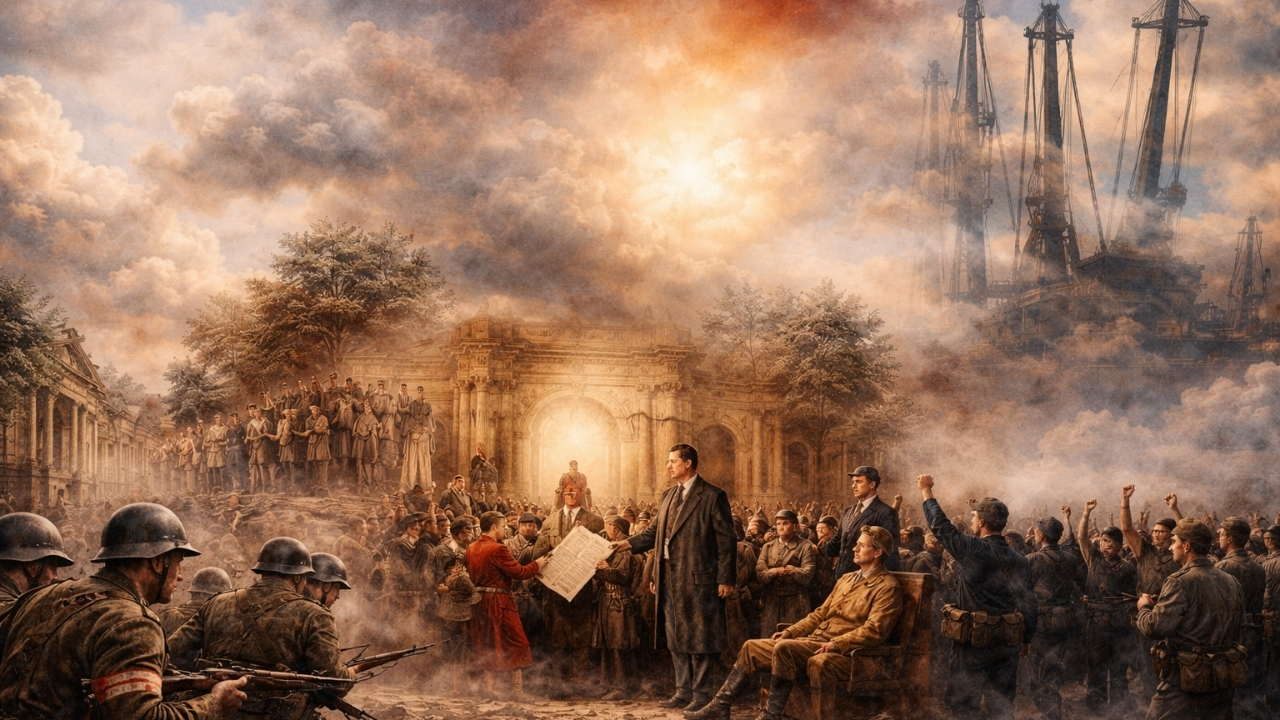
1945 – Unconditional German surrender and the end of World War II in Europe
It was on 8 May 1945 that the German command signed an unconditional surrender to the Western Allied and USSR. — The Soviet Union dates this moment on 9 May according to Moscow time, therefore in many post-Soviet countries the Day of Victory is celebrated 24 hours later. U.S. President Harry Truman informed his compatriots of this fact in a radio speech. This day in history is a symbol of the ending of the bloodiest armed conflict in human history, which consumed tens of millions of victims.
1886 – The birth of Coca-Cola
On that day in 1886, a pharmacist from Atlanta, John S. Pemberton, developed a formula for a refreshing drink, which he called Coca-Cola. Today, it is hard to believe that one of the most popular drinks in the world was created in a mere pharmacy in Georgia. It was originally sold as a syrup with medicinal properties, and only a few decades later it set off on global conquests. This is one of those cases where that day in history decided to face pop culture and business for the following centuries.
1943 – The fall of Bunker Anielewicz and the tragic end of the Warsaw Ghetto Uprising
On May 8, 1943, the Germans detected and surrounded the key shelter of the Jewish Combat Organization at 18. — The so-called Bunker Anielewicza. The leader of the uprising Mordecai Anielewicz and a group of several dozen militants chose collective suicide instead of surrendering to the oppressors. On the same day, the Germans murdered the hidden civilians at Świętjańska Street, including poet Władysław Szlengel and his wife. This day in history is one of the most tragic moments of the Holocaust, a symbol of desperate resistance and relentless dignity.
1933 – Stanisław Skarżyński completes his flight through the Atlantic
On that day in 1933 pilot Stanisław Skarżyński completed his pioneering flight through the Atlantic with a Polish aircraft RWD-5bis. It was an almost unimaginable feat for the technical possibilities of the time. — Skarżyński defeated the Atlantic Ocean on a small tourist plane, setting a world record in flights over the Atlantic for small machines. His feat was a reason for Poles of the time for great national pride, and the pilot himself became a popular hero throughout Europe.
1989 – First edition of "Gazeta Wyborcza"
Only a few weeks before the historic June elections, the first issue of "Gazeta Wyborcza" was released on May 8, 1989. The letter founded by the solidarity community with Adam Michnik at the head became a symbol of regained freedom of speech in Poland. It is difficult to overestimate its importance for the Polish systemic transformation — In a few months, it became the most widely read journal in the country. What happened that day had a lasting impact on the shape of Polish media for decades.
1947 – Arrest of Captain Witold Pilecki
On May 8, 1947, officers of the Ministry of Public Security arrested Captain Witold Pilecki — a man who voluntarily was imprisoned in Auschwitz to organize the resistance from there and to inform the world about Nazi crimes. After the war, he returned to the country and worked for immigration intelligence, which became an excuse for his capture by the communist authorities. Less than a year later, in May 1948, Pilecki was murdered by a gunshot to the back of the head. His story is one of the most shocking examples of how this day in history intertwins heroism with tragedy.
1953 – Letter of Polish bishops "Non possumus"
On May 8, 1953, Polish bishops addressed a historical letter to the government of the Polish People's Republic, which went into history under the Latin title "Non possumus", or "We Can't". This was a courageous opposition to the hierarchy of the Catholic Church to attempts to subdue it to the communist state, interference by the authorities in filling church posts and breaking religious freedom. The document became one of the symbols of the Church's resistance to totalitarianism and was of great importance for maintaining the national identity of Poles during the most difficult period of Stalinism.
1980 – A world officially free from real smallpox
That day in 1980, the World Health Organization announced the complete eradication of smallpox — One of the most deadly diseases in human history. Smallpox killed an estimated 300 million people in the 20th century, and thanks to the global vaccination campaign it was eliminated completely. To this day, it is the only human infectious disease that has been fully overcome by medicine. This historical calendar May 8 could be proud of this one entry — The triumph of science over death on an unprecedented scale.
1971 – Opening of a Podek in Katowice
On May 8, 1971, the official opening ceremony of the Spodek Hall in Katowice was held. — one of the most recognizable architectural objects of PRL. The building with the characteristic shape of the flying saucer quickly became a symbol of Silesia and a place of iconic concerts, sports events and performances. To this day, Spodek is one of the most recognizable spectacle arenas in Poland, and her futuristic lump is still impressive.
Born 8 May
Henri Dunant (1828) – Swiss philanthropist and pacifist, co-founder of the Red Cross, winner of the first ever Nobel Peace Prize, born exactly 8 May.
Harry S. Truman (1884) – 33rd President of the United States, who made the decision, among others, to drop atomic bombs on Japan and announced the end of World War II in Europe.
Friedrich August von Hayek (1899) – Austrian economist and political philosopher, one of the most important thinkers of economic liberalism of the 20th century, winner of the Alfred Nobel Prize of the Bank of Sweden in Economics.
David Attenborough (1926) – British naturalist, writer and narrator, author of dozens of groundbreaking documents about nature, one of the most recognizable figures in the history of popular science television.
Enrique Iglesias (1975) – Spanish singer, one of the most popular artists in Latin music history, son of legendary Julio Iglesias.
World events
1541 – Discovery of the Mississippi by Hernando de Soto – The Spanish expedition of Conquistador Hernando de Soto reached the Mississippi River that day, opening the way for Europeans to the interior of the North American continent.
1794 – Lavoisiera shear guillotine – Antoine Lavoisier, father of modern chemistry and creator of mass conservation law, was guillotined during the French Revolution, despite being one of the greatest scientists of the era.
1902 – The disastrous eruption of Montagne Pelée – A volcano on Caribbean Martinique destroyed the city of Saint-Pierre, killing about 30,000 people in minutes, making this eruption one of the most deadly in modern history.
1978 – Everest without oxygen for the first time – Italy Reinhold Messner and Austrian Peter Habeler were the first ever to capture Mount Everest without using oxygen cameras, proving that the human body can survive at the highest height of the world without artificial aid.
2025 – New Pope Leon XIV – American Cardinal Robert Provost was elected 267. pope of the Catholic Church and assumed the name Leon XIV, becoming the first American on the Peter's throne.
May 8 is a date that proves how unusual what happened that day in history over the centuries — from victories and tragedy, through inventions changing the face of civilization, to the birth of people who changed the fate of millions. This historical calendar reminds us that each day contains dozens of stories worth knowing. Look tomorrow — May 9 has equally fascinating stories to tell.