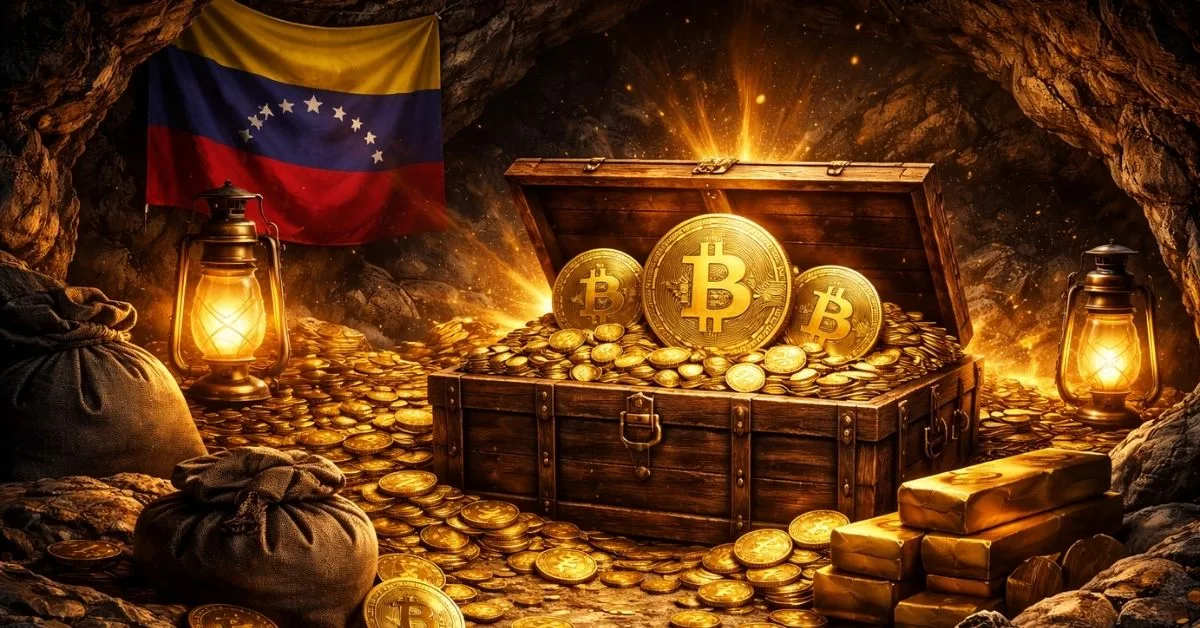
Venezuela, a country struggling under severe international sanctions, may hold huge reserves of Bitcoin and other cryptocurrencies, which serve as an alternative to traditional assets such as gold or dollars. According to reports, these holdings could be worth as much as 60 billion dollars, although official estimates are much lower. The discovery is controversial, especially after the recent change of power, when Nicolás Maduro was ousted last weekend.
The Project Brazen report suggests that Venezuela is hiding as many as 600,000 Bitcoins, which at current prices amounts to about 60 billion dollars. Meanwhile, data from Bitcointreasuries.net points to a more modest 240 BTC, worth just 22 million dollars, which places Venezuela ninth among governments holding Bitcoin. The differences in estimates stem from the nature of Bitcoin itself: its decentralization and privacy make it difficult to identify owners. Experts suspect the assets are spread across thousands of wallets controlled by Maduro’s allies, generals and party members.
How did Venezuela build these reserves? Mainly through unconventional methods, bypassing sanctions imposed by the US and its allies. A key role was played by the confiscation of equipment and cryptocurrencies from miners: in 2017, many of them were arrested, and in 2024, mining was completely banned. Bitcoin was also used for international trade and for storing wealth. The country experimented with its own cryptocurrency, Petro, launched in 2018 as a token backed by oil, but the project ended in failure and was shut down in 2024. PDVSA, the state oil company, may have been involved in these operations, although the details remain unclear.
Controversies abound, and the lack of transparency makes the data hard to verify. On-chain analysis does not provide clear answers, and sources such as Project Brazen rely on anonymous information. Historically, Venezuela has moved assets, such as gold, on private planes, which suggests similar tactics may have been used for crypto. Since Maduro’s ouster, the risk of instability has grown: the new authorities could sell these assets, which in the short term could push the price of Bitcoin down.
Experts stress that Venezuela has likely accumulated significant amounts of crypto, seeing Bitcoin as a neutral tool beyond the influence of the US. Possible scenarios include confiscation by the United States, which could strengthen the American strategic Bitcoin reserve. According to experts, this would be bullish for the market in the long term.
This case shows how cryptocurrencies are becoming a geopolitical tool. Will Venezuela’s hidden treasure come to light? Market observers are waiting for the next moves, because the stakes are not only billions of dollars but also the future of Bitcoin in global politics.
Source: CNBC