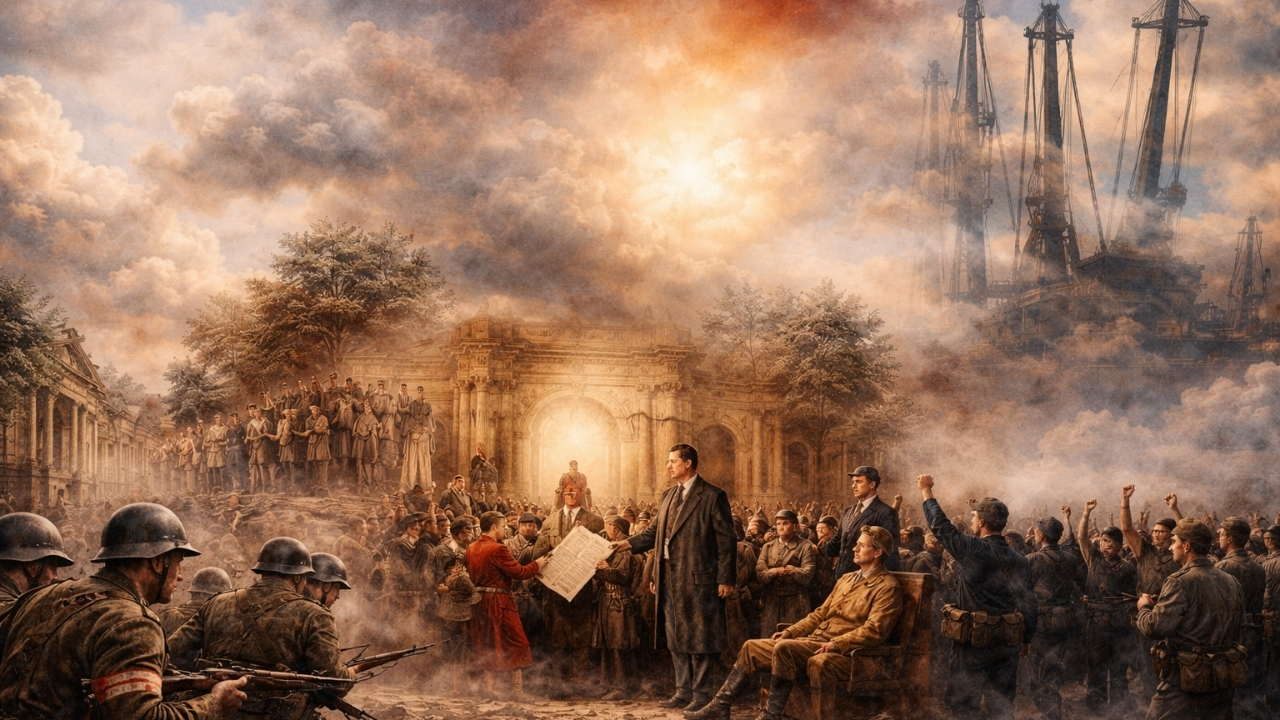
Do you know that one day in history can contain the birth of a pope, the capture of a mountain fortress, the invention of a nuclear bomb, and the tragic assassination of a school? May 18th is just such a day — extremely dense in events that changed the fate of nations and individuals. If you ever wondered what happened that day in history, this article is exactly for you. Prepare to travel for centuries.
What happened on May 18th? Major events in history
1498 – Vasco da Gama hits Kalikutu
One of the landmark moments in the history of world exploration. Portuguese sailor Vasco da Gama after a multi-month sea voyage reached the port of Kalikut on the west coast of India, thereby opening a direct maritime trade route between Europe and Asia. This discovery has shaken the dominance of Mediterranean trade routes and started a new era of European colonialism. This day in history is one of those moments after which the world never looked the same again.
1804 – Napoleon Bonaparte Emperor of the French
Just a few years after the revolution that overthrows the monarchy in the name of freedom, equality and brotherhood, France returned to the rule of the only ruler — Except this time in a very theatrical setting. On May 18, 1804, the First French Republic was abolished, and Napoleon Bonaparte was declared emperor of the French. It was one of the most ironic phrases in modern European political history. The coronation took place a few months later, in December 1804, and Napoleon himself — to the consternation of Pope Pius VII — He crowned himself.
1944 – 2nd Polish Corps wins Monte Cassino
This is one of the most important and touching moments in Polish war history. On May 18, 1944, soldiers of the 2nd Polish Corps under General Władysław Anders captured Monte Cassino hill in Italy, putting a white-red flag into the ruins of the monastery after many days of bloody fighting. It was a breakthrough throughout the Italian campaign — The Allies could finally move to Rome. The battle cost nearly a thousand Polish soldiers, and the dedication of the Second Corps went to legend.
1944 – Deportation of Crimean Tartars
On the same day, when Poles celebrated the victory of Monte Cassino, thousands of kilometers further followed by one of the largest Soviet ethnic crimes. On May 18, 1944, Stalin ordered a mass deportation of Crimean Tatars to Central Asia under the pretext of alleged collaboration with Germany. Within a few days, 180 to over 190,000 people were forced to be displaced. It is estimated that as much as half of those deported have died as a result of hunger, sickness, and travel hardship. The entire nation has been stripped of its homeland for over four decades.
1974 – India carries out the first test nuclear explosion
The historical calendar records this day as the moment when another state joined the elite "nuclear club". India carried out their first successful trial nuclear bomb explosion, giving it the codename "The Smile of Buddha". It was a signal for the whole world — India, the greatest democracy on Earth, became a nuclear power. The operation has caused enormous diplomatic tensions, especially with Pakistan, which over the next decades itself has joined a group of nuclear states.
1980 – Mount St. Helens Eruption
On May 18, 1980, one of the largest natural disasters in the history of the United States occurred in the state of Washington. Mount St. Helens' volcano exploded after several weeks of seismic warnings, levelling nearly 600 square kilometers of forest to the ground and killing 57 people. The eruption was so powerful that volcanic ash reached several states, and a cloud of smoke and dust rose to an altitude of more than 24 kilometres. This day in history reminds us of how erratic nature can be.
1927 – Bombing the Bath Township School
This event still remains one of the most shocking acts of violence against children in American history. On May 18, 1927, Andrew Kehoe, a local politician and farmer from Michigan, detonated bombs hidden previously in a primary school building in Bath Township. 44 people died in the explosion, including 36 children. The unsub died blowing up his own car. This tragedy, though almost forgotten in the shadow of later events, was the bloodiest attack on school in U.S. history until the 21st century.
1792 – The outbreak of war in defence of the Constitution on 3 May
Only a year after the adoption of one of the first modern constitutions in the world, Poland had to stand up for it with a gun in its hand. On May 18, 1792, a Polish-Russian war broke out, known as a war in defence of the Constitution on May 3. Russia, allied with Polish magnates concentrated in the Targowice Confederation, entered the territory of the Republic. The campaign ended with the defeat of Poland and was one of the direct steps leading to the second partition of the country. What happened that day in 1792, had disastrous consequences for the Polish statehood.
1910 – Earth passes through Halley's Comet braid
It's one of those events in the historical calendar that sounds like a movie script. On May 18, 1910, our planet was literally inside Halley's Comet braid. Previous analysis showed that the braid contains poisonous gas — cyanogen — Which has caused a worldwide panic wave. Gas masks were sold, farewell services were organized. In practice, the Earth went through this cosmic dust without any consequences for life on the planet, but fear was as real as possible.
1997 – The premiere of the novel "Drakula" by Bram Stoker
Exactly 18 May 1897 — And it's worth stopping here. — One of the most famous horror movies of all time appeared on the bookshop shelves. Irish writer Bram Stoker published a novel "Drakula", which forever defined the image of a vampire in popular culture. Although Stoker drew from various historical and folklore sources, his Count Dracula became the icon of horror. The novel was translated into dozens of languages and adapted in hundreds of films, series and theatre plays.
Born 18 May
Karol Wojtyła (1920) – Polish priest, Archbishop of Kraków Metropolitan, Cardinal, and since 1978 Pope John Paul II, one of the most influential spiritual leaders of the 20th century and saint of the Catholic Church.
Bertrand Russell (1872) – British logic, mathematician and philosopher, Nobel Prize laureate in literature, one of the most important intellectuals of the 20th century, co-creator of symbolic logic.
Walter Gropius (1883) – German architect and visionary, founder of the famous Bauhaus design school, whose influence on architecture and industrial design is felt to this day.
Frank Capra (1897) – American film director of Italian origin, creator of classics such as "It's a Wonderful Life" or "Mr. Smith is going to Washington", three-time Oscar winner.
Tina Fey (1970) – American actress, comedian, and screenwriter, author and recreater of the lead role in the series "30 Rock", one of the most influential women in American television history.
World events
113 – Opening of the Trajan Forum in Rome – Emperor Trajan solemnly opened one of the most impressive architectural complexes of ancient Rome, built after the winning dackish wars.
1152 – Henry II marries Eleonora Aquitaine – this marriage changed the arrangement of forces in medieval Europe, combining the English crown with vast territories in France and leading to centuries of Anglo-French conflicts.
1565 – Great Siege of Malta by the Turks – Sultan Sulejman the Magnificent sent his fleet to conquer the strategic island defended by the Joanite Order; the siege ended with an Ottoman defeat and went to legend.
1756 – The outbreak of the Seven Years' War – one of the first global conflicts in history to be spread across Europe, Asia, Africa and both Americas, and its effects are felt in geopolitics to this day.
1969 – Apollo 10 mission launch – the last general attempt before landing on the Moon; the astronauts approached the surface of the Silver Globe just 15 kilometres away, paving the path of the historical mission Apollo 11.
Looking through this day in history, it's hard not to be surprised at how many groundbreaking moments have just come to 18 May — from imperial coronation, by the capture of mountain fortresses, to cosmic voyages and geological cataclysms. Each year he added another chapter to this historical calendar. Look at us tomorrow, because on May 19th there are no less fascinating secrets.