Did you know that one day – May 5 – witnessed the birth of one of the greatest revolutionaries in world history and the death of the man who wanted to conquer this world? If you're wondering what happened that day in history and why this day is so special in the historical calendar, you have an answer ahead of you. From ancient battles, through space pioneering, to the birth of pop stars – 5 May hides more than it might seem. Read it to the end, because this story really surprises.
What happened on May 5th? Major events in history
1821 – Death of Napoleon Bonaparte
On the island of Saint Helena, in a distant corner of the Atlantic, he ended the life of one of the most prominent and controversial military commanders in history – Napoleon Bonaparte. The man who dominated Europe changed the course of wars and revolutionized the law spent the last years in forced isolation. His death closed a chapter in the history of the continent, although the Emperor's legend continues to this day. He was only 51 years old.
1818 – The Birth of Charles Marx
In Trewira, in the territory of the Prusai of the time, Karl Marx – a philosopher, economist and author of the "Communist Manifesto", whose ideas marked the entire 20th century. So this day in history is the day a child came into the world, which was to shake the foundations of capitalism and give ideological foundations to revolutionary movements throughout the world. Marx and Napoleon – born and died on the same day, though in different years – form a peculiar two that shaped the modern world. It's hard to get a more meaningful combination.
1961 – Alan Shepard First American in Space
About what happened that day in history in 1961, every lover of space conquest knows. Alan Shepard boarded the Mercury-Redstone 3 capsule and took a 15-minute ballistic flight, becoming the first U.S. citizen to cross the border of space. Although the flight was shorter than Yuri Gagarin's earlier feat, it was of great prestige in the context of the Cold War Space Race. Shepard has proved that America is not going to let the Soviet Union go.
1494 – Christopher Columbus discovers Jamaica
Just two years after the famous discovery of America, Krzysztof Columbus reached the coast of the island during his second expedition, which natives called Xaymaca – today we know it as Jamaica. This discovery is part of a wider era of great geographical discoveries that have forever changed the world map and opened the way for Europeans to both Americas. For Jamaica itself, however, this marked the beginning of dramatic changes – colonization, slavery and centuries-old exploitation.
1945 – 1st Armoured Division wins Wilhelmshaven and liberation of camps
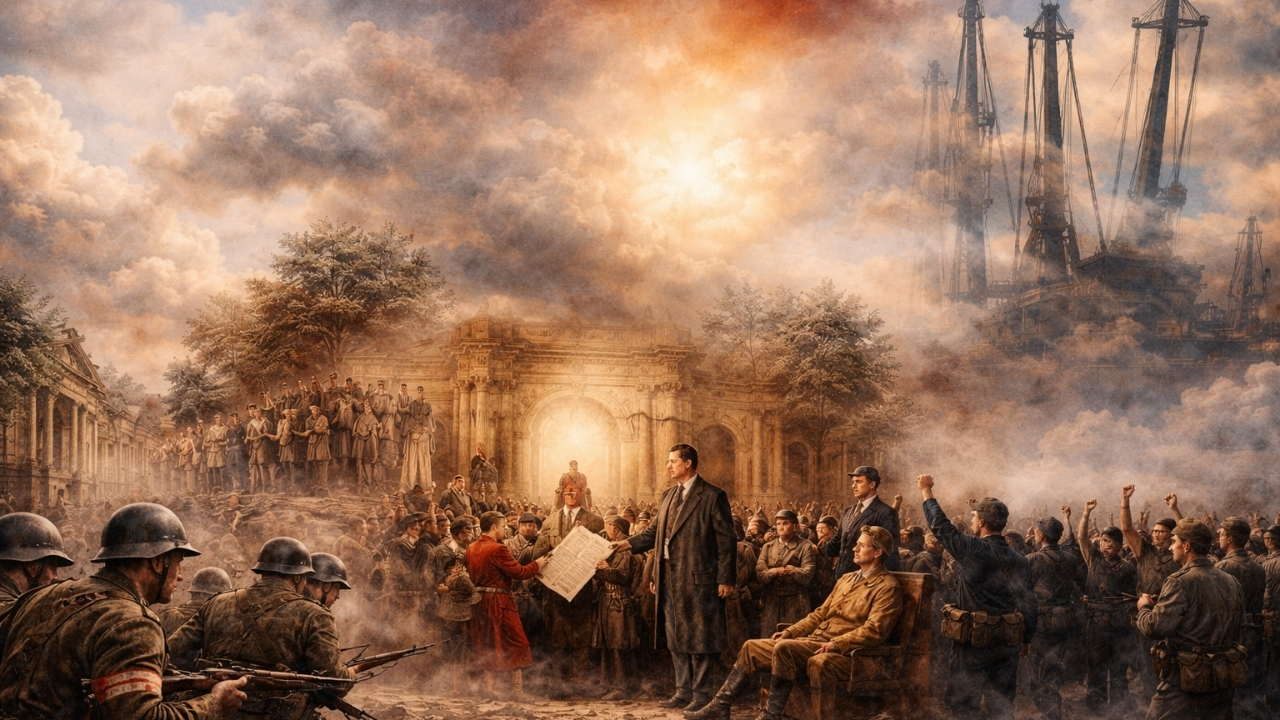
This day in history is one of the symbols of Polish military effort in the West for Poles. May 5, 1945 1. The Panzer Division commanded by General Stanisław Maczka won Wilhelmshaven – one of the largest war ports of the Third Reich. On the same day, U.S. troops liberated Mauthausen-Gusen concentration camp, and the NSZ Świętokrzyska Brigade liberated women imprisoned in the camp in the Czech city of Holýšov. At the end of the same day there was also a Prague uprising. One day, infinite history.
1949 – The Council of Europe is established
At a time when Europe was still counting wounds after World War II, a Council of Europe was established in London on 5 May 1949 – an organization aimed at protecting human rights, democracy and the rule of law on the continent. It is difficult today to imagine a European legal order without this institution, which has become a pillar of the protection of civil liberties. The Council of Europe, not to be confused with the European Council, today brings together several dozen countries and forms one of the foundations of the European value system.
1939 – Józef Beck rejects German demands in the Sejm
A few months before the outbreak of World War II, on May 5, 1939, Foreign Minister of the Second Republic Józef Beck delivered a speech in the Sejm that went back to history. He strongly rejected Germany's demands to include Gdańsk in the Third Reich and to designate extraterritorial communication lines through Polish territory. The words "Peace is precious and desirable. But peace, like almost all the affairs of this world, has its price" became a symbol of Polish determination. Beck pointed out that Poland does not intend to give way to aggression.
1974 – First use of the word "Internet"
The word that changed civilization first appeared in print on May 5, 1974. Vint Cerf and Bob Kahn, today considered the fathers of the Internet, used the term "Internet" in their research report on the TCP protocol. It was not yet the Internet in today's sense, but the foundations for its construction were then formally described. Without this step there would be neither social media nor streaming nor articles like this.
1980 – Operation "Nimrod": anti-terrorists take hostages in London
After six days of hostage holding at the Iranian embassy at Prince’s Gate, London, on May 5, 1980, the famous SAS unit conducted a rapid anti-terrorist operation codenamed "Nimrod". Within minutes, the commandos freed the hostages and neutralized the terrorists. The action was broadcast live by the BBC and became one of the most spectacular examples of the effective operation of special units in history. To this day, it is discussed in military academies around the world.
Born 5 May
Karl Marx (1818) – German philosopher and economist, author of the "Communist Manifesto" and "Capital", whose theories shaped global politics for over a hundred years.
Henryk Sienkiewicz (1846) – Polish writer, Nobel Prize laureate in 1905, creator of "Trilogy" and "Quo Vadis", one of the most popular Polish writers of all time.
Søren Kierkegaard (1813) – Danish philosopher and theologian considered to be the father of existentialism, whose works still inspire philosophers, theologians and writers around the world.
Adele (1988) – British singer and songwriter, multiple Grammy winners, one of the best-selling artists in the history of entertainment music.
Stanisław Moniuszko (1819) – Polish composer, the creator of the operas "Halka" and "Strashy Manor", recognized as the father of the Polish national opera.
World events
1260 – Kublai-chan becomes ruler of the Mongolian Empire – Genghis Khan's grandson took over one of the largest empires in history, which stretched from China to Eastern Europe.
1821 – First edition of The Guardian – In Manchester, the first issue of the journal was published, which, under the name "The Manchester Guardian", began the story of one of the world's most influential newspapers.
1891 – Carnegie Hall opening in New York City – One of the world's most famous concert halls opened its doors, becoming a symbol of the cultural metropolis and the dream of every classical music.
1921 – Coco Chanel chooses Chanel No. 5 – Legendary fashion designer chose from samples prepared by perfumer Ernest Beaux a composition that became the most famous perfume in history.
1955 – Entry into force of the Paris Agreements – Under the agreements signed by Western powers, the occupation status of West Germany was abolished, they were granted the right to have an army and incorporated into NATO, which changed the balance of power in cold war Europe.
May 5 is a day which in this historical calendar has uniquely condensed great names, landmark decisions and fates of nations – from the birth of Marx to the death of Napoleon, from the discovery of Jamaica to the invention of the Internet. It's hard to believe that so many stories can fit in one day. Come back tomorrow – May 6 hides equally surprising secrets.