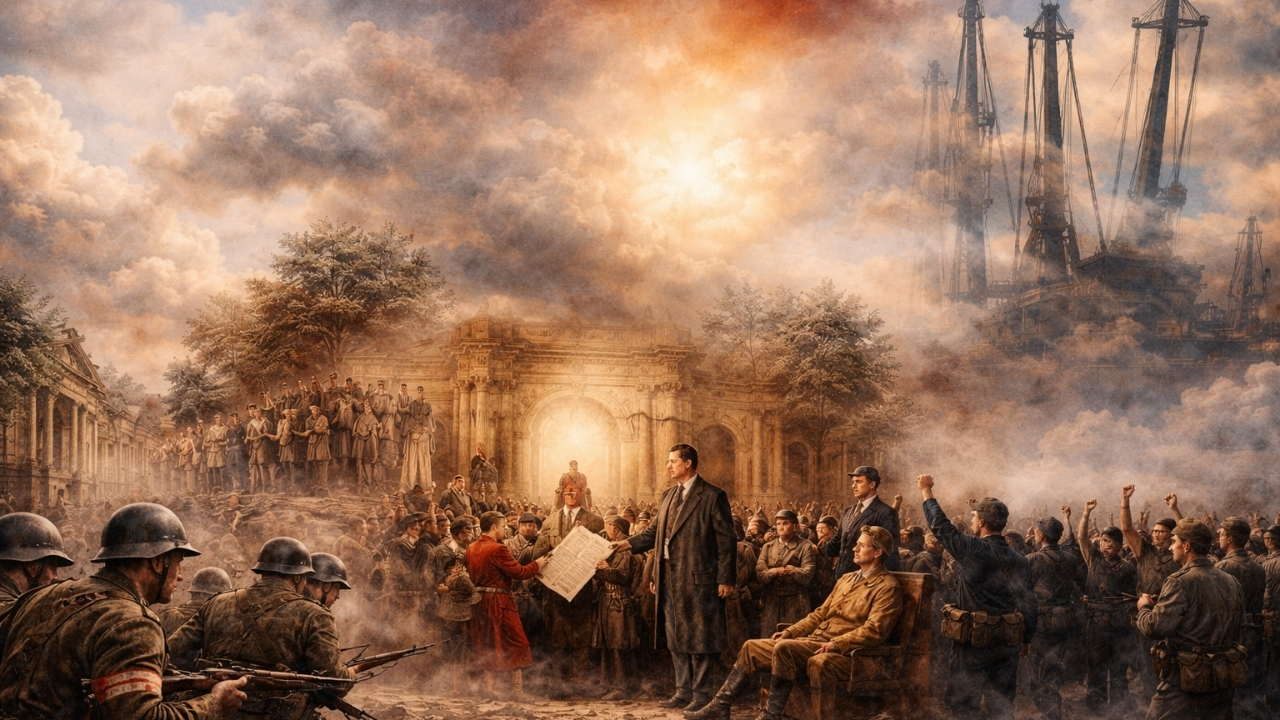
Do you know that April 14 is one of those days that history has filled to the brink with events that change the course of the world? From the baptism of the first Polish ruler, by the assassination of the President of the United States, to the sinking of the famous Titanic — What happened that day in history is breathtaking. Prepare to travel for centuries, because this historical calendar contains more surprises than you might think.
What happened on April 14th? Major events in history
966 – Baptism Lives I and the birth of Christian Poland
This is one of the most important dates in the whole Polish history. On April 14, as symbolically accepted, Prince Mieszko I and his court were baptized, thus opening Poland to Latin civilization and European cultural circle. This decision was not merely an act of faith — was first of all a master political move that set Poland among the established states of Europe and gave it protection from the pretexts for conquest by Christian neighbours. Without this day, Polish statehood could go completely differently.
1430 – Assault on Jasna Góra and damage to the Black Madonna
It is hard to believe that one of the most venerable images in Poland was the target of armed robbery. In 1430 an armed band of knights and robbers from Moravia, the Czech Republic and Silesia entered the monastery of the Paulins on Jasna Góra, killed several monks, took some of the valuables and — what went to legend — damaged the famous painting of the Black Madonna. The scars on the face of Our Lady of Czestochowa, which are still visible today, are just a souvenir of that violent attack. This day in history has forever entered into the spiritual identity of the Polish nation.
1865 – The Murder of Abraham Lincoln at the Ford Theatre
On the evening of April 14, 1865, just a few days after the end of the Civil War, U.S. President Abraham Lincoln sat down at the Ford Theatre lodge in Washington to watch the play. Actor John Wilkes Booth, a fervent Confederate supporter, fired a gun at him, hitting him in the head. Lincoln died the next morning in a nearby boarding house without regaining consciousness. His death shook the whole country and to this day remains one of the greatest tragedies in American democracy.
1912 – Titanic hits the iceberg
Just before midnight on 14 April 1912, a recognised unsinkable steamer RMS "Titanic" collided in the North Atlantic with an iceberg during its maiden voyage. The ship began taking on water, and within hours it went down, taking more than 1,500 people with it. This disaster shook the world and forever changed the regulations on maritime safety. This is one of those events whose date is permanently etched in the collective memory of humanity.
1931 – Proclamation of the Second Spanish Republic
On April 14, 1931, Spain survived the revolution. — almost bloodless. After the local elections, which showed clear support for the Republican forces, the Second Spanish Republic was proclaimed and King Alfons XIII left the country. The same day the Catalan Republic was proclaimed. The new system was to bring about the modernization and democratisation of the country, but only a few years later Spain sank a bloody civil war. So this day in history proved to be both the dawn of hope and the announcement of drama.
1956 – Presentation of the first VCR in Chicago
What happened that day in the field of technology? Well, on April 14, 1956, a VCR was first presented in Chicago for the first time. — a device that revolutionized the television and entertainment industry worldwide. Ampex's invention made it possible to record and play images and sound from magnetic tape. Without this breakthrough there would be no home video, VHS cassettes, or many other technologies that shaped the 20th century mass culture.
1980 – The debut album Iron Maiden hits the market
For rock and metal music lovers, this day in history is of particular importance. On April 14, 1980, British group Iron Maiden released their debut album titled simply "Iron Maiden". The album became the foundation of the New Wave of British Heavy Metal current and launched one of the most legendary careers in rock music history. Today, this album is considered a classic of the genre, and the band itself continuously touring and recording, enjoying a multimillion-dollar fan base worldwide.
2010 – Eyjafjöll volcano eruption paralyzes European aviation
An Icelandic volcano called the majority of Europeans had a problem even saying, on April 14, 2010 it made itself known in a way that over weeks paralyzed air traffic across the continent. The eruption of Eyjafjöll lifted into the air huge clouds of volcanic ash that threatened aircraft engines. Tens of thousands of flights were cancelled, millions of travellers were stuck in airports, and losses in the aviation industry were estimated at EUR billion. It was one of the biggest communication crises in the post-war history of Europe.
2022 – The sinking of the Russian cruiser "Moscow"
The latest entries in this historical calendar are as dramatic as those of centuries ago. On April 14, 2022 a Russian missile cruiser "Moscow" sank — Black Sea Fleet flagship — hit the day before by two Ukrainian anti-ship missiles maneuvering Neptune. It was the largest warship sunk in combat activities since World War II and one of Ukraine's most spectacular military successes during the ongoing Russian invasion. The loss of Moscow had a huge symbolic and strategic dimension for both sides of the conflict.
Born 14 April
Christiaan Huygens (1629) – Dutch mathematician, physicist and astronomer, explorer of Titan and creator of the wave theory of light, one of the greatest scholars of the Baroque era.
Julie Christie (1940) – British actress, cinema icon of the 1960s, Oscar winner for her role in the film "Darling", a symbol of the liberated femininity of that era.
Ritchie Blackmore (1945) – British guitarist, co-founder and lead creative force of legendary bands Deep Purple and Rainbow, one of the most influential rock guitarists of all time.
Adrien Brody (1973) – American actor, Oscar winner for his role in Roman Polański's film "Pianist", in which he became a Polish Jewish musician who survived the Holocaust.
Sarah Michelle Gellar (1977) – American actress, primarily known for her iconic role as Buffy Summers in the series "Buffy: Vampire Postrach", who revolutionized the way of portraying female heroines in popular culture.
World events
1900 – Opening of the World Exhibition in Paris "The great festival of progress and modernization attracted millions of visitors to Paris and became a symbol of faith in the power of science and technology at the threshold of the 20th century.
1927 – Volvo first pulled off production tape – On April 14, the first Volvo passenger car, the ÖV4 model, was launched, starting with the history of the Swedish brand, which is primarily associated with safety today.
1935 – Great Sand Storm in the USA – A powerful sandstorm passed through the states of New Mexico, Colorado and Oklahoma, becoming one of the symbols of the Dust Bowl — An environmental disaster that forced hundreds of thousands of Americans to abandon their homes.
1988 – Geneva Agreement on Afghanistan "Afghanistan, Pakistan, the United States and the USSR signed an agreement in Geneva to regulate the conditions for the withdrawal of Soviet troops from Afghanistan, ending one of the most devastating Cold War conflicts.
2003 – Completion of the project to know the human genome – The final completion of human DNA sequencing as part of the Human Genome Knowledge Project was announced, reaching 99,99% accuracy — a breakthrough that opened a new era in medicine and biology.
History likes to surprise, and April 14 is an excellent proof of that — On this one day, for centuries, the fate of nations crossed, geniuses were born, empires were lost and new technologies were born. This shows how fascinating a mirror of human fate is a reliable historical calendar. Look tomorrow — because on April 15, it hides a story worth knowing.