
Today, President of the Republic of Poland Karol Nawrocki decided to veto the act on the crypto-asset market. This controversial decision has sparked a heated debate among political and business circles and crypto experts. The act, passed by the Sejm on 8 November 2025, was meant to implement the EU’s MiCA (Markets in Crypto-Assets) regulation, which governs the market for digital assets in Poland. The president argues that the provisions threatened citizens’ freedoms, their property and the stability of the state. Critics of the decision, however, argue that the veto could expose investors to greater risks and hinder the development of the industry in the country.
Background to the Act and EU Requirements
The EU’s MiCA regulation, which entered into force in 2023, requires member states to regulate the crypto-asset market, including cryptocurrencies, tokens and stablecoins. Its goals are to protect consumers, prevent money laundering and ensure financial stability. Poland, like other EU countries, had two years to implement these rules at the national level. The prepared act defined, among other things, the supervisory bodies (with the Financial Supervision Commission (KNF) as the main regulator), the rules for registering firms and mechanisms for protecting investors.
However, according to the Chancellery of the President (KPRP), the Polish version of the act went too far. In a statement on the prezydent.pl website, it stressed that the regulations were excessive compared with solutions adopted in other countries, such as the Czech Republic, Slovakia or Hungary, where similar acts run to only a few or a dozen or so pages, while the Polish one had over a hundred. According to the president, this could push Polish firms abroad, for example to Lithuania or Malta, where conditions are more favourable to innovation.
Reasons for the Veto: Protecting Freedom and the Economy
Presidential spokesman Rafał Leśkiewicz, in a detailed post on the X platform, explained three main reasons for the decision:
- The possibility of blocking websites: The act provided that the government could, by a single decision, shut down domains of firms operating in the crypto-asset market. These provisions were deemed opaque and open to abuse. In most EU countries, simpler warning lists are used, without blocking entire services. „When the government shuts down a site, people lose access to their digital assets. This cannot be accepted” – Leśkiewicz wrote.
- Overregulation and lack of transparency: According to the president, the length and complexity of the act would hinder the development of the industry. President Nawrocki stressed during his election campaign that he would not allow regulations restricting freedom in relation to investment in modern assets.
- High supervisory fees: These would prevent small firms and startups from developing, favouring large foreign corporations and banks. According to the KPRP, this would kill competition and innovation.
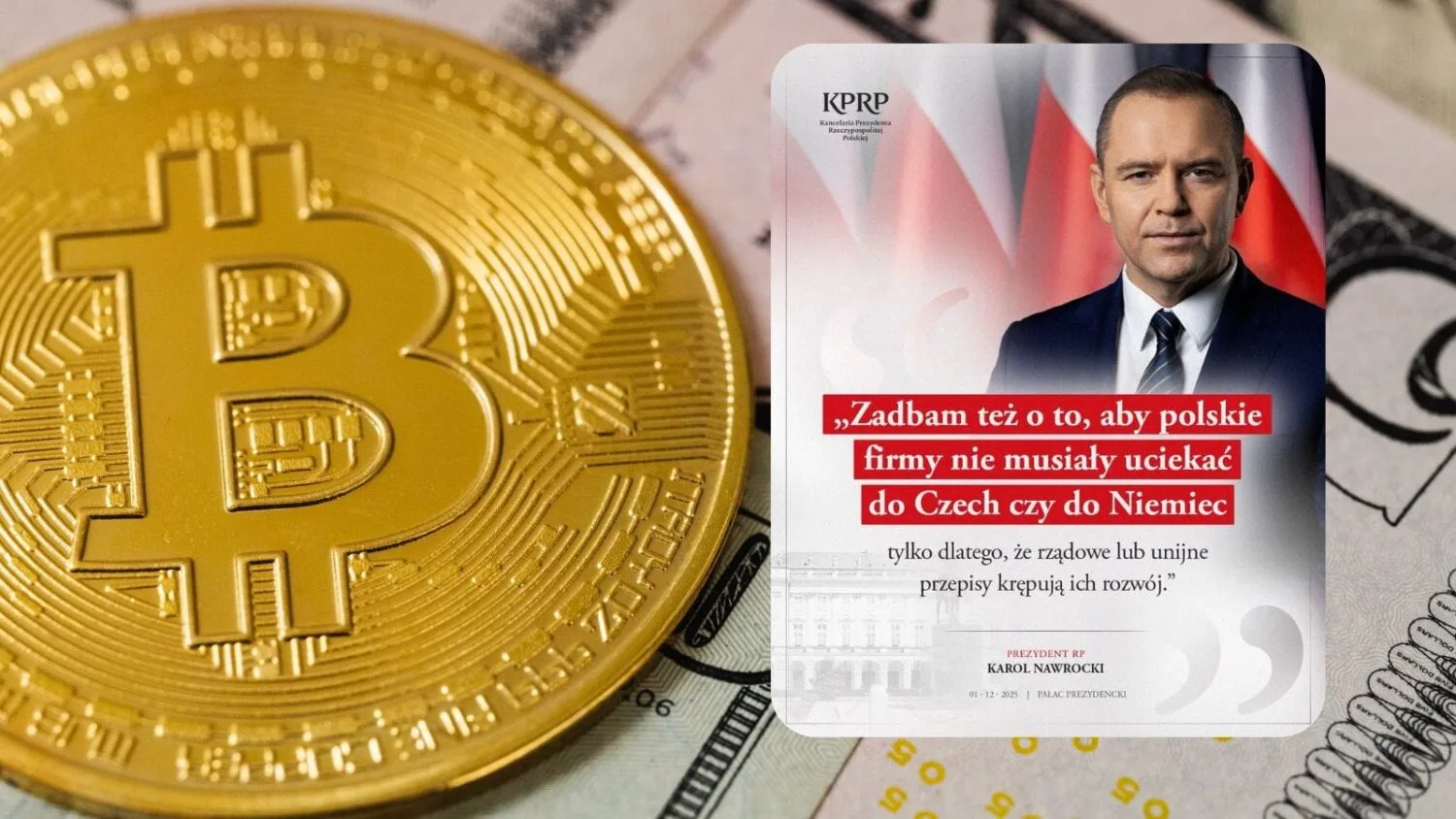
In the official statement on the prezydent.pl website we read: „The president uses his constitutional prerogative of veto only when provisions threaten the freedoms of Poles, their property and the stability of the state. And this act creates such real threats.” The decision fits into the president’s broader narrative, expressed in a graphic with his statement: „I will also make sure that Polish firms do not have to flee to the Czech Republic or Germany just because government or EU rules restrict their development.”
Political and Industry Reactions
The president’s decision was received enthusiastically by some in the opposition and by the crypto industry. Sławomir Mentzen, a Confederation MP and well-known advocate of the free market, publicly thanked the president on X: „This is a great decision, in line with the crypto industry’s expectations! I too publicly, and during a meeting with the President, appealed for this harmful act to be vetoed.” In another post, responding to criticism from Deputy Prime Minister Radosław Sikorski, Mentzen sarcastically wrote: „Don’t worry. The bubble will burst (No, editor’s note) only in Poland, and Poles without the act will have to trade on exchanges in other countries, so they won’t lose anything :D”.
On the other hand, Donald Tusk’s government sharply criticised the veto. Finance Minister Andrzej Domański stated: „The presidential veto is against the clients and investors of the crypto-asset market.” Foreign Minister Radosław Sikorski wrote on X: „The President has vetoed an act that was supposed to regulate the crypto market. When the bubble bursts and thousands of Poles lose their savings, at least they will know whom to thank.” Polska 2050 MP Sławomir Ćwik added: „By vetoing the act on crypto-assets, you are wiping out all crypto firms from Poland within half a year – does the president realise this? MiCA already applies in Poland. Without an act designating the supervisory body in Poland, a crypto firm will not be able to be registered.”
The media also shared differing views. The tvn24.pl portal quotes the presidential spokesman, emphasising the real threats posed by the act. Meanwhile, „Rzeczpospolita” notes that the president signed four other acts that day, but refused to sign this one, citing a threat to Poles’ freedoms.
Consequences and the Future of Regulation
The veto means the act returns to the Sejm, where MPs may try to override it with a 3/5 majority. If they fail, the legislative process must start again. The lack of national regulations does not, however, mean a complete absence of oversight – the EU’s MiCA continues to apply directly, but without a Polish supervisory body, firms may struggle to register in Poland.
Experts from the crypto-asset industry, including representatives of exchanges and startups, welcome the decision with relief, arguing that overregulation could stifle innovation. On the other hand, supporters of the act warn of an increased risk of fraud and the loss of savings by inexperienced investors.
President Nawrocki stresses that regulation is necessary, but it must be „reasonable, proportionate and safe for users”. Will the veto prove to be a protection of economic freedom, or a delay of necessary reforms? Time will tell how Poland’s crypto-asset market adapts to this situation.