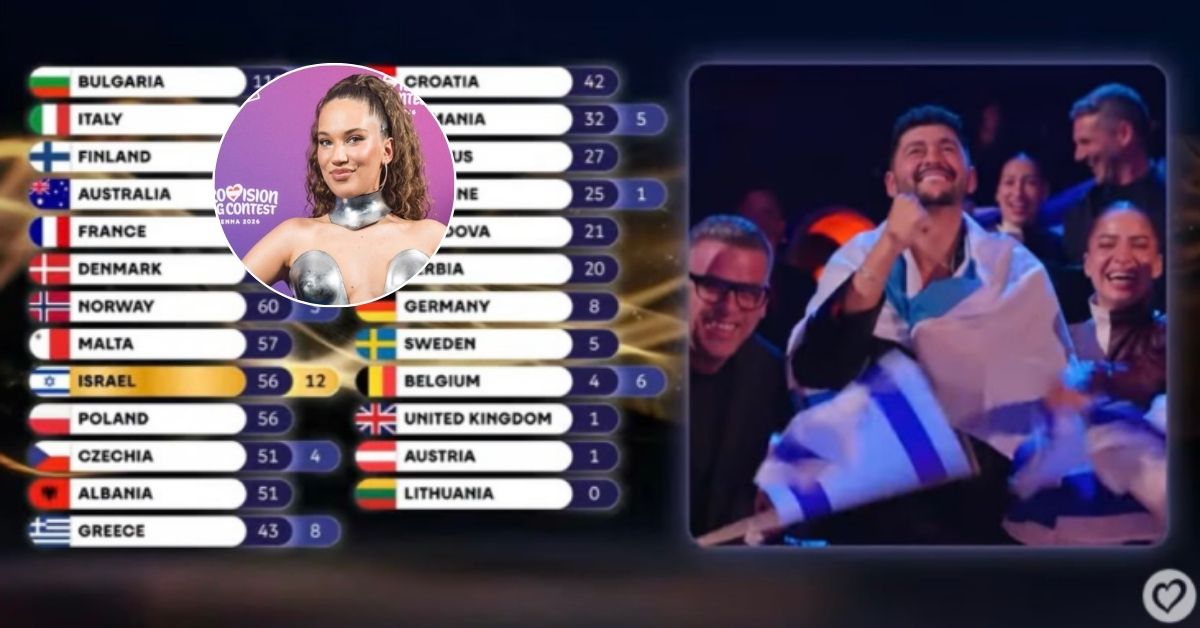
Eurovision 2026 again showed how strongly music mixes with politics. The Polish jury was the only one in Europe to award a maximum of 12 points to Israel's representative – Noam Bettan. The decision caused a huge storm in the network, and TV Poland had to react quickly with an official message.
Controversies around the Polish vote
The final in Vienna ended with a victory Bulgaria (Dara with the song "Bangaranga"). Israel ranked second, mainly thanks to the strong support of audiences from different countries. However, it was the voice of the Polish jury that attracted the most attention and criticism.
The Polish jury included Viki Gabor, Eliza Orzechowska, Filip Kuncewicz and other musicians and experts. Their decision contrasted with the vote of TV viewers in Poland, who assessed other countries, e.g. Ukraine and Romania. Many people in the comments called the result "scandal" or "ashamed", combining it with the current geopolitical situation.
TVP Statement
Full TVP Statement (composed on the basis of messages transmitted to the media, including WP Culture and Onet):
"Eurvision has been very emotional for many years, and this year's edition has shown that there are also very serious social and political discussions around the event. Television Poland sees the scale of these emotions and the fact that for some viewers and participants this year's competition had a dimension beyond the music itself.
At the same time, it is worth noting that according to the principles of the European Broadcasting Union (EBU), the national jury evaluates performances primarily based on artistic and musical criteria such as vocal qualities, composition of the track, stage performance or general presentation quality. Members of the jury shall vote individually and independently and the final result shall be the result of an algorithm used by the EBU for all participating countries. The TVP does not provide the jury with guidelines on assessing performances in the context of current political developments.
The composition of the Polish jury was chosen according to the procedures and guidelines in force within the framework of Eurovision and accepted by the EBU.
We understand that Israel's participation in this year's edition has caused numerous controversy and has been the subject of a broad public debate in many European countries. At the same time, as a public broadcaster, we participate in a competition organised by the EBU and operate on the basis of applicable regulations and competition rules."
Additional explanation of TVP (to Onet, among others):
"It is worth recalling that judges do not jointly determine the order of the States or directly award points. Each juror creates an individual ranking of all performances, and the final score is calculated automatically by the EBU system based on aggregate results. In the case of Poland's vote, only one of the judges placed Israel first. The final 12 points were therefore not the result of one joint decision or any top-down arrangement, but of a mathematical conversion of votes in accordance with the rules applicable to all participating countries."
One of the judges, Filip Kuncewicz, publicly explained that the result was not "a joint decision" and that the hate directed at the judges often resulted from a misunderstanding of the rules.
Why is it so emotional?
Eurovision was never just a song contest. This year several countries resigned due to Israel’s participation. For some viewers, voting is not only an assessment of music, but also a symbolic gesture.