Do you know that one day on a calendar can hold thousands of years of history — From the fall of the emperors, through scientific discoveries, to the birth of icons of culture? If you are wondering what happened that day in history, on April 16 it provides answers to the surprisingly wealthy. It is a date that combines ancient Rome with cold war, Polish uprisings with Hollywood legends and landmark treaties with maritime tragedies. Feel free to read — This day in history deserves special attention.
What happened on April 16? Major events in history
69 C.E. – The suicide of Emperor Oton and the end of his reign
Roman Emperor Mark Salvius Oton, after only three months of rule, committed suicide after a devastating defeat at the Battle of Bedriacum. His rival, the usurper Vitelius, went triumphantly to Rome and declared himself a new emperor. This episode is one of the most dramatic moments of the year of the four emperors — A period that showed how fragile power was even at the peak of the Romanum Empire power. Oton went into history as a ruler who chose death to spare the Romans further bloodshed.
73 C.E. – The Fall of Masada Fortress
After one of the most legendary sieges of ancient times, Roman chief Flavius Silva occupied the Jewish fortress Masada. When the soldiers entered the walls, they found nothing but silence — defenders and families chose collective suicide by refusing to surrender to slavery. Masada became a symbol of Jewish resistance and is still a place of pilgrimage and a source of Israel's national pride. It's one of those events that, although it happened two thousand years ago, still move imagination and emotion.
1521 – Hernán Cortés wins Xochimilco
During the conquest of Mexico, in the historical calendar of 1521, the Spanish led by Hernán Cortés captured the Aztec city of Xochimilco — one of the most remarkable urban assumptions of Mesoamerica, built on a network of canals and artificial islands. This was another link in the chain of events leading to the final collapse of the Aztec Empire only a few months later. Xochimilco has survived to this day and is included in the UNESCO World Heritage List — The living trace of civilization, whose end was sealed on that very day.
1710 – First Ukrainian Constitution
This day in history has been recorded in the Ukrainian legal and political tradition. In exile in Benders, the newly elected Cossack hetman Philip Orlik concluded a document with the elder called the Constitution of the Rights and Freedom of the Zaporosian Army. This document, ahead of the famous American and Polish Constitution 3 May, defined the borders of the state, the notion of the nation, the structure of power, finances and justice. Historians recognise him as one of the first modern constitutional acts in European history.
1943 – Albert Hofmann discovers LSD
Swiss chemist Albert Hofmann in his laboratory in Basel accidentally absorbed a small amount of synthesized chemical compound through the skin — lysergic acid diethylamide. A few hours later he survived the first documented LSD experience in history, describing extraordinary visions and perceptional disorders. This discovery, although completely unintentional, has forever changed the face of psychiatry, the culture of the 1960s and research into human consciousness. Hofmann himself called this substance "a difficult child" — He appreciated her therapeutic potential, but feared the consequences of abuse.
1945 – Battle of Berlin and sinking "Goi"
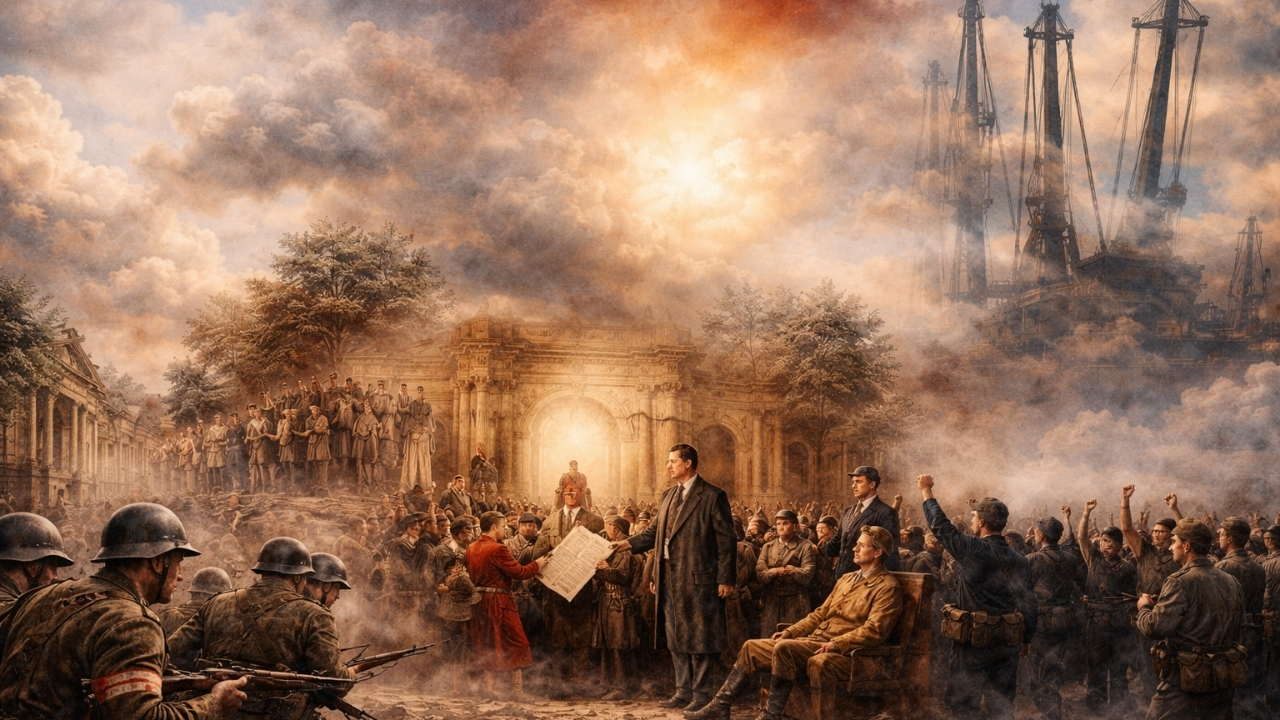
April 16, 1945 is one of the most tragic days of the last weeks of World War II. On that day a great offensive of Soviet and Polish troops began along the line of Oder towards Berlin — an operation to end the war in Europe. At the same time in the Baltic, the Soviet submarine sank the German transport "Goya", on which there were at least six thousand refugees from East Prussia and Gdańsk. The "Goi" disaster is one of the greatest maritime tragedies in history, still few known to the general public.
1947 – The execution of Rudolf Höss and the first use of the term "cold war"
This day brought two historical moments of a very different character. At the site of the former Auschwitz-Birkenau camp, the death sentence was executed on Rudolf Hössie — Camp commander responsible for the deaths of over a million people. On the same day in the United States, industrialist Bernard Baruch used the term "cold war" for the first time in public. — expressions that over the next decades have defined world politics. The irony of history makes what happened that day, both the closing of one era and the opening of the next.
1991 – First session of the Warsaw Stock Exchange
Only two years after the fall of communism, on 16 April 1991, Poland held its first session on the reborn Warsaw Stock Exchange. Only five companies were traded and the turnover was symbolic — But the mere fact of opening the dance floor was a deeply historical act. Poland officially entered the free market era, and the WSE became the largest stock exchange in Central and Eastern Europe over time. This event from the local historical calendar proved to be a milestone in the transformation of the whole region.
2003 – Signature of the Athens Treaty
Ten countries in Athens — Cyprus, Czech Republic, Estonia, Lithuania, Latvia, Malta, Poland, Slovakia, Slovenia and Hungary — signed the Treaty of Accession to the European Union. This was one of the largest enlargements in the history of the European community and culminating in the many years of their efforts to integrate with the West. For Poland, which for decades was behind the Iron Curtain, it was a special moment — symbolic completion of the path initiated by Solidarity. A year later, on May 1, 2004, the treaty entered into force.
Born 16 April
Charlie Chaplin (1889) – British actor, director and screenwriter, creator of Charlie's unforgettable character — A little tramp, one of the greatest geniuses of silent cinema and a symbol of the golden era of Hollywood.
Wilbur Wright (1867) – American aviation designer and pioneer, who together with Brother Orville made the first motor flight of man in history, forever changing the face of transport and civilization.
Joseph Ratzinger (1927) – German Catholic clergyman, later cardinal and Pope Benedict XVI, one of the most influential theologians of the 20th century, who abdicated from papal office as the first in over 600 years.
Kareem Abdul-Jabbar (1947) – recognized as one of the best basketball players in NBA history, a six-time league champion, a record score winner and a social activist and writer.
Margaret II (1940) – Queen of Denmark, painter and translator, one of the longest reigning monarchies of Europe, who in 2024 surprised the world with abdication for his son.
World events
1705 – Isaac Newton matching knight – Queen Anna Stuart gave the knighthood to Isaac Newton, making him Sir Isaac — One of the few scholars whose achievements have been honored in such a solemn way.
1746 – Battle of Culloden – The British Army broke up the Jacobite troops in the last regular land battle in the British Isles, ending definitely the second Jacobite uprising and dreams of the Stuart dynasty restaurant.
1853 – First railway line in India – the launch of a regular connection between Bombay and Thane started an era of railways on the Indian subcontinent, which became home to one of the largest railway networks in the world over time.
1925 – Sofia bombing – Bulgarian communists detonated the bomb in Sweta Nedelja's council during the service, killing 213 people and injuring more than 500 — This was one of the most bloody terrorist acts in the history of interwar Europe.
2007 – Massacre on Virginia Tech – 33 people were killed in two shootings on Virginia Polytechnic Institute campus, including the perpetrator; it was at the time the most tragic firearms attack in the history of the United States.
April 16 is a day that in its historical calendar holds a whole spectrum of human experiences — from triumphs and discoveries to tragedies and political breakthroughs. It is these days that remind us that history is not a dry collection of dates, but a living tissue of events that shaped our world. Come back tomorrow, because on April 17th, there are equally fascinating stories. — And we will again answer the question of what happened that day in history.