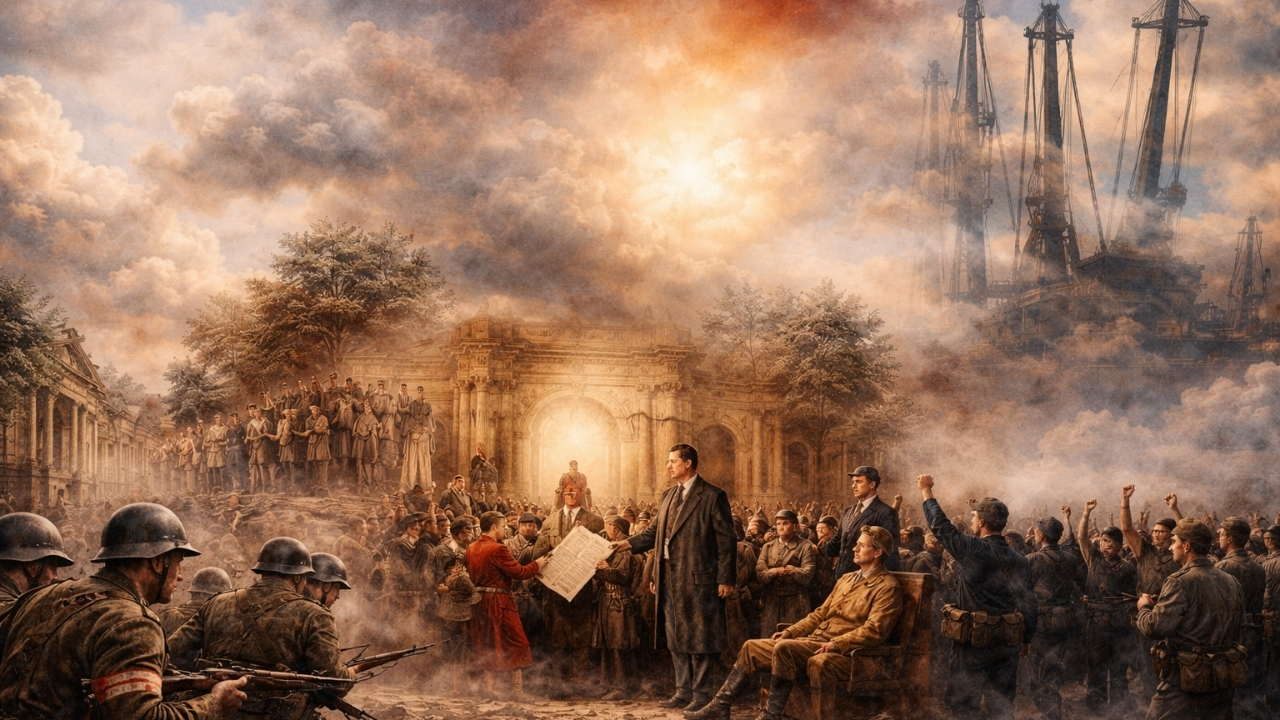
Do you know that one day in the calendar can contain the fall of a dictator, the birth of a boxing legend and the beginning of one of the most bravado maritime expeditions in history? That's why it's worth checking the historical calendar every once in a while to see what happened that day in history. April 28 is a date that surprises with the wealth of breakthroughs, tragic and completely unpredictable. See for yourself — This day in history has much more to tell than it might seem.
What happened on April 28th? Major events in history
1789 – Rebellion on Bounty: one of the most famous naval mutinies in history
Near the archipelago of the Friendly Islands (today's Tonga), the crew of the British ship HMS "Bounty" raised a rebellion against Captain William Bligh. Rebellious sailors led by Fletcher Christian left Bligh with 18 loyal sailors in an open ocean boat. Amazingly, Bligh managed to reach Timor Island after more than six weeks, beating nearly 7,000 kilometres. The rebellion on Bounty has become one of the most famous stories in naval history and continues to inspire filmmakers, writers and historians.
1902 – Newton Heath renamed Manchester United
This day in history It's a special date for football lovers around the world. Newton Heath football club, founded in 1878 by railroad workers, officially changed its name to Manchester United. The change of name coincided with the rescue of a financially sinking club by local businessman John Davies. What began as a Manchester team of workers became one of the world's most recognizable and titled sports brands over time.
1945 – The end of Mussolini: the shooting of an Italian dictator
On 28 April 1945 communist guerrillas shot in the village of Giuliano di Mezzegra Benita Mussolini — creator of Fascism and long-standing dictator of Italy — along with his mistress Clara Petacci. Mussolini attempted to flee to Switzerland, hiding in a column of German soldiers, however he was recognized and detained. The day after their body was executed, they were hung with their heads down at a gas station in Milan, which became one of the most shocking photographs of the end of World War II.
1947 – Kon-Tiki expedition: raft versus Pacific Ocean
Norwegian traveler and ethnologist Thor Heyerdahl sailed from the Peruvian port on a primitive raft called "Kon-Tiki" to prove that ancient South American residents could have settled the islands of Polynesia. The expedition that most experts thought was crazy was a success. — After 101 days, the raft reached Polynesia, crossing nearly 8,000 kilometres. History This became an inspiration for generations of researchers and travelers, and filmed about it movie The documentary won an Oscar.
1969 – Charles de Gaulle's resignation from the presidency of France
After over a decade of power, Charles de Gaulle resigned from the office of President of France. The direct cause was the loss in the referendum on Senate reform and regionalisation — De Gaulle himself announced that he would leave if he did not get the support of the citizens. The departure of one of the most distinctive European 20th century policies has closed a certain era in the history of France and Europe. General de Gaulle never returned to active politics again and died just a year and a half later.
1988 – Aloha Airlines disaster: aeroplane without a roof over Hawaii
There was one of the most spectacular in Hawaii. — and unbelievably happy at the same time — air incidents in history. In Boeing 737 of the Aloha Airlines line at an altitude of over 7,000 metres, a large portion of the upper hull was torn apart, exposing passengers to wind. The incident killed one person — flight attendant thrown outside the plane — And 65 were injured. The pilots were able to crash-land, and this case permanently changed the procedures for checking the technical condition of aircraft worldwide.
1939 – Hitler announces the British Maritime Treaty
In a speech in the Reichstag, Adolf Hitler formally declared a maritime treaty with Britain and a Polish-German declaration of non-violence of 1934. It was one of the clear signals that the path to armed conflict in Europe was almost doomed. Just a few months later, on September 1, 1939, Germany they attacked Poland. Looking at the historical calendar of that day, it is difficult to resist the impression that many key decisions were made in the shadow of the upcoming tragedy.
2001 – Dennis Tito: the first space tourist in history
American billionaire Dennis Tito became the first ever space tourist, joining as a passenger the crew of the Russian spacecraft Soyuz TM-32. He reportedly paid about $20 million for the flight. NASA initially opposed this mission, fearing that the amateur would disrupt the professional crew. Tito spent almost eight days at the International Space Station and after returning to Earth described the journey as a "racial" dream he had fulfilled since his childhood.
Born 28 April
James Monroe (1758) – The fifth president of the United States, the creator of the famous Doctrine Monroe, who for decades designated the directions of American foreign policy.
Harper Lee (1926) – American writer, author of the cult novel "Kill the Drozda", awarded Pulitzer, belonging to the canon of world literature.
Penélope Cruz (1974) – Spanish actress, the first Spanish woman honored with Oscar for her best supporting role, one of the most recognizable stars of European and Hollywood cinema.
Oskar Schindler (1908) – German industrialist who saved over 1,200 Jews during World War II, employing them in his factories, hero of the famous Steven Spielberg film.
Terry Pratchett (1948) – British fantasy writer and satirist, author of the series "Disk World", one of the most widely read English-language authors of the 20th and 21st centuries.
World events
1788 – Maryland joins the Union – Maryland as the seventh state ratified the Constitution of the United States and officially joined the young federation.
1923 – Opening of the First Wembley Stadium – The legendary stadium in London was opened and almost immediately became a symbol of English football and world sport.
1925 – The Birth of Art Déco – The International Exhibition of Decorative Art and Design opened in Paris, from which the French name derives the whole Art Déco style.
1967 – Muhammad Ali refuses military service – boxing world champion Muhammad Ali publicly refused to join the U.S. Army, which brought him a loss of title, but also the status of the icon of the movements of the civil era.
1992 – The uprising of the Federal Republic of Yugoslavia – Serbia and Montenegro formally dissolved the Socialist Federation Republic of Yugoslavia, setting up a new state in its place with the capital in Belgrade.
April 28 is the day that — as shown in the historical calendar — Invariably, it turns out to be extremely rich in events that shape the fate of the world: from the collapse of dictators, through groundbreaking political decisions, to experiments that have changed our understanding of human capabilities. What happened that day in history could fill many thick volumes of encyclopedias. Come back tomorrow. — Because on April 29th, he has many stories to remember.