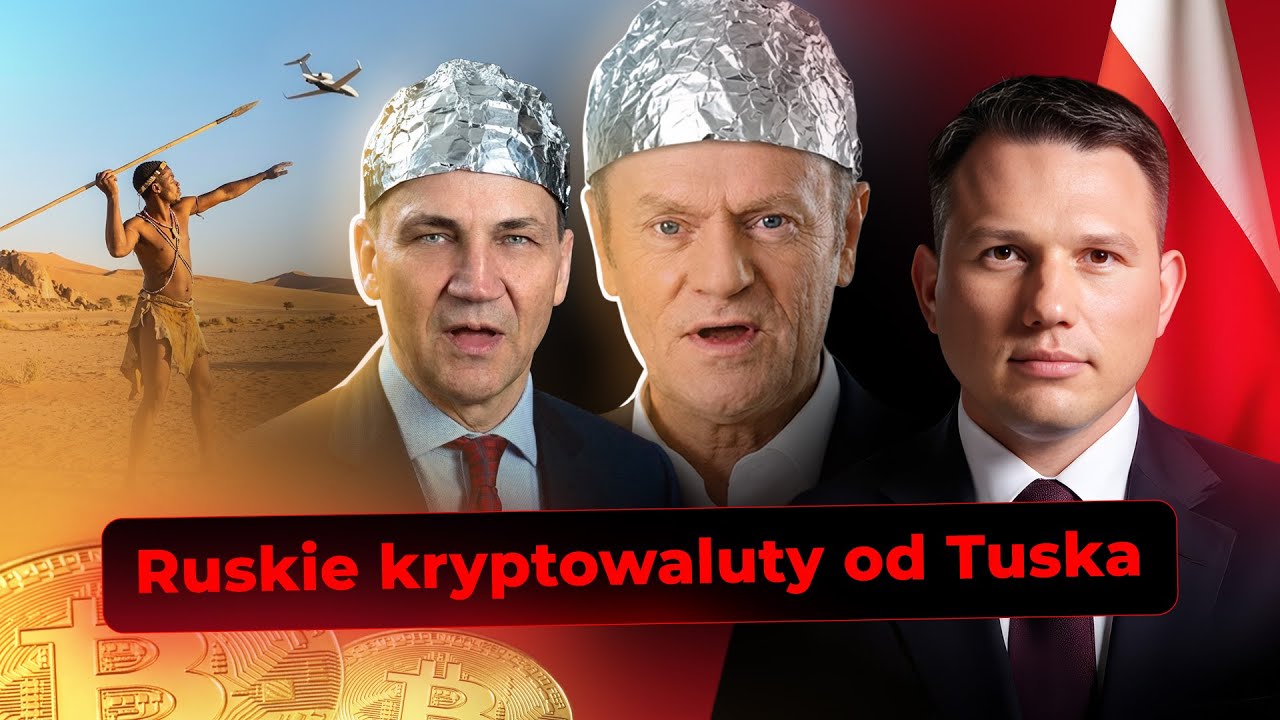
Sławomir Mentzen, known for his enthusiasm for cryptocurrency (he declares himself to have Bitcoins) accused Donald Tusk and his government of "Cryptoscharism". In a YouTube video titled "Russian cryptocurrency from Tusk," Mentzen breaks down the first parliamentary debate on the cryptocurrency bill, the veto of President Karol Nawrocki and the entire circle of political speculation. This is not just a discussion about digital money – it is a war on words in which cryptocurrency becomes a tool for personal attacks and conspiracy theories. Is the government really fighting Russian saboteurs, or is it simply sabotaging the development of the industry?
The genesis of the feud: Veto, which surprised everyone
It all started with a presidential veto to amend the anti-money laundering and terrorist financing bill, which was to regulate the cryptocurrency market in Poland. The bill, originally prepared under the Law of Law and Justice, was to adapt Polish law to the EU regulation MiCA (Markets in Crypto-Assets). However, according to Mentzen, Tusk's government added so much overregulation to it that it became a "burden for cryptocurrency companies". President Nawrocki, surprisingly for many, vetoed the project on 1 December, causing a storm.
Mentzen, known for his enthusiasm for cryptocurrency (self declares to have Bitcoins)It's not surprising the scale of interest in the subject. "The whole cryptocurrency industry demanded veto," he says in the video.Industry fears that new regulations, supervised by the Financial Supervision Commission (KNF), will cause exodus of Polish companies abroad– Lithuania or Malta, where the regulations are more mild.As a result, Poland would lose taxes and jobs and the market would dominate foreign entities.
Secret sittings and "Russian footprints": Propaganda or real threat?
The key moment of the parliamentary debate is Donald Tusk's tweet, in which the Prime Minister suggested that the veto had a second bottom: "great money, scandals and Russian connections". Tusk mentioned the disappearance of "King of cryptocurrency" by Sylwester Suszek, associated with the zondacrypto stock exchange, and the support for the "high right" by Presidents Duda and Nawrocki. "Cryptowaluty is not fun – it is a tool of Russian saboteurs" – Mr Tusk thundered, holding a secret session of the Sejm without cameras, but for MPs.
Mentzen calls it pure propaganda. In a 35-minute video, one step at a time, he breaks the arguments of the ruling coalition. "Russians pay cryptocurrency for sabotage? The law will not stop it, because cryptic essence is the lack of intermediaries" - he argues.It emphasizes hypocrisy: the same stock exchange zondacrypto sponsored "Republica", Onet, TVN, or even WOŚP. What about cryptocurrency crimes? "More fraud happens through banks – phishing, VAT carousels" – reposts Mentzen. Ministers, like Adam Bodnar or Andrzej Domanski, repeated Tusk's thesis, but without substance: one spoke of an "efirium" instead of an Ethereum, another said of a "scripto" as something inherently bad (compared to cryptophane or... cryptogay).
It was particularly shocking for the opposition that Minister of Justice Adam Żurek revealed secret information from the meeting – allegedly Krzysztof Bosak was to warn against the risk of the Bitcoins. The speech fragment was quickly removed from YouTube Sejm, but the video is circulating online. "It's a violation of the law and a lack of transparency," Mentzen resents, demanding declassification of materials.
Ridiculous debate: From foil caps to "wild west"
The parliamentary debate, according to Mentzen, was a farce. Members of the coalition painted apocalyptic visions: speculative bubble, losses of savings of Poles, Russian hackers. Radosław Sikorski claimed that without the act "Poles will lose everything" and MP Gasiuk-Pihowicz called investments in crypto "stupid". Mentzen compares this to primitive fears: "Imagine a native throwing a spear at a plane – that's how politicians approach technology they don't understand."
He also criticizes KNF as a regulator: "It's an antiscript institution that issues licenses after years". The rush of the government to act? "They delayed it themselves, and now they pretend to be heroes". What about the property statements?Mentzen jokes about fake screenshots showing his "hidden" crypto – he actually keeps them in a cold wallet, outside the stock exchanges.
What next for the Polish code? Call for Reason
Mentzen concludes the video with an appeal: "Ignorate Tusk's propaganda of 'Russian cryptocurrency'. Investments always carry risks, but regulations should protect, not choke." The cryptocurrency industry in Poland, worth billions, is waiting for a new bill – simpler, according to the MiCA, without excessive bureaucracy. Is Nawrocki's veto a chance to reset, or just a pretext for another political fight?
In the era when Bitcoin surpasses $100,000, Poland cannot afford party pushes. It's time for a substantive debate, not for memes with Tuski in the role of the cryptologist. As Mentzen rightly points out, "Cryptowaluty is not the future – it is the present". The question is whether the ruling will understand this before the companies flee abroad.