

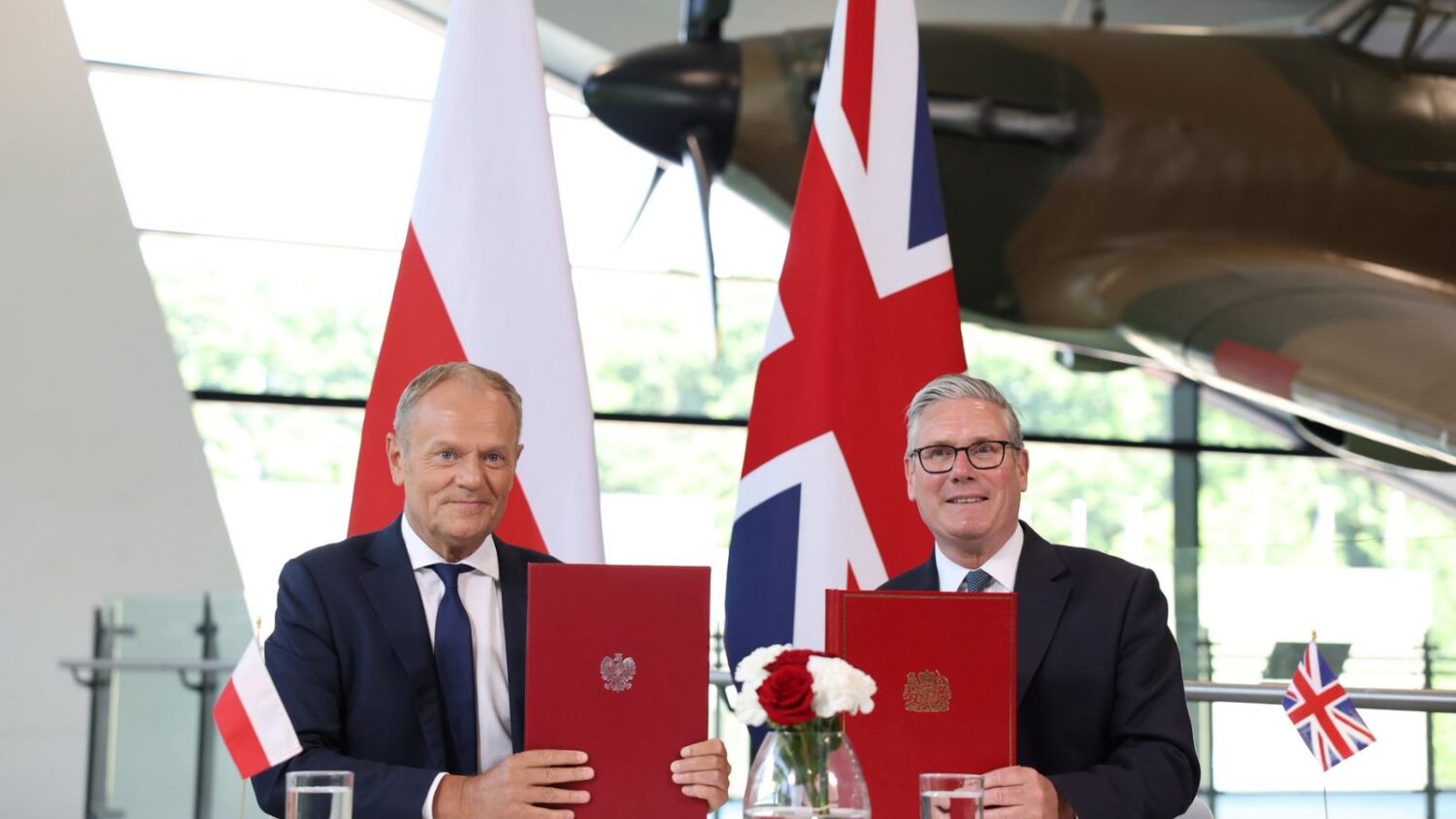
On 27 May 2026 at RAF Northolt near London, Prime Minister Donald Tusk and Prime Minister Keir Starmer signed the Treaty between the Republic of Poland and the United Kingdom of Great Britain and Northern Ireland on Partnership in the Field of Security and Defence. It is described as the “biggest step forward in a generation” in bilateral relations.
The treaty deepens existing cooperation (including that of 2017 and 2023) and covers a broad range of areas: interoperability of armed forces, joint exercises and training, development of defence technologies (including drones and air defence), cybersecurity, countering hybrid threats, exchange of intelligence information, and cooperation in the arms industry and energy security.
The parties committed to mutual consultation and coordination in the event of a crisis, and confirmed their determination to implement Article 5 of the North Atlantic Treaty (NATO collective defence).
What does this mean for Poland?
For Poland, the treaty is above all additional bilateral security guarantees alongside NATO membership. The United Kingdom is one of the most militarily powerful countries in Europe and a key ally on NATO’s eastern flank. The agreement is meant to speed up joint responses to threats (especially from Russia), facilitate joint equipment purchases, technology exchange and large-scale exercises.
Prime Minister Tusk stressed that history teaches that Poland must build its own defence capabilities and complement them with strong bilateral alliances.
Does this mean a repeat of 1939?
This question naturally arises in the Polish public debate. In September 1939, Poland had alliance treaties with the United Kingdom and France, which however did not translate into real, effective military assistance after the aggression of Hitler’s Germany and the USSR. The United Kingdom and France limited themselves mainly to declarations and symbolic actions.
Today’s context is, however, completely different:
- Poland is a member of NATO with its binding Article 5,
- the United Kingdom has far greater power projection capabilities than in 1939,
- the treaty contains concrete mechanisms for consultation and operational cooperation,
- the current threat (Russia) is seen as shared by the whole of NATO.
Even so, many commentators point out that no treaty is worth more than the real readiness and military capabilities of the parties. The ultimate value of this agreement will only be tested by a possible crisis.
The treaty is seen as an important deterrent signal to Russia and a strengthening of NATO’s eastern flank.
Source: KPRM




Komentarze