

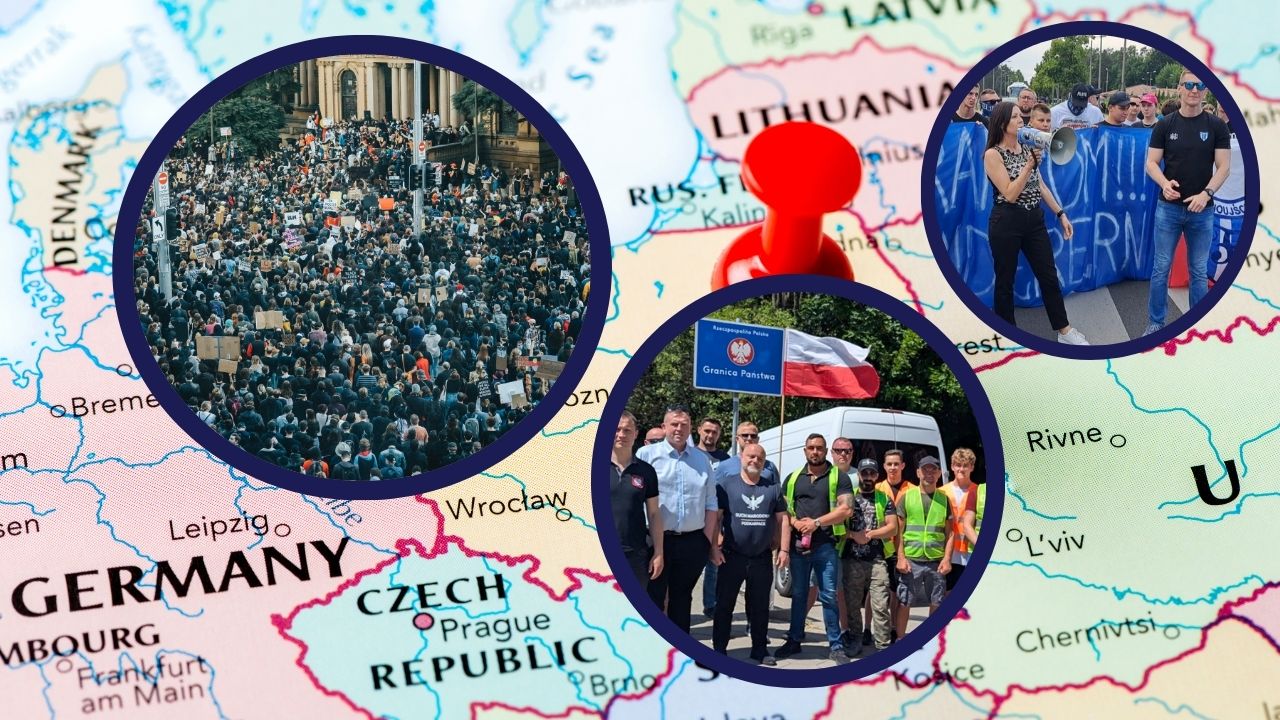
Tension is rising on the Polish-German border. Poles are protesting against illegal migration and organising civilian patrols to protect their territory.
Migration pressure in the West – where does the problem come from?
In recent months the Polish-German border has become a new focal point of the migration debate. Thousands of migrants who have crossed Poland’s eastern border are trying to get further west. German services, using procedures such as Dublin III or readmission, increasingly send them back to Poland. This most often concerns people who have no documents or who crossed the border illegally.
In practice, this means Poland is becoming a “buffer country” – migrants who have been refused entry to Germany return to our territory. According to Border Guard data, in the first half of 2025 alone nearly 4,500 people were checked on the western border.
Anti-immigrant protests on the Polish-German border
Scale and nature of the protests
The last few days have brought mass protests at border crossings, especially in Lubieszyn and Zgorzelec. Hundreds of people, including fans of local clubs, blocked roads and voiced opposition to the migration policy of Germany and the European Union. Banners carried slogans such as “Don’t dump your guests on us”, “Stop relocation’, “This is Poland”.
The organisers of the protests – often nationalist circles and local activists – argue that Germany not only turns migrants back but even “dumps” them on Poland, destabilising the social situation and security.
Examples of protest actions
- Street blockades at border crossings
- Symbolic barriers with the word “stop”
- Chanting anti-immigrant slogans
- Information campaigns on social media
Civilian patrols – a grassroots response to the crisis
In response to growing social concerns, more and more people are joining civilian patrols. Their aim is to monitor the border, document attempted illegal crossings and call in the services when needed. The patrols operate legally, without confrontation, and participants undergo basic training and receive support from coordinators.
Activities and challenges of the patrols
- Observing and documenting movement at the border
- Cooperation with the Polish Border Guard (SG)
- Responding to attempts to smuggle migrants across the border
- Detentions and checks by German police (e.g. in Lubieszyn two patrol participants were detained)
The most common activities of civilian patrols
| Activity | Goal |
|---|---|
| Border observation | Early detection of attempted illegal crossings |
| Documentation (photo/video) | Proving violations and alerting services |
| Reporting incidents | Cooperation with the Border Guard |
| Education and mobilisation | Encouraging others to join patrols |
Social and political consequences of the migration crisis
The tensions on the Polish-German border show how deeply the migration issue divides society and politicians. On one hand, pressure is growing on the government to protect borders more effectively; on the other, voices are emerging calling for respect for human rights and European solidarity.
Civilian patrols and protests are an expression of anxiety, but also an attempt at grassroots control of a situation which – as the organisers stress – may only intensify if effective systemic solutions are not developed.


Komentarze