
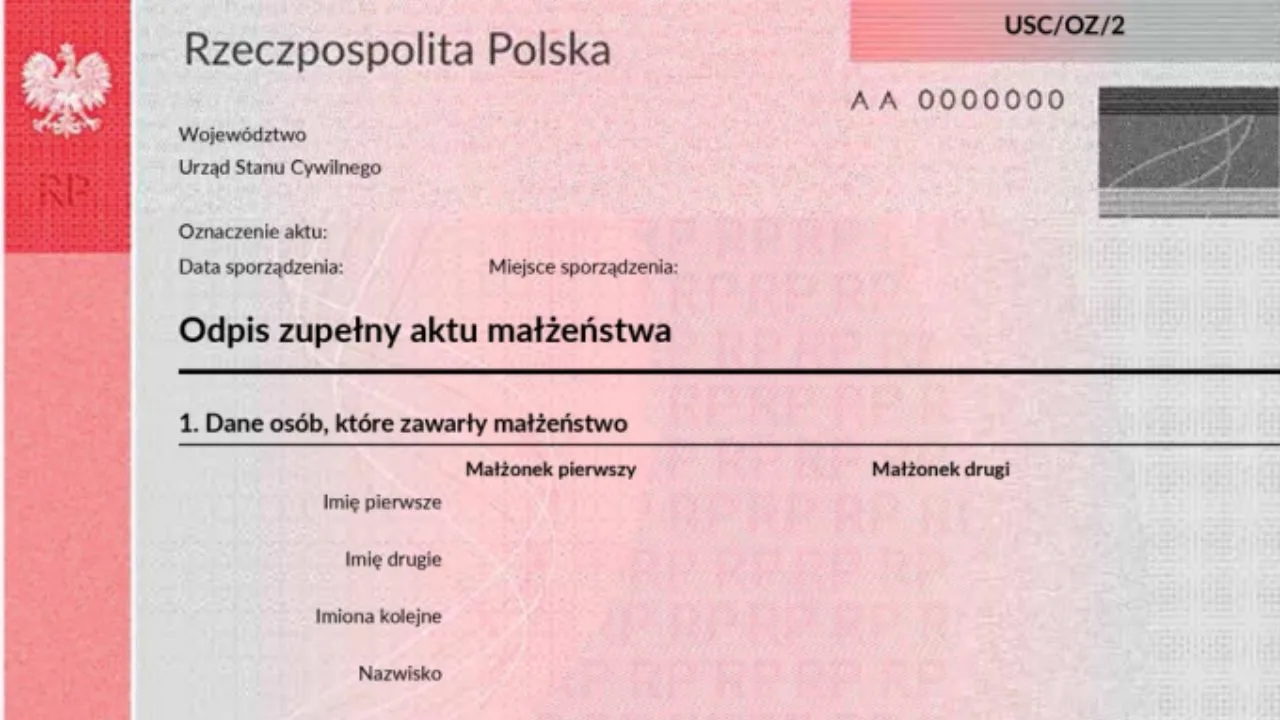
Poland is changing the template of the marriage certificate, replacing the terms “woman” and “man” with “first spouse” and “second spouse”.
Where do the changes to the marriage certificate come from?
The Ministry of Digital Affairs has published a draft regulation introducing gender-neutral terms into the templates of civil status records. It concerns full and abridged copies of marriage certificates and certificates issued from the civil status register.
The changes follow a ruling of the Court of Justice of the EU of 25 November 2025, which obliged Poland to recognise same-sex marriages legally concluded in other EU member states. A country does not have to introduce same-sex marriage into its own law, but it must allow such couples to enjoy the rights associated with marriage if they entered into a union abroad.
What exactly changes in the documents?
The new rules provide for changes to several key fields in civil status documents. The change does not affect the content of the institution of marriage in the Constitution, but the way the parties to a marriage are described in official forms.
“First spouse” and “second spouse” – new fields
The draft document templates provide, among other things, for:
- Replacing the fields “woman” and “man” with the terms “first spouse” and “second spouse”.
- Changing the descriptions for parents to “father of the first spouse”, “mother of the first spouse”, “father of the second spouse”, “mother of the second spouse”.
- Updating the section “Surnames of the spouses after the marriage” so that it refers to the “first” and “second spouse”.
In practice, this means that the same form will serve both different-sex and same-sex couples, without interfering with the definition of marriage in national law.
Why is the government doing this? The official justification
The Ministry of Digital Affairs stresses that the aim is primarily the “technical” implementation of the CJEU ruling and the alignment of Polish registers with EU law. The current document templates make it impossible to correctly enter same-sex marriages, because the form presupposes a woman and a man.
Official communications highlight three main goals of the changes:
- Enabling the transcription of foreign marriage certificates of same-sex persons.
- Ensuring compliance with EU standards (including Regulation 2016/1191).
- Facilitating the exercise of rights associated with marriage, e.g. in respect of benefits, insurance and taxes.
From the government’s perspective, this is meant to be a change that is more administrative than cultural, although its social and symbolic effects are far broader.
Controversy: gender-neutral language or “back-door marriages”?
The conservative opposition and some Catholic circles accuse the government of attempting to “introduce same-sex marriages through the back door”. Right-wing politicians argue that gender-neutral terms in documents contradict the constitutional protection of marriage as a union of a woman and a man.
LGBT+ communities and human rights organisations, on the other hand, see the draft as a belated, partial step – a tool that will make life easier for same-sex couples already married abroad, but that still does not resolve the question of marriage equality in Poland.
What does this mean for ordinary marriages?
For different-sex couples marrying in Poland, the everyday procedure at the civil registry office (USC) will not change – they will still take their vows, and clergy and officials may continue to use the traditional terms “husband” and “wife”. The change concerns primarily how the marriage is recorded in the system and on the official certificate.