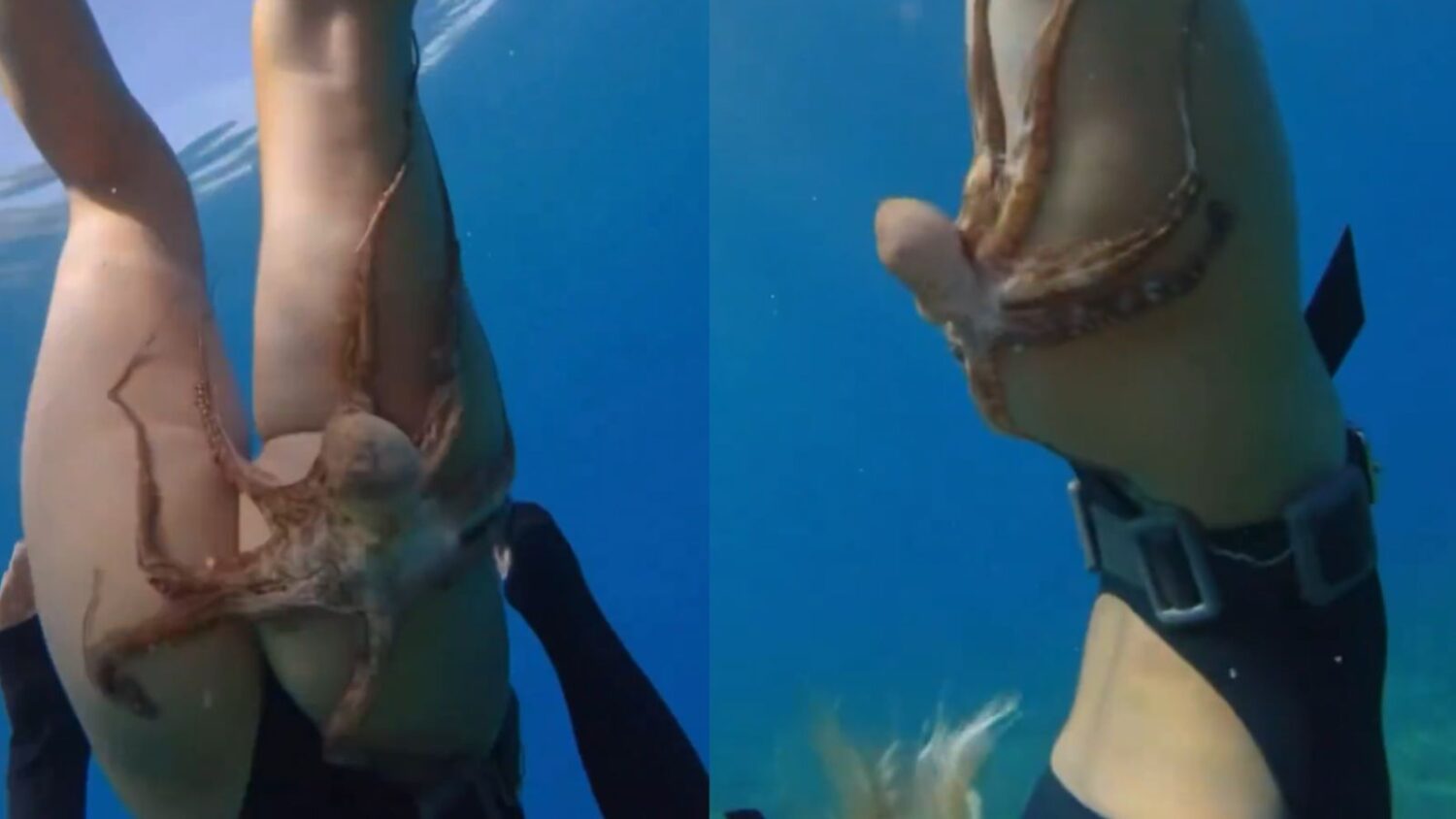
In the era of social media, where content spreads rapidly, a post on the X platform (formerly Twitter) caught the attention of millions of users. Published on December 2, 2025 by Matt Wallace, a well-known influencer and cryptocurrency enthusiast with trade @MattWallace888, a video depicting an octopus attaching to a woman's leg underwater became a viral. By December 3, the post collected over 54,000 likes, nearly 3,000 reposts and over 10 million views. The title of the post is: "Terrifying moment caught on camera showing an octoplus laching on to a woman underwater 😳". What exactly is this video showing, and why has it attracted such interest? Let's take a closer look.
Description Events From Video
The video lasts about 21 seconds and was recorded underwater, probably during recreational diving. At first we see a close-up on the leg of a woman wearing a black dive suit. Octopus, with brown-orange coloration, firmly attaches to her thigh, wrapping the tentacles around the skin. The woman tries to gently tear off the creature, but the octopus holds tight using suction cups. The camera shows different angles: from close to close to take tentacles to a wider plan, where you can see the bottom of the ocean with corals and sand. Finally, after several attempts, the octopus lets go, floats away to the bottom and releases a cloud of ink – a classic defense mechanism of these animals. There is no sign of blood or injury, but the moment is tense and may cause anxiety in viewers not accustomed to such interactions with sea creatures.
Matt Wallace, who has over a million followers and often shares sensational content, did not give details of the origin of the recording – whether it is an authentic event or a fragment from a document. However, the style of the recording suggests that it is an amateur video with GoPro or a similar camera, typical of divers sharing adventures online.
User Reactions On Platform X
Post quickly sparked a wave of comments, mostly humorous and memetic. X users did not fail in creativity – from jokes about "octopussy" (playing words with James Bond film) to memes with an octopus "smoking cigarette" after the event. One popular comment from @l4pablo reads: "Women + Octopus = Octopussy", which collected almost a thousand likes. Another user, @BrainDumpTweets, wrote: "If I had my 8 arms on a gyatt like that I’d squirt a little ink myself" – a humorous reference to octopus ink.
There were also video memes: one shows an animated octopus after an "act", another is a clip from South Park, where two women fight for a man, with subtitles adapted to the situation ("Nobody touches my man Matt Wallace, besides me"). Even Wallace himself later added another post with a humorous video, which only served the discussion. Among the nearly 3,000 answers are laughter and admiration for the intelligence of octopus, although some express concerns about the safety of divers.
Why do Octopus stick to people? Facts about the preservation of these creatures
Octopus is one of the most intelligent invertebrates on Earth. They have a complex nervous system, ability to camouflage and solve problems. According to experts, such behavior as clinging to a man is not usually an attack, but a result of curiosity. Octopus explores the environment with tentacles, which act as both hands and sensory organs. In the case of divers, these creatures may confuse human skin with potential shelter or simply explore new objects.
According to sources, such interactions are common among divers. For example, in one of the Quora reports, an experienced diver advises: "If the creature touches you, go with it unless there is danger." However, not all octopuses are harmless – species like blue-ringed octopus (blue-ringed octopus) have a strong venom that can be fatal. In this video it seems to be a common octopus, but it is always worth to be careful.
Other stories confirm the curiosity of these animals: in 2016, Earth Touch News described an octopus that "attached" to the diving arm and refused to let go. On YouTube, the video is popular, where the octopus leads the diver to a hidden treasure – an old bottle. These examples show that octopuses treat people as part of an environment for exploration rather than a threat.