

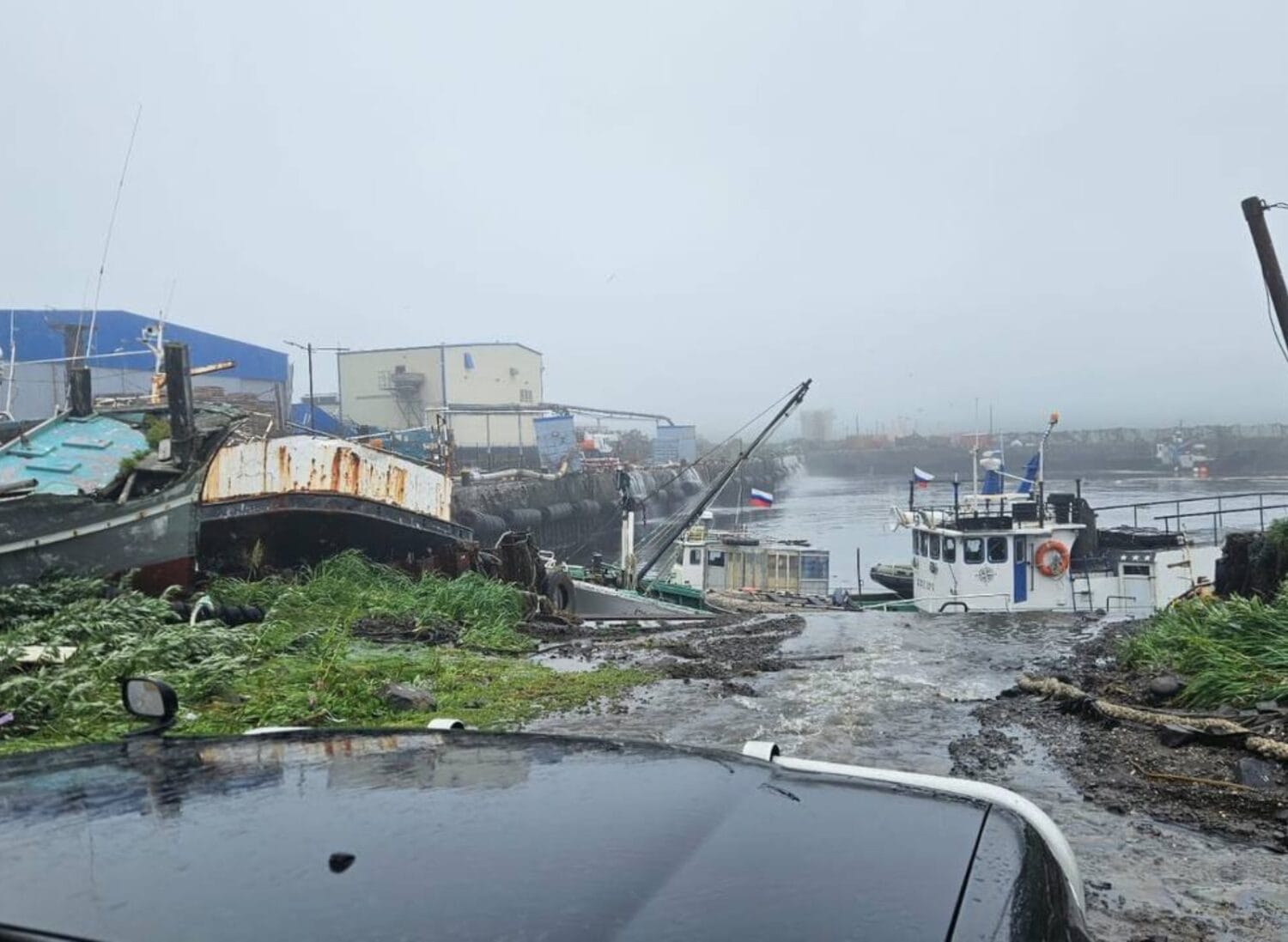
On Wednesday, 30 July, a powerful magnitude 8.8 earthquake shook the Kamchatka Peninsula. Tsunami waves reached Russia’s Kuril Islands and threatened Japan’s islands.
Key facts about the Kamchatka earthquake
- At 11:24 local time on 30 July, seismographs recorded a magnitude 8.8 earthquake at a depth of approx. 32 km below the seabed, 136 km ESE of Petropavlovsk-Kamchatsky.
- The quake triggered a tsunami wave that reached up to 5 m high in Severo-Kurilsk on the Kuril Islands, flooding the port, a fish processing plant and part of the town’s streets.
- Russian authorities declared a state of emergency on the Kurils and Sakhalin; evacuations were carried out from coastal areas, and the local power grid was damaged.
- Tsunami waves of 1-1.5 m also reached Hokkaido in Japan, and slight rises in sea level were recorded in Hawaii.
Tsunami waves are hitting Russia’s Kamchatka coast, flooding the port of Severo-Kurilsk.
Scale of damage
| Location | Impact of quake/tsunami | Current status |
|---|---|---|
| Petropavlovsk-Kamchatsky | Cracks in buildings, temporary power outage | Coastal areas closed |
| Severo-Kurilsk (Kurils) | 3-5 m wave, flooded port, evacuation of 2,000 people | Clean-up of damage underway |
| Sakhalin | Local blackouts, inspection of bridges and roads | Power being restored |
| Hokkaido (Japan) | 1-1.5 m waves, no serious damage | Warning in effect until 14:00 CEST |
The geological background of the disaster
The Kamchatka region is one of the most seismically active places on Earth. The collision of the Pacific Plate with the North American Plate causes regular earthquakes. The current energy had been accumulating since the previous great quake in 1952, which allowed the fault to suddenly slip by more than 8 metres. The main phase lasted as long as 230 seconds, triggering more than 30 strong aftershocks, the strongest of which measured 6.9 Mw.
Response and consequences
Russia’s EMERCOM sent several hundred rescuers to the islands, where the priorities are assessing schools and hospitals and restoring power. The Governor of Kamchatka is urging residents to stay on higher ground until further notice, although seismologists consider the risk of secondary damage to be decreasing. Japan’s Shinkansen bullet trains prophylactically slowed to 30 km/h, and tsunami alerts remain in place on Hokkaido.
Is the danger over?
According to the US Geological Survey (USGS), further earthquakes of similar strength are unlikely in the coming days. However, local flooding may still occur after aftershocks and subsequent waves, so authorities advise caution in coastal zones. Inspectors are checking bridges and ports for hidden damage, while scientists are installing new sensors to better analyse movements of the Earth’s crust.





Komentarze