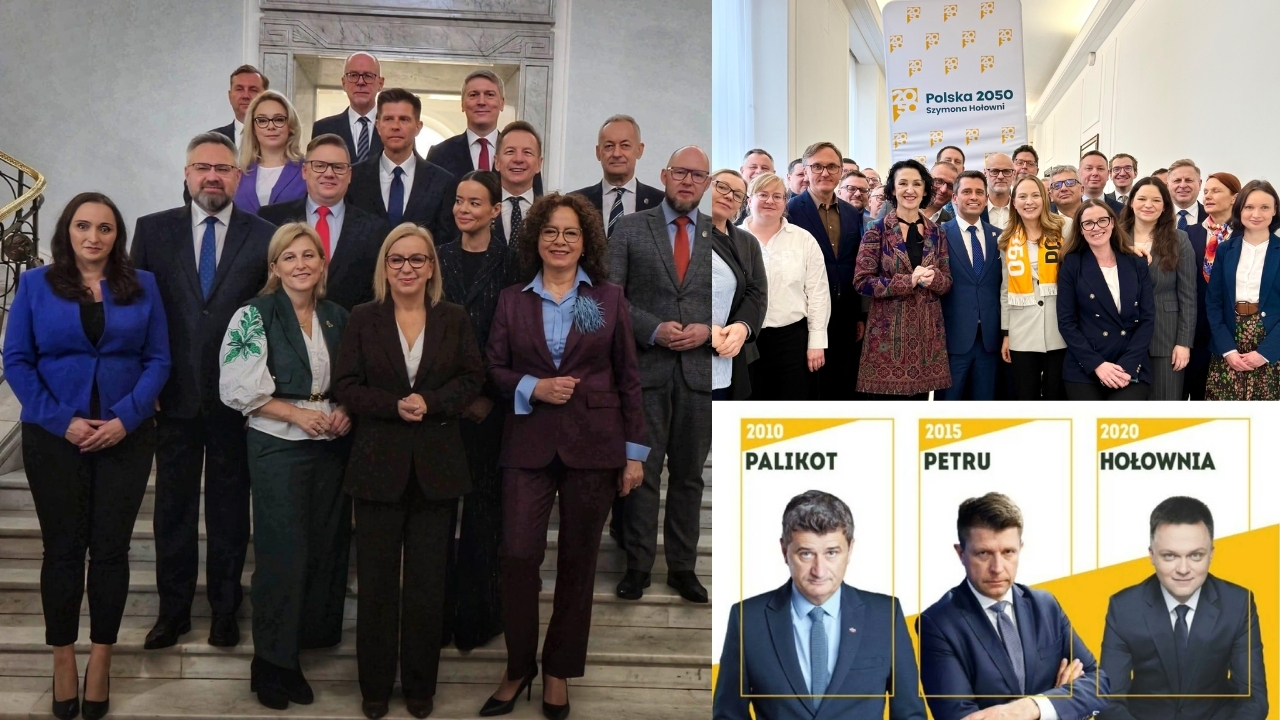
On Wednesday, February 18, 2026, what has been speculated about for months: Poland 2050 Szymon Hołownia ceased to exist in its present form. The 18 parliamentarians group – including climate and environment minister Paulina Hennig-Kloska, Ryszard Petru, Aleksandra Leo, Mirosław Suchoń and several others – left the party and announced the establishment of a new parliamentary club under the name of the Centre. It's not a small split. This is the end of the project, which was supposed to be a fresh, centre air in Polish politics three years ago.
From the perspective of an observer who has been following the Polish scene for years, this moment does not surprise, but hurts. Poland 2050 was formed on a wave of enthusiasm around Holownia – a charismatic speaker who promised a policy without hate, without extremes, with emphasis on competence and the future. Today, the same project falls apart in front of our eyes, only a few months after Holownia failed in the presidential election and gave the controls to Katarzyna Pełczyńska-Nałęcz. The internal conflict proved stronger than the common vision. One faction wants to be loyal support for Donald Tusk, the other – to maintain independence and centre profile. Effect? Two clubs instead of one and the feeling that the dream of a "third way" had just ended.
The new formation of the Center declares that it wants to be a place of compromise and pragmatism. Hennig-Kloska emphasizes that this is a space where "people meet and work out good solutions". It sounds beautiful, but in Polish politics such declarations are rarely enough. Petru returns to play after years of break, Leo and others bring experience – this may be an interesting mix. The question is whether the Centre will be able to build wider facilities outside the Sejm, whether it will remain a parliamentary club without a real field backdrop.
What about the October 15th coalition? Prime Minister Donald Tusk has already calmed down: both sides – both Pełczyńska-Nałęcz and Hennig-Kloska – assured him of his loyalty to the government. The parliamentary majority is expected to survive until the election in 2027. In theory, everything's fine. In practice, however, the dissolution of Poland 2050 is a serious blow to the coalition structure. The Third Road (which was the alliance of Poland 2050 and PSL) loses coherence. PSL remains, but without a strong partner from the center it becomes more exposed to pressure. The left gains relatively, because the weaker centre flank means that KO will have to pay more attention to its demands. And this in turn can generate new tensions.
Can the government fall apart? I don't think so in the coming months. Tusk has experience bonding coalitions with inferior materials. Both new groups need stability not to disappear in polls. However, the renegotiation of the coalition agreement is inevitable – mandates, positions, influences on ministries. It's gonna be a real test. If the Centre starts playing on its own and the remnants of Poland 2050 feel marginalized, cracks can deepen. One major crisis – budget, EU or reform of the judiciary – is enough, and a delicate balance will collapse.
In my opinion, this is not just an internal matter of one party. This is a symptom of the wider problem of Polish centre policy: the difficulty in maintaining cohesion, when the leader loses momentum, and personal ambitions take over the programme. The holovnia built movement on charisma, but not on strong structures. We see the effect today. Poland needs a strong, rational center – not as a decoration, but as a brake against extremes. Will the Center fill this gap, or will it only deepen? Time will tell.
One thing is certain: Polish policy has just become a little more dynamic and – unfortunately – more unpredictable. The coalition of October 15 will survive, but it will never be the same again. And we voters got another lesson that no group is eternal. Even the ones that started with the greatest credit.